
In defending Budget 2013 Labour has argued that it contained
€500 million in a ‘wealth tax package’ or revenue from taxation on high income
groups. This, goes the argument, is
evidence of Labour’s influence on the budget – revenue that would be missing
were Labour not in Government. So what
are the measures that add up to €500 million?
And is this sum robust?
First, we have a problem with labelling. While some Labour TDs have called this a ‘wealth’
package, the only tax on wealth (defined as an asset) is the property tax. However, they do not refer to this and with
good reason – the property tax will attract revenue from high income
groups. So Labour is not referring to
tax on wealth but rather on personal or capital income.
The list that Labour has been putting forth includes: a mansion tax on properties worth over €1
million (this is a small tax on wealth), an increase in the USC on high-income pensions,
extending PRSI to trade and unearned income, reducing tax reliefs for large
pension pots, an increase in Capital Gains tax, Capital Acquisitions tax and
Deposit Interest Retention Tax (DIRT), etc.
So does all this add up to €500 million?
Let’s look at the measures that will be introduced in Budget
2013.
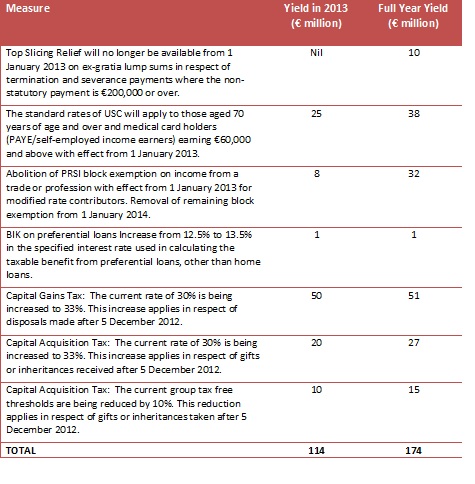
In the above measures we find that €114 million will be
raised in 2013 with a full year yield of €174 million – though this latter
figure is slightly inflated by an extension of the PRSI base on to unearned
income that won’t be introduced until 2014.
This seems a long ways away from the €500 million package
Labour has referred to. What else could
there be, that is not captured by the table above?
Deposit Interest
Retention Tax: This has been
referred to as a tax on high incomes and clearly high income groups are more
likely to hold more cash than the rest of us.
However, low and modest income groups also have deposits. And the tax rate is somewhat quirky. If interest on deposits were included in the
income tax regime, low-modest income groups would pay only 20 percent while
those on the top rate would pay 41 percent.
As it is, low-average income groups pay more under DIRT and high-income
groups pay less. Nonetheless, let’s
allow this a tax on high-income groups, knowing that others will be caught.
Pre-retirement access
to funded Additional Voluntary Contributions: this is the provision that allows people to
draw down 30 percent of their AVC prior to retirement. This is intended to give a boost to consumer
spending (more on this in a later post).
Holders of AVCs would usually be higher income earners and if they pull
down this money they will be taxed at the marginal rate – for most this would
be 41 percent. However, this is not a
tax. If I don’t pull down my AVC, I face
no tax. In essence, the 41 percent tax I
would pay is the price for being allowed to draw down the money. And if no one, or very few, draw this down,
there is no gain to the Exchequer. This
is not a tax and shouldn’t be included.
Changes to the
maximum allowable pension fund: this
refers to withdrawing relief from large-pension pots. This is a good step. The problem is that this is not part of
Budget 2013. This is intended to be
introduced in 2014. We have no details
of how this will be achieved or what the estimate of €250 million revenue is
based on. If we allowed this as part of
the calculation then we would have to spread the impact over two years which
would dilute the impact of the €500 million package. It’s not consistent to include this in the package
since it plays no part in Budget 2013.
‘Mansion Tax’: as compensation for not achieving an increase
in the USC on incomes over €100,000, Labour was able to get an increase in the
property tax of 0.25 percent on houses valued over €1 million (but only on the
portion that exceeds €1,000, 000). The
Minister has provided no estimate as to how much this will bring in. The Commission on Taxation, using 2004
valuation data, assumed that there were 3,000 houses valued at €1 million or
more. However, this was a guestimate and
was not grounded in any data. But
assuming 3,000 houses in this category, and an average value of €2 million, the
mansion tax would raise approximately €7.5 million. Let’s include that.
Now we have a sum of €168 million in 2013 and €245 million. One could make an estimate of property tax
revenue from high-income groups that don’t have houses valued at €1 million or
more, but even if we could agree the assumptions, the sum would only push up
this total by a relatively small amount.
How does this compare to the previous two budgets?
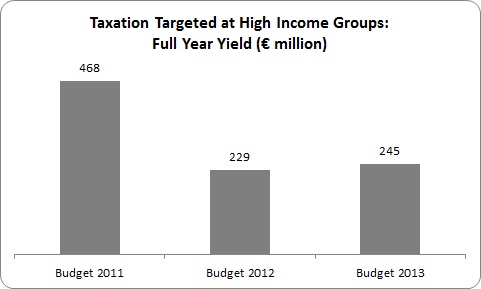
In last year’s budget, €229 million was raised from taxes
targeted primarily at high-income groups.
The big items were changes to capital income and DIRT.
In Budget 2011, Fianna Fail’s farewell budget, nearly €470
million was taken from primarily high-income groups. The big items were the abolition of the PRSI
ceiling for incomes above €75,000, restrictions on legacy property reliefs,
PRSI on pension contributions (this raised €60 million but, like DIRT, would have
hit some average incomes), other pension contribution changes, DIRT and capital
income. Of course, this was also a
budget which hit low-income earners through cuts in personal tax credits (much
like the current abolition of weekly PRSI allowance) and the Universal Social
Charge.
So Budget 2013 is not much different than last year and is
yielding less than Budget 2011 when it comes to targeting high-income groups.
Of course, some may insist on adding the €250 million in
changes to the pension pots which was announced Wednesday but won’t be
implemented until 2014 – and in a way we don’t know yet. But that would only be taking the
progressivity from the 2014 budget and inserting in this one artificially. To my mind, let Budget 2014 speak for itself
and hope that Labour can build on it.
It is hard to see where Labour’s ‘€500 million wealth tax
package’ is coming from, But in one
sense I doubt that it will have much political impact. It will be little solace to low-paid PAYE
workers affected by the PRSI changes, or medical card holders facing a trebling
of prescription charges, or parents seeing their Child Benefit cut – little solace
to be told that x amount of money is being levied on high income groups. For one is concrete – the impact on one’s own
household where the increase is almost, if not fully, unaffordable; the other
is abstract or, at least, distant – the impact on a household that can afford
it anyway.
For therein lies the problem that Labour faces. I have no doubt that this is not the budget
that Labour backbenchers would have introduced. Using inflated or highly contestable figures
to counter what is a regressive budget will not diminish the cuts and
regressive taxes. The cold political
reality, being in government with a larger party that does not share its
values, is that they may have to vote for budget not of their making.
‘May’ being the operative word.


 Notes on the Front
Leave a reply to Colum McCaffery Cancel reply