
It’s official. The
Government’s employment policy is failing.
This finding comes from the Government itself, in the form of projections
contained in yesterday’s Medium Term Fiscal Framework. The projections are chilling and
depressing. Let’s first turn to employment.
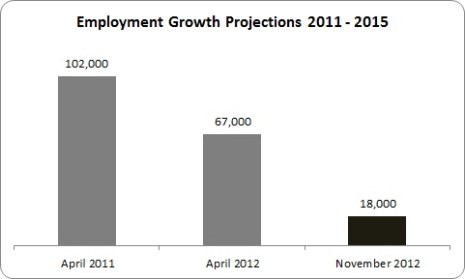
In April last year, the Government was somewhat bullish
about employment growth; projecting that the numbers at work would grow by
102,000 by 2015. After the launch of the
Jobs Initiative and the Action Plan for Jobs, the Government lowered their
forecast to 67,000. Yesterday, they
lowered their forecast again – to 18,000.
In 2011, there were 1,810,000 people working (this includes
full-time and part-time). By 2015, the
Government expects this to rise to 1,828,000.
After all the Government’s initiatives, IDA job announcements,
protestations that jobs remains at the core of public policy – the Government
itself admits that net job creation will only be 18,000 by 2015.
Let’s look at the annual projections.
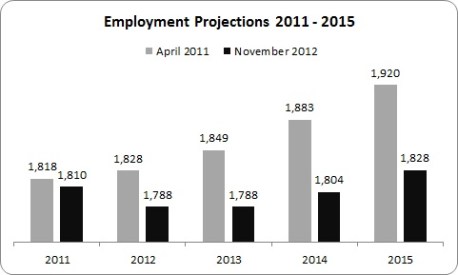
In April last year, the Government expected employment growth
to start this year, increasing by 37,000 in 2015 alone. Now, the Government accepts that employment will
fall this year (by 22,000) and won’t start growing until 2014. In 2015 alone net job creation will only be
24,000.
This is grim. During
the life-time of this government, employment will rise only marginally.
We can now see why unemployment is barely moving. In April last year, the Government projected
that the unemployment rate would be 10 percent in 2015 – not great at all, but
at least showing some movement downwards.
Now the Government projects unemployment to be 13 percent. That shows almost no movement at all.
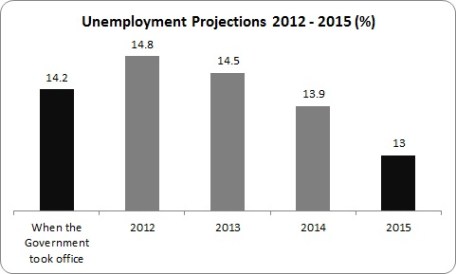
When the Government took office unemployment was 14.2
percent. By 2015 it is expected to be 13
percent – a reduction of one percent.
We should acknowledge the difficulties of reducing
unemployment – especially after it skyrocketed under the previous government
following the property crash.
Unemployment is like a huge ship – you first have to stop it, turn it
around and start it going in a different direction; not an easy thing to do in
the short-term.
However, the Government has pursued policies that have (a)
not addressed the underlying problem and (b) actually exacerbated the
situation. In regards the former, they
have treated unemployment as a supply-side problem (issues of training, wage
levels, employers’ PRSI, etc.) when in fact it is a demand-side problem. When you have nearly 30 unemployed for every
job vacancy, the problem lies in the lack of demand for labour.
But they have actually worsened the situation by budgetary
measures that have actually depressed the demand for labour – cuts in
investment and public spending along with regressive tax increases. ICTU projected that the last budget cut
nearly 30,000 jobs out of the economy while the Nevin Economic Research Institute
projects that Budget 2013 could cut another 29,000 out of the economy. Don’t be surprised if unemployment remains
high the Government pursues job-cutting measures.
The Government has admitted its current policies are not
working. They are not generating much in
the way of jobs, they are not reducing unemployment. Following this admission, they should now
launch a new jobs policy, or at least launch a short, sharp national debate
over what that policy should be.
But if official spokespeople come forth and state that they
remain focussed on jobs, that they will double their efforts, that jobs remain
at the heart of policy – we will know:
not only do we have a Government out of touch with reality, it is even
out of touch with its own official projections.


 Notes on the Front
Leave a reply to Ciaran Cancel reply