
We are constantly assured (warned) that ‘everything is on
the table’. All manner of tax increases
and spending cuts are being considered, and none are ruled out in principle. So, goes the script. There is one issue,
however, that is not on the table. It is
not even in the room. It is not even in the
house or lurking around the grounds. And
that issue is the corporate tax rate. Why?
If we increased the corporate tax rate, this would undermine
our ability to attract foreign direct investment. This, in turn, would result in fewer jobs
being created and put current jobs at risk; further, it would lower exports
which would skewer our balance of payments.
All that value-added and economic activity would be jeopardised.
Before we confront this argument, let’s first look at how
successful multi-nationals (MNCs) are in racking up profits in Ireland (also, this
analysis from Michael Burke is also worth a read). From this, we might get a sense of how
sensitive they would be to an increase in the corporate tax rate. For, in truth,
they
are really really racking up the profits.
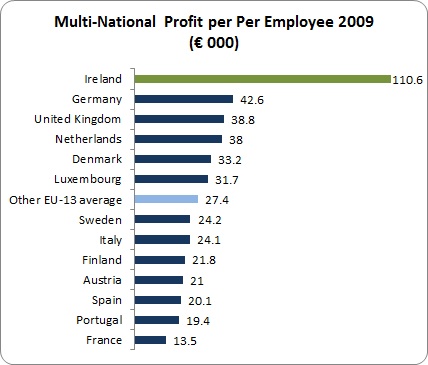
Ireland is not just a league-leader, it is off the
chart. MNCs here make more than four
times the profit per employees than the average of the other EU-15 countries
reporting (no data for Belgium or Greece). No wonder more and more multi-nationals
are making Ireland their home. It should
be noted that this Eurostat data does not include the financial sector so the
massive profits being made in the IFSC are not included. Nor does the above include taxation – we’ll
come to this later.
Not only are MNC profits high in Ireland, they are
resilient. 2009 was the year that saw
global profitability fall. But not in
Ireland. Whereas in 2009 profits fell in
the other EU-13 countries by an average of 17 percent, in Ireland they fell by
less than 1 percent.
This is just the overview – let’s look at some key MNC
sectors in Ireland. In the Manufacturing
and Information & Communication sectors, Irish MNC profits are through the
roof.
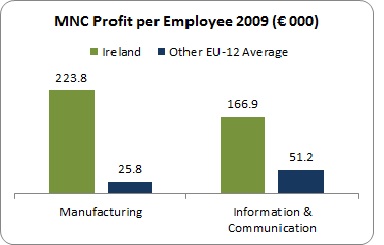
In the Manufacturing sector, MNC profitability in Ireland is
nearly 10 times that of MNCs in other countries. In the Information & Communication, the
ratio is more than three-to-one.
In other sectors, MNCs in Ireland also exceed the EU average
but not to the same degree.
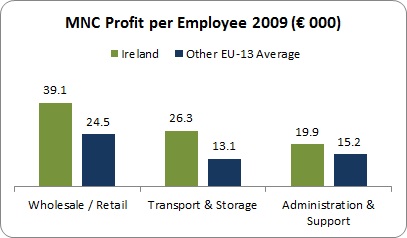
In each of these sectors – particularly retail and transport
– MNC profits in Ireland significantly exceed the average of other countries.
Only in two sectors – the Professional & Scientific and
Accommodation – is MNC profit in Ireland lower than the average of other EU
countries. These two sectors, however,
are relatively small, making up less than 2 percent of the turnover of all MNCs
in Ireland.
Another insight is MNC by home country. US multi-nationals have a strong presence in
Ireland – making up nearly two-thirds of all MNC turnover in Ireland. American MNCs take €240,000
in profit per employee here in Ireland; in the other EU countries, they take
only €31,800. More interesting, despite
the global recession, American MNCs increased their profit per employee in 2009
by over 8 percent in Ireland. In other EU
countries, American MNCs suffered a loss of nearly 21 percent.
Another, albeit smaller category, is
MNCs owned by ‘offshore financial centres’ (OFCs). One would assume that these would be
primarily involved in the financial sector. But the data here refers to the non-financial
business sector. These OFCs are still
relatively small (making up only 3 percent of all MNC turnover in Ireland). But they are growing. In the dark days of 2009, OFCs saw their
turnover nearly double over 2008, with the number of OFCs operating in Ireland also
doubling. And no wonder: they take nearly €61,000 in profits per
employed in Ireland while in other countries this figure is nearly half –
€34,300.
Of course, there is an
Alice-in-Wonderland character to all these numbers. Profits, turnover, value-added – these are
all distorted by transfer pricing. MNCs
do not actually produce these levels of profit in Ireland – not all of them;
they ‘report’ a considerable level of profit here, taking advantage of transfer-pricing
in order to exploit our ultra-low corporate tax rates and the facility to
engage in global tax avoidance (which is why a US Senate Committee described
Ireland as a tax haven – see page 30).
But we should also take note: all of the above reports profits before
tax. If we had an after-tax figure, we’d
find the gap between MNCs in Ireland and the other EU countries grow even
wider. For instance, Germany comes
second when it comes to MNC profit per employee at €42,600. On that they pay a headline corporate tax
rate of 30 percent. In Ireland, with
MNCs taking €110,600 per employee, the headline rate is 12.5 percent. Yes, the effective tax rate (after reliefs
and allowances) will be lower – but it will be lower for both countries.
Profits
are rising in Ireland. They
increased by 4 percent in 2010 and 7 percent in 2011. According to the CSO, this is largely
accruing to multi-nationals.
So here is a question: if all things are on the budgetary table, why
is there no place for an increase in the corporate tax rate? This would not undermine pre-tax profits, and
even if it were raised by a mere 2.5 percent, it would still be lower – much
lower – than almost any other European country.
And here is another question: where in Europe, indeed the world, can MNCs
make as much profit as in Ireland even if the corporate tax rate were
increased?
So, why is the issue of the corporate
tax rate taboo? That’s an easy question
to answer: because it has
been elevated to almost metaphysical status. In the Dail the Taoiseach stated
piously:
‘The key elements of
the Jobs Initiative included: reaffirming, as the Minister for Finance repeated
yesterday, that our 12.5% corporate tax rate remains sacrosanct . . . ‘
To declare something sacrosanct is not an invitation to
debate. It is a threat. For to challenge the sacrosanct
is to engage in heresy, blasphemy, apostasy.
So suck it up. Cut
homecare help, bash low-paid workers (public and private), slash social
protection, close down services, tax average income earners even more. But don’t anyone dare mention the holy of
holies – the corporate tax rate.
As
Minister Creighton says – stop whingeing.
In each of these sectors – particularly retail and transport
– MNC profits in Ireland significantly exceed the average of other countries.
Only in two sectors – the Professional & Scientific and
Accommodation – is MNC profit in Ireland lower than the average of other EU
countries. These two sectors, however,
are relatively small, making up less than 2 percent of the turnover of all MNCs
in Ireland.
Another insight is MNC by home country. US multi-nationals have a strong presence in
Ireland – making up nearly two-thirds of all MNC turnover in Ireland. American MNCs take €240,000
in profit per employee here in Ireland; in the other EU countries, they take
only €31,800. More interesting, despite
the global recession, American MNCs increased their profit per employee in 2009
by over 8 percent. In other EU
countries, American MNCs suffered a loss of nearly 21 percent.
Another, albeit smaller category, is
MNCs owned by ‘offshore financial centres’ (OFCs). One would assume that these would be
primarily involved in the financial sector. But the data here refers to the non-financial
business sector. These OFCs are still
relatively small (making up only 3 percent of all MNC turnover in Ireland). But they are growing. In the dark days of 2009, OFCs saw their
turnover nearly double over 2008, with the number of OFCs operating in Ireland also
doubling. And no wonder: they take nearly €61,000 in profits per
employed in Ireland while in other countries this figure is nearly half –
€34,300.
Of course, there is an
Alice-in-Wonderland character to all these numbers. Profits, turnover, value-added – these are
all distorted by transfer pricing. MNCs
do not actually produce these levels of profit in Ireland – not all of them;
they ‘report’ a considerable level of profit here, taking advantage of transfer-pricing
in order to exploit our ultra-low corporate tax rates and the facility to
engage in global tax avoidance (which is why a US Senate Committee described
Ireland as a tax haven – see page 30).
But we should also take note: all of the above reports profits before
tax. If we had an after-tax figure, we’d
find the gap between MNCs in Ireland and the other EU countries grow even
wider. For instance, Germany comes
second when it comes to MNC profit per employee at €42,600. On that they pay a headline corporate tax
rate of 30 percent. In Ireland, with
MNCs taking €110,600 per employee, the headline rate is 12.5 percent. Yes, the effective tax rate (after reliefs
and allowances) will be lower – but it will be lower for both countries.
Profits
are rising in Ireland. They
increased by 4 percent in 2010 and 7 percent in 2011. According to the CSO, this is largely
accruing to multi-nationals.
So here is a question: if all things are on the budgetary table, why
is there no place for an increase in the corporate tax rate? This would not undermine pre-tax profits, and
even if it were raised by a mere 2.5 percent, it would still be lower – much
lower – than almost any other European country.
And here is another question: where in Europe, indeed the world, can MNCs
make as much profit as in Ireland even if the corporate tax rate were
increased?
So, why is the issue of the corporate
tax rate taboo? That’s an easy question
to answer: because it is no longer a
policy issue around which we can have a rational discussion. Rather, the corporate tax rate has
been elevated to almost metaphysical status.
The Taoiseach in the last budget stated
piously:
‘The key elements of
the Jobs Initiative included: reaffirming, as the Minister for Finance repeated
yesterday, that our 12.5% corporate tax rate remains sacrosanct . . . ‘
To declare something sacrosanct is not an invitation to
debate. It is an injunction not to
debate. For to challenge the sacrosanct
is to engage in heresy, blasphemy, apostasy.
So suck it up. Cut
homecare help, bash low-paid workers (public and private), slash social
protection, close down services, tax average income earners even more. But don’t anyone dare mention the holy of
holies – the corporate tax rate.


Leave a Reply