
Is there no limit to the extent to which poverty deniers
will twist and misrepresent facts to fit their agenda? If
Eilis O’Hanlon’s piece in the Sunday Independent is anything to go by,
probably not. I usually don’t write
about Sindo pieces – the day is too short; if the day were a thousand hours
long, it would still be too short. I let
Garibaldy
do the heavy lifting in responding to Sindo nonsense (he does it with far
greater patience than I could). But
O’Hanlon’s piece – mocking people who are experiencing deprivation, labelling
them pawns and refusing to face up to the elephant-fact in the room: that austerity is driving people into despair
– this kind of thing should not go unchallenged.
O’Hanlon takes issue with the Irish Times article, written
by Kathy Sheridan, about a family
who had gone to the Money Advice and Budgeting Service (Mabs) because they were
finding it extremely difficult to make ends meet. O’Hanlon purports to break down the income and
expenditure of this couple as reported by Sheridan, comes to a bottom line and
then criticises, in a condescending tone, the couple for spending too much.
The first thing O’Hanlon does is to misrepresent the family's income
figure. Sheridan is quite specific on
this:
Now, the
family’s total weekly income, including child benefit, is €807 net, according
to Mabs.
€807 net a week; when I punch that into my calculator I get
€3,497 a month. You try it. You’ll get the same figure. What figure does O’Hanlon get? €5,080. An inflation of 45 percent.
The
EU Survey on Income and Living Conditions estimates the proportion of the
population that experience multiple deprivation experiences by equivalised
incomes. Equivalised incomes attempt to
factor in household size. It does this because a single-person household
earning €807 a week has a different living standard than a household with two
adults and children.
So what is the equivalised income of the family Sheridan writes about
(hereafter referred to as Family X), assuming that the €807
net income is valid for the CSO Survey? €271 per week. That’s assuming they have three children. Sheridan rightly doesn’t refer to the number
so as to protect anonymity but it certainly appears from the piece that it is
at least three children – even O’Hanlon accepts this. (NOTE: the calculations using the CSO’s equivalence
scale are shown at the end of this post.)
That puts this family, in 2010, in the 4th lowest decile,
or in the lower half of the table. The
average in 2010 was €424 weekly. So this
family earns 36 percent below the national equivalised average. Of course, the family’s income is in today’s
numbers and the benchmarks I’m using are from 2010, the last year we have data
for; however, this is unlikely to change the overall situation by much.
So what is the likelihood of suffering multiple deprivation
experiences if you are in the 4th decile according to the CSO?
Those in the 4th decile have nearly a third of a
chance of being included in the CSO deprivation rate. This compares to a national average of 22
percent. So there is a reasonable chance
that Family X is actually suffering multiple deprivation experiences.
O’Hanlon writes:
‘The new
figures showed, for example, that the family was spending well over €1,000 a
week, a huge amount by any standards, including a significant sum of €200 a
week on food.’
Let’s turn to the CSO’s Household
Budget Survey to test this ‘huge amount’ and ‘significant sum’ claim. The survey gives household expenditure broken
down by actual disposable income. These
figures come from 2009/2010 – the latest year we have data for. Family X would be placed in the 6th
decile, below the national household average of €885 per week in disposable
income.
While the CSO doesn’t perform this operation, I will attempt
to equivalise household expenditure – because a single-person household
spending €800 a week has a higher consumption level per person than a family
with children spending the same amount.
The following, however should be treated as indicative as I’m working
from different databases with different methodologies.
6th decile households spend €776 per week. Family X spends €1,094. However, in this family there are at least
five people; the average household size for the 6th decile is 3.1.
The average household size nationally is 2.78.
So if we equivalise the latter two upward to Family X’s size we find the
following.
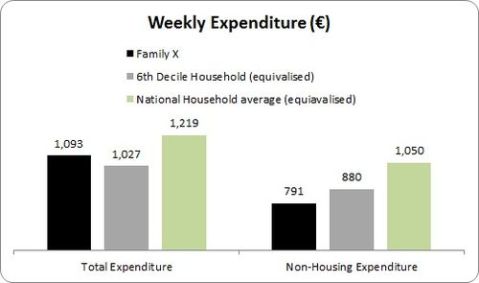
In terms of total expenditure, Family X spends slightly more
than other households in the 6th decile, but less than the national
average. However, when we exclude
housing costs – and this is a big expenditure for Family X and so many others
caught in the bubble economy – we find that the family that is criticised by
O’Hanlon for spending a ‘huge amount’, actually spent 10 percent less than households
in the 6th decile and 25 percent less than the national average. So much for allegations of ‘huge amount’.
O’Hanlon seems to have problems with Family X’s food and
clothing budget (she claims they are spending €200 a week on food which is misleading;
the category used in Sheridan’s article is ‘Food / Housekeeping’, not just food). Anyway, let’s examine these categories.
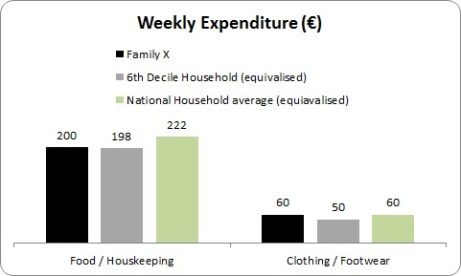
Family X’s expenditures are not out of line with the average
and, in terms of food/housekeeping (for the latter I use Household Non-Durables
in the CSO tables), it is 10 percent below the national equivalised average. Similarly, spending on clothing/footwear is
not out of the ordinary.
It should be noted here that the categories that Sheridan
uses do not necessarily coincide with CSO listings – so families might categorise
an expenditure differently. How would
any family categorise bank charges, barbers and hairdressers, newspapers, books
(especially for children), household repairs, household and kitchen
durables?
None of this is out of the ordinary. That Family X is going through seriously
difficult times is, unfortunately, becoming ever more ordinary for hundreds of
thousands of households. So why is O’Hanlon
having such a go at them?
‘Far from being one family's personal testimony, it was
blatantly political . . . If the children of public sector workers are going
hungry, then clearly there is no more fat to trim from public sector
expenditure. End of. That's why they leapt on the garda's wife as their new
poster girl rather than one of the hundreds of thousands of private sector
workers who've been forced into unemployment, emigration, repossession and
depression, and who would dearly love to have a "mere" €800 a week on
which to get by, and certainly wouldn't use their unfortunate children as
ideological pawns if they did. . . .Was the Irish Times duped by a crude
propaganda stunt on behalf of the public sector unions?'
Oh, lord, please save me.
What it comes down to is that one of the adults in Family X works for An Garda Siochana. This is beyond logic and reason (the attack on
the public sector trade unions is interesting insofar as the Garda Sergeant is
not allowed to be a member of one). In
short, if O’Hanlon doesn’t like your employer, If you happen to be a member of
a trade union – and most trade unions have public sector members – not only
will you get no sympathy from her, you’re likely to be attacked in the Sunday
Independent.
For O’Hanlon, her attack was embarrassingly mistimed. This morning the League of Credit Unions
published their What’s
Left tracker. Some key points come
across:
- 1,855,000 left with €100 or less at the end of
the month after essential bills are paid - Half of all adults now struggling to pay their
bills on time - 42% of consumers have had to borrow money to pay
bills in the last 12 months - 8 in 10 consumers are worried that they won’t be
able to cope with the increasing energy costs this winter
So when O’Hanlon is attacking Family X, she is attacking
hundreds of thousands of households whether in the public or private sector as
well as those out of work. Her attempt
to distort and twist a story to her own ideological agenda means she has to
rubbish the experience of so many people.
Personally, I think Family X is brave. Deprivation is hidden and, for too many
people, a source of personal shame. Too
many people believe the deprivation and poverty they experience is a personal
fault when in truth it is an economic and social phenomenon, produced by
political elites who are forcing people and their families to pay for a crisis
not of their making. I hope more people
will come forward to tell their story and force deprivation on to the
agenda.
Of course, they should be warned that if they do, there will
be ideologues waiting in the long grass, ready to attack them if they dare
tell their story. My advice: don’t let that deter you. The majority of people are on your side.
NOTE: Next instalment in poverty denial: no one is really
homeless. All those people sleeping
rough in the rain and the cold are actually well-paid public sector workers who
have been ordered to do so by their trade union leaders, in collusion with RTE
and the Irish Times.
NOTE: The CSO uses
the following scale to equivalise household incomes. ‘The national scale
attributes a weight of 1 to the first adult, 0.66 to each subsequent adult
(aged 14+ living in the household) and 0.33 to each child aged less than 14.’ Family X would therefore have an equivalised 2.98
in terms of assessing income. Using
Household Budget Survey expenditure data, I approximate the 6th
decile with a 2.25 and a national average of 1.98. To compare expenditure on an equivalised
basis, I increase the respective spending up to 2.98. As stated, expenditure estimates are
indicative only. There is no data
specifically relating to expenditure per child by age or adult.


 Notes on the Front
Leave a reply to Ciaran Cancel reply