Notes on the Front

Commentary on Irish Political Economy by Michael Taft, researcher for SIPTU

It’s Called Hunger

A new report is out – Constructing
a Food Poverty Indicator for Ireland

It estimates that one in ten people experienced ‘food poverty’ in 2010.  In other words, hunger.  I know the phrase ‘must-read’ is sometimes
over-used, but this is truly a must-read report.  The very idea that one-in-ten of our
neighbours suffer from food poverty is truly frightening.  Maybe you won’t be guaranteed a job, maybe you
won’t be guaranteed free medical care regardless of your need, but surely in a
civilised society we can ensure that no one goes without food.  That we can’t, that we don’t, says something
about the kind of society that is being created for us.

This estimate produced by Caroline Carney (General Council
of the Bar of England and Wales) and Bertrand Maître (ESRI) is based on a
careful methodology.  It uses deprivation
indicators that relate to food in the EU’s Survey of Income and Living
Conditions:

  • Inability to afford a meal with meat or vegetarian
    equivalent every second day
  • Inability to afford a roast or vegetarian equivalent once a
    week
  • Whether during the last fortnight, there was at least one
    day (i.e. from getting up to going to bed) when the respondent did not have a substantial
    meal due to lack of money
  • Inability to have family or friends for a meal or drink once
    a month

While they produce a number of findings based on these
indicators, in the final analysis they omit the last one – having family or
friends over once a month for a meal or drink, though they acknowledge the
importance of this indicator:

‘This paper does not suggest that this item is not a valid
indicator of deprivation per se but is concerned with its ability to identify
food deprivation specifically. This item captures deprivation of social
participation, in particular social participation relating to food and drink.
However the other deprivation items being used by this research capture
deprivation that is specific to not affording adequate food.’

I don’t intend to reproduce the numerous tables contained in the
report to show the extent and scale of food poverty.  However, I would like to draw attention to
the following findings:
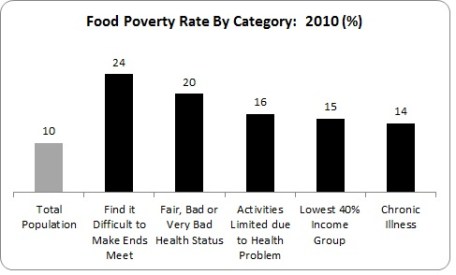
Food Poverty

For those who find it difficult to make ends meet, the food
poverty rate is 24 percent – which means that one-in-four in this category experience
one of the three indicators used above. 
Those suffering from poor self-reported health status rank close behind.

There are a couple of things to note.  First, these numbers are probably an
under-estimate.  The authors point out
that the data they were using, from the EU-SILC report, covers only private
households.  This would exclude homeless,
asylum seekers, travellers and people in institutions.  As the report rightly points out, ‘These
groups may be more vulnerable to food poverty.’

Second, this only goes up to 2010. 
We should not be surprised if the food poverty rate has risen since
then.  Budget 2011 contained a number of
highly regressive measures (cuts in social protection payments, the flat rate
tax in the form of cutting personal tax credits, the USC) along with falling
employment and income for key groups. 
Budget 2012 contained social protection cuts in particular items and
across-the-board cuts in real terms (that is, after inflation), along with the
regressive Household Charge.

I urge you to have a look at this highly accessible report.  Flip through the tables and graphs.  At least read the conclusion.  It may not be as sexy as the latest
story about property prices or public sector allowances or some Minister’s
latest peccadillo – but can we please have some perspective in this debate.

Some of our neighbours are going hungry.

7 responses to “It’s Called Hunger”

  1. eamonn moran Avatar
    eamonn moran

    Good article Michael. One point I would like to bring up that was shown in this report but not really expanded on was evedence of transfer of wealth from young to old. The stats on table 6 show young people 18-30 are over 3 times more likely (18%) to be at risk of hunger as people over 61%. This was picked up before in a CSO results.
    Take a look at pages 23 and 24 of this document. Its a great place to start.
    http://www.cso.ie/en/media/csoie/releasespublications/documents/housing/2010/0910first.pdf
    “There was a notable change in the demographic structure of households
    in the first decile over the five year period
    2004-2005 to 2009-2010. While over 56% of persons in the lowest income
    decile in 2004-2005 were 65 years or older
    in 2009-2010 this percentage had dropped to just under 24%.” That is a huge transfer in just 5 years.

    Like

  2. Michael Taft Avatar

    Well spotted, Eamonn. That certainly explains the collapse of old age pension income in the lowest decile of the EU-SILC report (though the micro-data which is not published would have it). We will have to start re-orientating policy (and not just social protection) to take account of this demographic shift.
    Thanks for bringing this link to my attention.

    Like

  3. de Charette Avatar
    de Charette

    These data would seam to argue strongly in favour of direct provision for low-income and welfare-dependent groups, in lieu of direct cash provision.
    For example, reduce Family Income Support and headline welfare rates, while replacing with the same value in food stamps.

    Like

  4. Ciaran Avatar

    Instead of direct cash provision, perhaps we could have things like a proper national health service (i.e., stop throwing people to VHI and their competitors) and a fully funded child-care system. That would be a good justification for reducing headline welfare rates. Our present system, sadly, has the effect of paying a sum of money that might seem like a lot to have in your pocket, but which, in fact, is paltry, and leaves you short when it comes to the essentials – such as nutritious food, it turns out.
    The idea of food stamps, on the other hand, is vile, and could only serve to humiliate the poor. Do you think food stamp amounts should go up and down depending on the fluctuating price of various foodstuffs? Or would that be a deterrent to ‘personal responsibility’?

    Like

  5. de Charette Avatar
    de Charette

    @Ciaran
    Why do you think spending on VHI and childcare is the problem among families that are largely covered by medical cards and overwhelming do not have two working parents?
    Seems you\’re projecting middle class sensibilities onto the hungry classes.
    And there is nothing vile about ensuring that those dependent on social welfare have sufficient food.
    Is it vile to provide a free education in public schools, instead of cash to go spending on private schools? Ditto for medical cards instead of a cash allowance to spend on GP visits (or on smoking, if thats your preference).
    On price variability, its not like the poor are speculating on futures in the frozen OJ concentrate market. What is your estimate of the retail price variability in basic foodstuffs over recent years?

    Like

  6. RosencrantzisDead Avatar
    RosencrantzisDead

    Great post, Michael; there does seem to be a massive dichotomy between rhetoric over budgets (apparently, recent budgets have been ‘progressive’) and economic prosperity (‘green shoots’) and the increasingly obvious issue of poverty and deprivation in Irish society.
    Do the Troika have a position on the increased problems of poverty and deprivation in Irish society?

    Like

  7. Michael Taft Avatar

    RosencrantzisDead – yes, the Troika (or the IMF anyway) has a position on the increased problems of poverty and deprivation in Irish society. Are you sitting down? Their position is that there is no increased problems of poverty and deprivation in Irish society.
    See here Box 2 page 21 (http://www.imf.org/external/pubs/ft/scr/2012/cr12264.pdf ). I would say that their use of the at-risk poverty measurement sets a new low in rationalising austerity but there have been so many lows and so many statistical manipulations, I can’t say anymore which is worse. I have been meaning to do a blog on this but, in truth, one can’t keep up with all the nonsense that comes out. Suffice it to say that, yes, the relative measurement hasn’t fallen but that’s because what it is measured against – median wages – has fallen so fast. No one gets too much poorer when everyone (especially the bottom 50 percent) gets poorer together.

    Like

Leave a reply to de Charette Cancel reply

Navigation

About

Commentary on Irish Political Economy by Michael Taft, researcher for SIPTU