
The Government claims that ‘everything is on the table’. If so, let’s put the findings of the ESRI
paper, ‘Emerging
From Recession?’ by John Bradley and
Gerhard Untiedt in the centre. It is an extremely
useful paper that provides three future scenarios for the Irish economy with a provocative
discussion on competitiveness and new industrial / enterprise strategy. They
make a very telling overall point:
‘Although medium-term forecasting is a hazardous activity
these days, strategic thinking is even more necessary than it was in better
times. Day to day decisions continue to have to be taken under the pressure of circumstances.
But good strategy almost never emerges from short-term actions. It needs to be
thought out explicitly.’
It is lengthy and
deserving of a number of blogs but here I want to focus on their estimates of
the benefits of a modest investment programme.
They put a modest investment programme to the test and measure
the impact on GDP, employment, and borrowing (i.e. the deficit). They propose, for this exercise, an
investment programme of €2.5 billion spread out over three years (€1 billion in
2013 and 2015, with €500 million in 2015).
It would be made up of 80 percent investment on physical infrastructure
with the remaining 20 percent focused on education/training and innovation.
They further measured it under three funding sources: ‘free’ money from the EU, traditional
borrowing, and taxation. Let’s examine
their findings from these three perspectives before coming to some overall
conclusions.
Impact on GDP
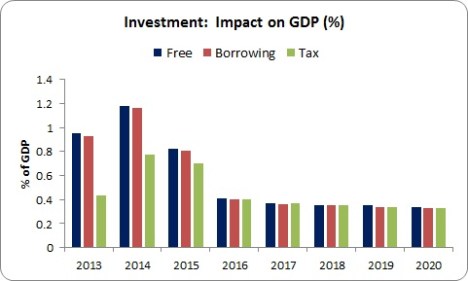
As seen, the most beneficial impact comes from ‘free’ money –
as it is not taken out of the economy.
However, borrowing the money is almost as beneficial. The benefit, however, falls when the
investment programme is paid out of taxation (though the authors don’t specify
what kind of taxation). This fall in
benefit occurs because economic activity is lowered when taxation is increased.
However, the increase in taxation is temporary to pay for the investment
programme. There are two key findings
here:
- The benefit to economy starts levelling out regardless of
the source of funding. By 2020, the
impact on GDP is almost the same.
- The return on the investment is strong. The investment itself makes up 1.7 percent of
GDP over three years. By 2020, the
long-term growth benefit is 0.33 percent (this is a key indicator for
investment as its purpose is to increase the economy’s long-term capacity to
grow). Therefore, the return on
investment, as measured by GDP growth, is approximately 20 percent. This is a good return whether in the public
or private sector.
Employment
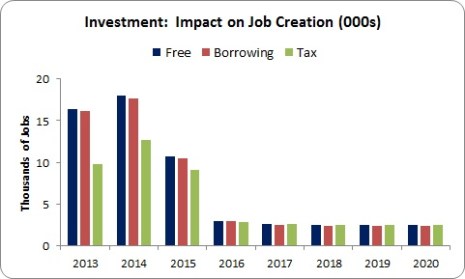
Again, we see a similar pattern between the three funding
sources. Using free money the benefit is
highest, creating 17,700 jobs by 2014 and 10,500 jobs by 2015. Using borrowed money follows close behind
(suggesting that borrowing does not impede either GDP or employment
growth). Using tax money lowers the
overall benefit. However, as above, employment
gains levels out after 2015 regardless of the funding source. There are some key points here:
- First, while the employment benefit is high during the programme,
once the investment ends, the employment benefit falls. The long-term benefit is 2,500 jobs per year
for a €2.5 billion investment. This
leads many people to claim that investment is an ‘expensive’ way to create
jobs.
BUT: the purpose of
investment is to grow the productive capacity of the economy. Put another way, after the investment ends we
have a new asset (a modern water system, a Next Generation Broadband network,
reskilled workers and managers, etc.) which will continue to generate revenue
long into the future. And we have more
jobs to boot.
- Second, as part of smart fiscal management, any Government
would find ways to fill in the slack periods until the economy gets on its
feet. For instance, this Government
expects employment to grow by 40,000 in 2016 (not nearly enough, BTW) but
employment to grow by only 8,000 next year (too optimistic, probably). With an investment programme, it can bridge
the slack period with the growth period.
Rather than 8,000 next year, it could be well over 20,000. That’s a social and economic good and will
see us through until the economy starts generating more jobs without the
investment.
I will discuss the third key point in the conclusion.
The Budget
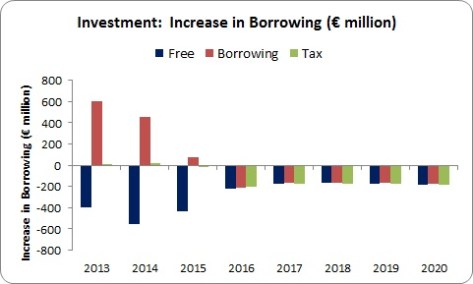
Let’s go through this calculation carefully. Obviously, using free money, borrowing falls immediately,
since the economy is benefitting from higher GDP and employment without having
to put anything down. Under a
tax-financed investment programme, again, there is no increase in borrowing.
Using borrowed money we find a number of things:
- First, while the investment programme spends €2.5 billion,
borrowing only increases for three years and only by €1.1 billion – or about 45
percent of the headline investment rate.
This is because the economy is benefiting from increased revenue and
lower unemployment costs through the increased employment and GDP growth.
- Second, after the period of investment, public finances improve at approximately the same pace as the other two options which don’t
increase borrowing at all.
- Third, investment pays for itself over the long term. Based on the Bradley and Untiedt calculations,
with borrowed money, investment pays for the borrowing after 10 years (an
additional year or so when an inflation rate of 2 percent is factored in). After that, it’s all profit. This is a strong
return.
So even with borrowed money, it costs only €1.1 billion in
the first three years. Afterward, public
finances benefit and after 10-11 years the investment pays for itself.
Conclusion
This works. It doesn’t
rely on sleight-of-hand accounting and presentation, as the Government engaged
in when it launched its own ‘Investment Stimulus’. What Bradley and Untiedt found is what the Nevin
Economic Research Institute found (using the same HERMIN programme), is what
the
ESRI has found in the past, is what Lane-Benetrix found using
more limited measurements. This is what Pereira and Pinho found
when comparing Irish public investment with other EU countries. How much more evidence does the Government
need before it puts a proper investment programme ‘on the table’.
I would suggest three ways to maximise the benefits of
public investment that Bradley and Untiedt measured.
- First, we have ‘free money’.
The Government now has, through the National Treasury Management Agency,
nearly €24 billion in cash balances which has already been borrowed (so we
wouldn’t have to increase borrowing).
This doesn’t count the nearly €5 billion in the National Pension Reserve
Fund. It is difficult to argue that
drawing down €1.1 billion over a three-year period will upset ‘the markets’ or
undermine a healthy cash balance.
Even so, we could combine all three funding sources: cash balances, borrowing and a temporary
tax. This would mean less than €400 million
over a three year period from each source and would result in almost no overall
extra borrowing.
- Second, identify necessary investment projects which would
have a higher return than traditional capital investment (roads, buildings) and
prioritise them. For instance, the
return on a Next Generation Broadband would be higher than a new secondary
road; ditto for a national retrofit programme which is more labour dense. Education and training have particularly high
returns. Smart fiscal management means
identifying the highest return projects
in the short-term among a suite of necessary investment, especially when
resources are tight.
- Third – and this is a vital point – if a three-year
programme of investment works (boosting GDP and employment, repairing public finances)
– do it again. Start up another a
three-year programme in 2015 / 2016. The
gains might be slightly less -more capacity in the economy, slightly more inflationary
pressures and imports, etc. But the ESRI
showed that even during the white heat of the property bubble, investment pays
for itself in the long-term. So, if it
works, keep working it.
There you have it. If
the Government really means what it says – that everything is on the table –
let’s demand that an investment programme be slapped right down in the
middle. To ignore the growing evidence
that investment works is to ignore a pragmatic, do-able policy. It would mean a failure to engage in
strategic thinking and more knee-jerk short-termism.
And haven’t we had enough of that?

 Notes on the Front
Leave a reply to Ciaran Cancel reply