
We’re really lucky to have public sector workers to kick
around – what with all their allowances and increments. If we
didn’t, media and commentary would have to give more attention to the CSO’s two
reports that came out last week. The
first, discussed here, showed the economy destroying 1,200 jobs a week. The second, discussed below, shows a
continuing downward trend, confirming that just when you thought it couldn’t
get any worse, it gets worse.
The CSO’s Quarterly National Accounts (provisional) showed
all the main indicators going south.
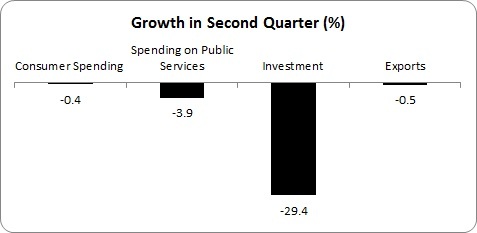
The only reason that the overall GDP flat-lined was because imports
fell faster than exports, declining by 5.2 percent. If anyone thinks this is a good thing, just
remember: most imports are business
imports. And given that the
multi-national sector is probably holding up well, this indicates that
indigenous business is coming under even more pressure.
Just to note: the
investment category is not as bad as it appears. In the first quarter, investment jumped 26
percent, but this was primarily on the back of one sector – aircraft leasing. Averaged out over the two quarters and
investment fell by far less; but it fell nonetheless.
Another indicator, GNP, shows an increase of 4.3
percent. But, again, look below the
headline and see a reason which has nothing to do with the health of the
domestic economy. GNP is arrived at by
subtracting the flows of money out of the economy, a large part of which are
repatriated profits. In the second
quarter, there was less money flowing out than in the first quarter. If it had been the same, GNP growth would
have been 1.5 percent – a growth facilitated by the fall in imports (Seamus
Coffey has a good discussion of GNP here).
Anywhere you look there are few silver linings – with the
exception of the growth in Industry. But
the multi-national dominated Industry makes up only a quarter of total output
and its rise couldn’t make up for the fall in all the other sectors.
The above compares the quarterly results. Year-on-year comparisons suggest that we are,
at best, stuck in a trough.
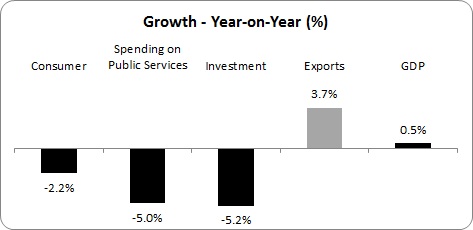
The domestic indicators are all going south. GDP is lower than it was this time last
year. What’s holding up overall GDP is
the growth in exports with a fall in imports of 1.1 percent.
And it’s not like there hasn’t been other portentous news in
September. The Exchequer returns showed
that for the second month in a row, tax receipts fell behind last year’s level
for the second month in a row – indicating that public finances are
weakening. That, too, was worthy of some
discussion.
But no. What we get is non-stop, wall-to-wall demands that
the Government cut €75 million in public sector allowances, regardless of how
many (if not most) are wholly legitimate by any measurement in the private or
public sector. And if the Government did cut this money? How much would it save on the deficit, as a %
of GDP? 0.032136%.
Yet, over the last six months 1,200
jobs are being lost a week while €899 million has been wiped off domestic
demand resulting in weakening public finances and even more misery in society.
We are invited to chase after mice while
the elephants, which get only cameo parts in the debate, trash the house. Oh, well, I guess it’s more fun chasing the
mice. Unfortunately, by the time we
catch them we won’t have a house to live in.


 Notes on the Front
Leave a reply to Colum McCaffery Cancel reply