
In the final quarter of last year there was a glimmer of
hope. Employment rose, suggesting that
the labour market was ‘bottoming-out’ and maybe, just maybe, we could start to
see a continuous rise in the number of people at work. That glimmer has been squashed, for the time
being anyway. The latest Quarterly
National Household Survey shows employment falling and falling again.
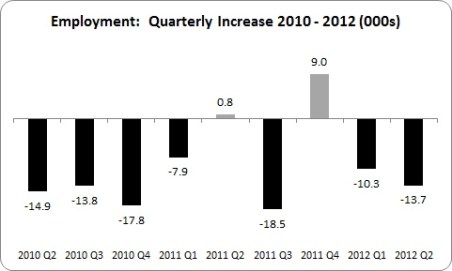
Late last year there was a rise of 9,000, albeit after a
horrendous drop in the autumn. Since,
then, however, there has been a fall of 24,000 people at work in the last six
months, with the trend heading in the wrong direction. But with full-time employment, it gets worse.
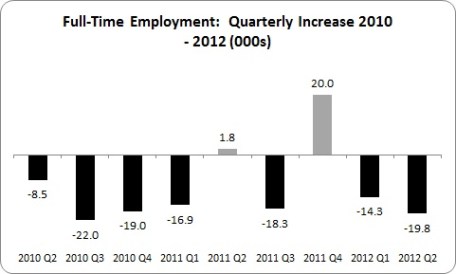
The pattern is similar.
An increase late last year but in the last six months a substantial
fall. There are 33,000 fewer full-time
jobs in the economy than late last year – and the recent fall is the highest
since 2010.
Unemployment over the last year has been on the wrong side
of 300,000. But it could be worse. The labour force has shrunk by 30,000 over
the last year (read: emigration) while there are 10,000 more people on ‘labour
activation’ programmes (made up mostly of new participants on Jobsbridge and
TUS). Without these, the unemployment
figures would be much higher than the official rate of 14.8 percent.
But there are other measurements that do not get the
attention they deserve. These come from
the ‘Indicators
of Potential Labour Supply’. This is
how they compare with the official unemployment rate:
- Unemployment Rate:
14.8 percent
- Unemployment + discouraged workers (S1): 15.4
percent
- Unemployment + discouraged workers + marginally attached to
the labour force (S2): 18.3 percent
- Unemployment + underemployment (those working part-time but
want to work full-time – S3): 25.2
percent
Over a quarter of the labour force are either unemployment
or under-employed. Combine that with the
EU Commission finding that there are approximately 28 unemployed per job
vacancy, and you have a real crisis.
Since the Government came into office, employment has fallen
by 33,000 while unemployment has crept up from 14.3 to 14.8 percent. Let’s first state: it would be unrealistic to expect a new
government to come into office and, presto, the job situation dramatically
improves. Unemployment is like a ship
heading in the wrong direction in narrow waters. First you have to bring it to a stop. Then you have to turn it around. Then you have to start going in the right
direction, accepting it will take time to accelerate. Let’s grant that.
But there’s accepting a difficult situation; then there’s
refusing to assess if what you are doing is producing the results. Since coming into office we have had the Jobs
Initiative, a ‘jobs-friendly’ budget and the Action Plan for Jobs. How do we know what effect these are
having? How do we know if they are
working? Is the Government measuring
this? Do they have the tools to measure
this? What if this is as good as it
gets?
And what’s even more unnerving, how do we know there’s a
captain on the bridge?


 Notes on the Front
Leave a reply to gotnakunort Cancel reply