
Sometimes you just want to pick up the radio and shake it
until the tiny little people inside start talking sense. Take Minister Frances Fitzgerald on the Pat Kenny show yesterday:
Minister: The country is broke. The path back for every citizen in this
country is going to be so tough. And yet we’re the fourth highest in the OECD when
it comes to spending on public services.
That’s often forgotten.
Never mind the country-is-broke lark (we’re not too broke to
pay over €3 billion a year on a non-existent bank). Nor the ‘path back’ reference (easy for some,
harder for others). But the fourth
highest spender on public services in the industrialised world? Huh? Not
only should it be forgotten, it shouldn’t even be remembered because it is
simply not the case.
Eurostat
provides a comprehensive database on spending on public services, or Government
final consumption expenditure. They
provide total spending, percentage of GDP, per capita and spending in power
purchase parities (PPPs which factor in living costs). It should be noted that this doesn’t count
spending on social transfers (pensions, unemployment payments, family income
supports, etc.).
Here is the spending per capita on public services in the
EU-15.
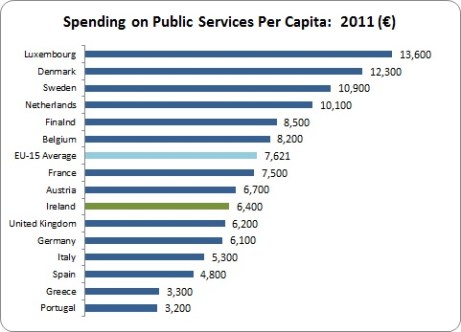
Ireland doesn’t rank as a large spender on public
services. We rank 9th in the
EU-15 league, ahead of the UK, Germany and, not surprisingly, the Mediterranean
countries. We spend 16 percent below the
average of the other EU-15 countries.
- We would have to spend an additional €5.5 billion on public services
just to reach the average of other EU countries.
- We would have to spend an additional €8.7 billion on public
services just to reach the average of other EU countries not in bail-out
(excluding Portugal and Greece).
We’d have to spend an awful lot more money to be like an
average EU country (though, yes, spending more money is not a guarantee of
improved output).
Maybe the Minister was referring to public spending measured
in PPPs to factor in the cost of living.
High cost countries need to spend more to get the same value as low cost
countries. So how do we stack up in this
measurement?
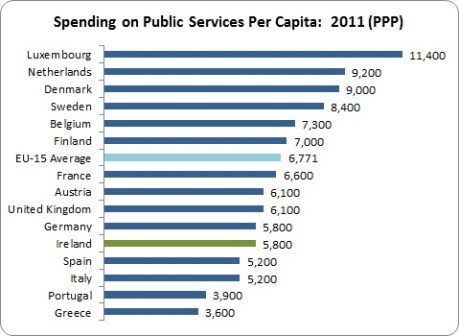
In this measurement, Ireland shares 11th place in the
standings with Germany. Now, we’re
only ahead of the Mediterranean countries.
Was the Minister referring to spending on public services as
measured by percentage of GDP? I don’t
think so. The other EU-15 countries
spend an average 22.3 percent of their GDP on public services; in Ireland, it
is 18.3 percent. We would need to
increase spending by €6.3 billion just to reach the average on this
measurement.
Eurostat also estimates the spend, as a percentage of GDP,
for the years 2012 and 2013. These
estimates show that Ireland would have to increase spending on public services
by €7.1 billion in 2012 and €7.9 billion in 2013 just to reach the average of
other EU-15 countries. This shouldn’t be
surprising as the Government intends to cut public services up to 2015 at
least.
Of course, some will raise the issue of military
spending. Unlike other EU countries,
especially the UK and Greece, we don’t spend a lot on military (neither should
the UK or Greece). This, say some,
skewers the spending figures.
So what happens if we subtract
spending on military services? Not a
whole lot. Ireland would still need to
spend an extra €4.9 billion to reach the average of other EU-15 countries in
2011. This figure would still rise in
2012 and 2013 if the Eurostat estimates hold.
There are other arguments.
For instance, other countries have a higher elderly population which require
more expenditure on health and other age-related services. This is true.
But Ireland has a higher youth demographic which requires a higher spend
on education and youth-related services (justice, recreation & leisure,
etc.). Further, Ireland has a much
lower population density than other EU-15 countries with the exception of
Sweden and Finland. There are 65 people
per square kilometre in Ireland; the average of the other EU-15 countries is
171 while in the Netherlands it is 492.
Thin density means that public services (health, education, water,
energy, security, etc.) have to be spread out, making it difficult to reach the scale that
can be obtained in highly urban societies.
However you spin it, the Minister is wrong. There is no measurement which can come even
close to justifying her claim that we are one of the highest spenders on public
services in the industrialised world.
The truth is that we’d have to spend billions just to reach the average
of other EU-15 countries. We are a
low-low spend economy when it comes to public services.
If people want to argue that fiscal consolidation based on
spending cuts is superior to a tax-based fiscal consolidation, fine. If people want to argue that much of our
spending on public services is inefficient, fine. Let’s test the evidence, let’s come up with
proposals to increase efficiency.
But first and foremost, lets’ start with the facts. Let’s describe the situation as it really
is. If we don’t, the debate becomes
degraded and reality becomes anything you want it to be.


 Notes on the Front
Leave a reply to Pat Cancel reply