
It’s open season on the Croke Park Agreement and public
sector workers in particular. It should
be scrapped, torn-up, renegotiated, whatever – just cut wages. Some of the arguments are Pythonesque. Dr Eddie Molloy, in particular, tries to
co-opt Jim Larkin into his proposals to cut workers’ wages (here
and here). I suppose now we’ll get someone co-opting
William Martin Murphy into the argument for raising the corporate income tax.
Dr Eddie claims the Government should plead inability to pay,
citing deterioration in the economy and public finances that were not foreseen
at the time the agreement was made.
Strangely, he fails to connect the dots – or even admit there are dots
to connect:
·
Pension levy · Budget
2010 pay cut · reduction
of public sector employment ·
real pay cuts under the Croke Park Agreement (after inflation) · economic and fiscal
deterioration
We’ve had pay cuts, we’ve had downsizing and we are still in
a mess. One might expect a consultant to
go back and see if there is some connection, a cause and effect, and ask that
most fundamental question -Is what we’re doing producing the effect we desire. Instead, Dr Eddie, seeing the tired old horse stumbling
to the ground, demands that we whip harder.
If Dr Eddie can’t or won’t ask those fundamental questions,
we can. His contention that economic deterioration
is making things harder is correct. What
would happen
if we cut public sector pay by, let’s say, €1 billion (7 percent across the
board cut)?
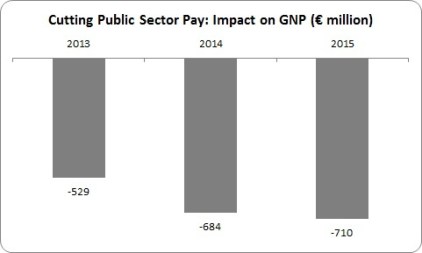
The impact on the domestic economy would be
considerable. In the first year alone,
over half a billion Euros would be wiped out.
Over the three year period, nearly € 2 billion would be wiped out. It is noteworthy that Dr Eddie, when
describing the deteriorating situation, points out that:
‘ . . . growth
projections for the economy have not materialised . . .’
Yet, he proposes a policy that will ensure that growth will
fall even further. Why would he do that? This is a classic example of proposing a
course of action without thinking through the impact.
I’m sure Dr Eddie would support proposals to increase
employment. After all, rising employment
means more tax revenue, lower unemployment costs, and greater economic
activity. However, according to the
ESRI, there will be private sector job losses if public sector wages are
cut. Keeping with the proposal to cut €1
billion in wages they estimate that up to 4,000 jobs will be lost by 2015 – but
we should remember that this estimate comes from 2010 against a background of
projected growth. Given the
deteriorating situation since then, we could expect this job loss figure to be
higher. Again, why would Dr Eddie
propose a policy that will cut more jobs out of the economy?
How many businesses will go out of businesses arising from a
public sector pay cut? This is a
difficult to quantify. But we can measure
the impact in consumer spending.
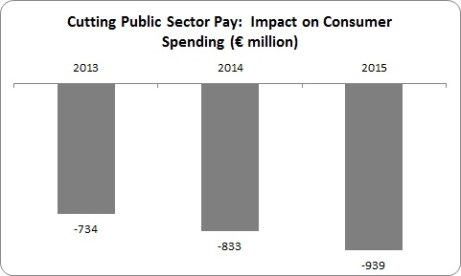
In 2013, €734 million in consumer spending will be lost by a
cut in public sector wages. This rises
to nearly a billion Euros by 2015. Over
the three years, €2.5 billion will cut out of consumer spending. This means less sales, turnover and revenue
for business. How many will go under? Dr Eddie doesn’t refer to this, even though
it is obvious that if you cut people’s disposable income, there will be a drop
in consumer spending – especially with so many households grappling with debt.
Ok, so growth will be cut, private sector jobs will be lost,
and consumer spending will fall, threatening more businesses. But Dr Eddie, like so many others who demand
we take ‘tough’ decisions, may say that this is the pain we must take to reduce
the deficit. This raises the question: how
much deficit will be reduced by cutting public sector pay by €1 billion? The answer is, not much.
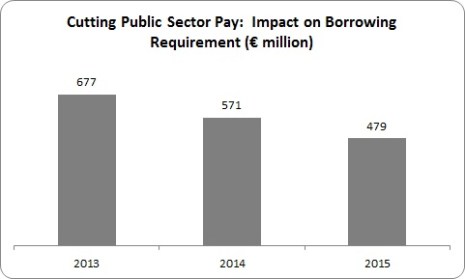
In the first year, the borrowing requirement will fall by
€677 million. However, as the deflationary
impact of the cuts become embedded in the economy, the reduction in the
borrowing requirement falls to €479 million by 2015. In other words, the ‘savings’ to the
Exchequer is less than 50 percent of the headline cut.
Let’s put this into perspective. Between 2012 and 2015 the Government is
hoping to reduce the borrowing requirement by €11.9 billion. Cutting public sector pay will reduce that
amount by €479 million. 4 percent. Dr Eddie’s proposal will have the effect of
cutting the borrowing requirement by 4 percent of the amount needed. Growth will be cut, private sector jobs will
be lost, consumer spending will put domestic businesses under even more
pressure – but at least we have reduced the borrowing requirement by 4
percent. Is this ‘tough’ decision either
efficient or effective?
But we don’t have to go through charts and graphs to figure
this out. Cutting people’s wages –
whether private or public sector – during a domestic demand recession is not
likely to turn out well. We can get a
better sense of this by looking at the range
of income groups that will be hit.

Over 60 percent of public sector workers earn less than
€50,000 a year – and this doesn’t take into account the impact of the pension
levy. There are less than 15 percent on
higher incomes (above €70,000) and a minute 2 percent in six figures.
To cut into low and average workers’ wages, regardless of
who their employer is, is to invite all manner of problems – and not just those
listed above. Cutting wages could see a
rise in social protection payments, in particular Family Income
Supplement. For instance, a worker on €28,000
with one child experiencing a 7 percent wage cut will end up costing the
Department of Social Protection an additional €800 per year in FIS
payments.
Cutting wages could also see a rise in mortgage arrears,
which will rebound on the Exchequer if this contributes to a growing
destabilisation of bank finances, resulting in higher capitalisation payments
or less credit in the economy.
These are just two instances of perverse consequences which
will undermine deficit reduction – and which those who claim to be taking touch
decisions just ignore or unaware of.
Ultimately, we’re back to the same old barrel, scraping and
scraping until the barrel is unfit for purpose, leaking all over the productive
economy. We have had cuts in both public
and private sector pay. And, as they
say, we are where we are. The problem is
that few people ask that fundamental question – why is it that after all the
cuts of past, we still are here.
Of course, if we did ask that might lead to new thinking –
innovative, strategic thinking – that will ensure that what we are doing is producing
the results we desire. That might lead us
away from the policies of cuts and austerity.
And we dare not to do that.
So, keep to the programme, steady-on, there is no alternative. All we have to do is whip harder.


 Notes on the Front
Leave a reply to Colum McCaffery Cancel reply