Notes on the Front

Commentary on Irish Political Economy by Michael Taft, researcher for SIPTU

Splashing the Water

First there was Claiming our Future with its bold but common-sensical proposals to promote growth and equity in the economy.  Now we have the Nevin Economic Research Institute (NERI) laying down a new fiscal framework to pursue such an alternative economic strategy.   And it poses a real challenge to all progressives.

Some of us have just been working at the edges of the pond.  For instance, some of us have argued for a freezing of current public expenditure at current levels up to 2015, substituting tax increases in place of spending cuts, and relying on an investment programme  (mostly paid out of own resources) to increase our productive capacity in the medium-term.  Of course, this approach accepts real cuts in the overall spending package (after inflation) but the argument is that savings on unemployment costs can be redirected into other areas of current spending.  It still represents an expansionary fiscal platform, but a tight one.

NERI, however, runs past us all, jumps into the pond with both feet and starts splashing the water all around – including all over us.  They, too, propose an expansionary programme but instead of freezing public spending, they want to increase it – increasing it to EU averages in the long-term.  This would be combined with increasing government revenue to similar EU levels. 

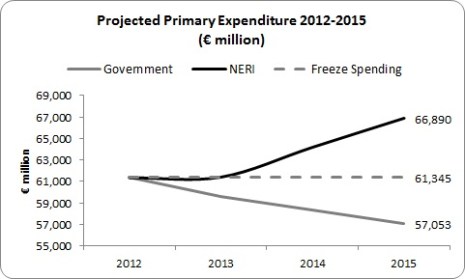
Let’s look at the differences – comparing Government projections, a ‘freeze-spending’ scenario, and NERI’s proposals.  The following looks at overall spending minus interest payments – that is, primary expenditure.
NERI 1

As seen, while freezing spending would provide an additional €4.3 billion for current and capital spending above the Government’s projections, NERI’s proposals would provide an additional €9.8 billion.  That’s a mighty sum.

The objections will be loud and voluminous – you’re adding to debt, you’re avoiding tough decisions (no one ever mentions avoiding bad decisions), you’re padding an already wasteful and inefficient public sector, etc. etc. and more etc.

But let’s briefly looks at some of the issues NERI’s proposals raise.

The first is whether you use GDP or GNP (or more properly GNI – which is GNP plus net EU payments) to measure spending.  This is one of those bottom-less pit debates where consensus is almost impossible.  I don’t intend to re-run the arguments here.   However, it is worth noting that while Irish GDP per capita exceeds the EU-15 average, owing to the froth of multi-national accounting, Irish GNI per capita is about average.  Average income, average spend – that’s NERI’s approach.

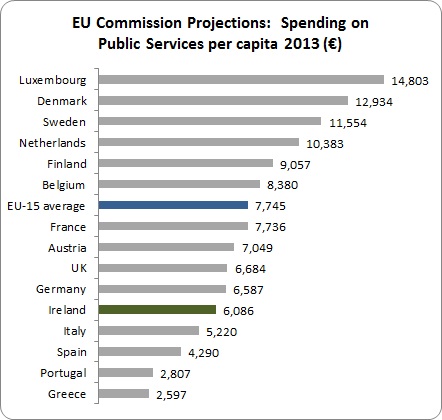
This suggests another approach to looking at expenditure.  The following looks at Government spending on public services per capita.  This is useful category given that overall spending can be skewered by pension expenditure in EU countries with a much older demographic.
NERI 2

Ireland would have to increase its spending on public services by €7.5 billion just to reach the average EU-levels.  There’s doing more with less as the mantra goes; then there’s doing less with a lot less.

Second, NERI’s proposes to increase Government revenue to EU-15 averages.  This would be a substantial sum.  By 2017 it would mean €13 billion extra.  I can hear a big gulp.  But the important point here is that this doesn’t mean that this amount must be met by increasing current tax levels.  Increasing growth and employment will make up a large part of this gap. 

For instance, the Government intends to increase tax by €3 billion over the next three years.  However, they project government revenue will increase by €7.5 billion.  Growth will increase government revenue by nearly two-thirds; the fiscal adjustments will only account for a third.  And that’s in a scenario where the Government is cutting investment and domestic demand.  Imagine the increase in government revenue in a scenario where investment and domestic demand is increasing.

Third, the idea that public spending is a drain on public finances has been firmly established in the public debate by the austerity orthodoxy.  NERI’s programme challenges this view. 

For instance, the ESRI shows that increasing spending on public services by €1 billion (a combination of increased employment and wages) would mean an increase in the borrowing requirement of €580 million in the first year.  Increasing income tax by €1 billion would reduce the borrowing requirement by €744 million.  In other words, a straight one-for-one increase in income tax and spending on public services would result in a net reduction in the borrowing requirement.

This is not an argument that we can spend our way out of a recession.  We can’t, we must invest.  But it is an argument for a more sophisticated fiscal approach which uses a number of instruments in a carefully calibrated way.  Increasing taxation beyond the economy’s capacity to absorb it (such as happened in the last few years) while increasing public spending without regard to productivity (which happened under Fianna Fail’s failed programme in the late 1970s) is a recipe for a real mess.

However, increased spending combined with similar increases in taxation can be a net boost to the economy and public finances.  Imagine if we introduce a wealth tax and took the proceeds to roll-out an early childhood education network – that would be a boost in the short and long-term.

None of the above constitutes a ‘model’.  There is still considerable work to be carried out.  But there is considerable evidence to show that NERI’s programme would work, that Claiming our Future’s vision is achievable. 

NERI has jumped into the pond and is splashing the water all around.  I suggest we all follow suit.  I have dipped my toe in.  And the waters of an expansionary economic strategy are just fine.

6 responses to “Splashing the Water”

  1. tellsitlikeitis Avatar
    tellsitlikeitis

    “The creation of a ‘solidarity tax’ on the super-rich including tax exiles would help to generate a good civic example and increase a greater sense of fairness.”
    Hilarious! This from the folks who brought you the most un-civic political campaign in living memory, the hugely damaging attempt to undermine the household charge.
    The catch-phrase seems to be: increase tax now, but only on the other guy!
    See, in the real world, it doesn’t work that way. You can’t both pander to the self-serving logic of the masses and also have a sustainable tax base. You have to choose one or the other.

    Like

  2. Ciaran Avatar

    There’s nothing wrong with undermining the household charge as was presented by Bigphil et al. They need to re-think that and introduce a site valuation tax instead – a fairer, more stable tax, which also attenuates the likelihood of volatile property markets.
    We need more income tax bands in this country – there’s too much of a rate jump (0% to 20% to 41%), and someone earning €40,000, and paying the same marginal income tax rate as someone earning €200,000, can’t be right. We need more of a sliding scale in our income tax rates. Some need to be paying more tax, others need to be paying less tax, so they can spend it elsewhere (which is why people at the low end of the income scale pay ‘not a bob’ in tax: they spend it all anyway).
    Michael, you would do well not to fall into the trap of using terminology like ‘solidarity tax’ or ‘wealth tax’ – you’ll only attribute a degree of victimhood to people who are more than able to pay a reasonable amount of tax on their income. You’ll also invite certain contributors to pounce on you with bogus figures relating to marginal tax rates, while not informing people exactly what ‘marginal tax rate’ means. We are not, as certain ‘straight-talkers’ would have you believe, ‘the most taxed people in Europe’ – this is borne out by the above figures in relation to our public spending, which has never been as runaway as people would like to think.

    Like

  3. tells.it.like.it.is Avatar
    tells.it.like.it.is

    Cairan, I love your reference to the crooked-talkers not explaining what a marginal rate is. What it is, econo-kindergarten?
    Seriously, someone who doesnt already understand a concept as simple and fundamental as the marginal rate has no business getting involved in a debate on tax policy.
    On your idea that the undertaxed low to mid-earners spend all their money anyway and this is somehow a valid replacement for paying income tax … the question is what spending they would cut out if their tax contribution were to increase towards European norms. Would it be on things that are of little or no benefit to the exchequer: the holiday on the Costa Brava, the odd line of coke, their Sky TV subscription? Or would it be zero-VAT-rated spending on food that gets cut? Or would it be high-tax items like Dutch Gold and John Players Blue that are consumed less?
    The answer would have a large bearing on the exchequer impact of absolving a large portion of the workforce of any substantial income tax obligations, in the expectation that the money will somehow come back anyway.

    Like

  4. Ciaran Avatar
    Ciaran

    Those uppity ‘undertaxed’ low- to middle-earners spend their money, and said money goes into the economy. Whether or not they spend money on activities which meet with your approval, is immaterial. Placing a larger tax burden on such people does nothing to help the economy.
    To reiterate, we need more income tax bands, not just the blunt 20% and 41% rates, the latter of which kicks in too early.
    Income tax amounts are down because there is a huge amount of unemployment in this country, not because low earners are sneakily avoiding tax (that, alas, is the hallmark of a lot of our higher earners).

    Like

  5. Ciaran Avatar
    Ciaran

    Incidentally, I just deciphered the first part of your last comment ‘tellsitlikeitis’/’tells.it.like.it.is’ – I know exactly what a marginal tax rate is. My point is, many commentators (usually right-wingers trying to pretend that direct tax rates are draconian in this country) use marginal rates to come up with a bigger percentage than the percentage people actually pay. This debate tactic is utterly misleading, but in most cases, deliberate.
    So I guess I’ll have to reserve my right to continue to take part in debates on tax policy – sorry!!

    Like

  6. tells.it.like.it.is Avatar
    tells.it.like.it.is

    @ciaran
    “Those uppity ‘undertaxed’ low- to middle-earners spend their money, and said money goes into the economy.”
    The point was the extent that it “goes into the economy” depends heavily on what they actually spend it on.
    My approval or otherwise is irrelevant.
    As the indigenous economic effect of someone deciding to discontinue their Sky TV subscription – a foreign corporation gets less money, and maybe they end up bidding less for the next english premiership contract. But the effect on the local economy – close to zilch!
    “I know exactly what a marginal tax rate is.”
    I assumed that you know, and I wasn’t questioning your right to debate.
    Instead, I was questioning your paternalistic view of the man-in-the-street being tricked by the right-wing commentators using obscure economic jargon to confuse the issue.
    In fact, the marginal rate of tax is so fundamental and simple a concept, that to even involve someone who didn’t understand it in a debate on tax, would be akin to discussing tax with someone who couldn’t grasp what a percentage is.
    And the reason those right-wing commentators refer the marginal rate of tax is not to trick the un-wary, rather it’s because it’s strongly linked to the disincentive effects of high taxation.

    Like

Leave a comment

Navigation

About

Commentary on Irish Political Economy by Michael Taft, researcher for SIPTU