Notes on the Front

Commentary on Irish Political Economy by Michael Taft, researcher for SIPTU

The ESRI Paper – Now You See It, Now You Don’t

Well, that was peculiar.  An ESRI working paper that estimated the cost of going to work was published made the top story on RTE Six One news and then was withdrawn only a few minutes after being featured.  Controversially, it said that 44 percent of families with children would be better off on the dole than at work.  The ESRI issued a statement explaining its withdrawal but already the drumbeats were sounding:  ‘disincentive to work’, ‘dole is too high’, ‘can’t get people to work for me’, etc.

Conspiracy theories will no doubt circulate – about how the Government forced the withdrawal of an ‘inconvenient’ paper.  A number of social organisations will be relieved – with a Government already hammering social protection recipients, it would have just added more weight to the hammer.  What are we to make of it?

The document in question – ‘The Cost of Working in Ireland’ – is a working paper that was published with the usual rider: an ‘un-refereed work-in-progress by researchers who are solely responsible for the content’.

The conclusion was the bombshell:

'The evidence presented in this paper suggests that the costs of working are high. Expenditure is higher for those in work than out of work. For an employed person without children the additional costs of working sum to some €140 per week, or almost €7000 a year. This increases to €9000 when there are young children in the household!

The employed may have a higher disposable income but they spend more on clothing, transport, childcare and eating out. . . . Employed people incur 5 times the costs of an unemployed person.'

This is important for policy as it substantially affects the incentives to work. A comparison of take home pay shows that it does not pay to work for 1% of the population. However, a comparison of take home pay plus extra expenditures shows that 15% of the people without children, and 44% of people with children, are better off not working.

The Irish Times reported: 

‘In a statement, the ESRI said the decision to withdraw the paper had been made "as it has emerged that the underlying analysis requires major revision and that the paper's estimates overstate the numbers of people who would be better off on the dole than in work”.

And to add to the story’s spice, Professor Richard Tol, one of the three co-authors, was on Morning Ireland, standing by his work, suggesting that the Government and even the trade unions may have had a hand in getting it withdrawn (trade unions?!).  

So what are we to make of this?  There are three issues but let’s state first:  the paper, in general, only states the obvious – that there are costs associated with working (childcare, transport, eating out).  .  Further, its findings, rather than give support to the ‘dole is so high no one will go back to work’ argument, actually undermine this unsubstantiated claim. 

Stating the Obvious

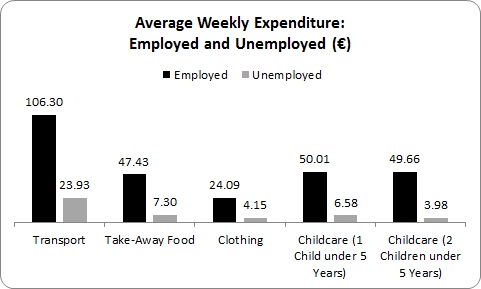
Is the methodology sound?  It is a technical paper (involving binary-dummies, logit regression, Heckman selection model, a rho discounting function, etc.) working with two separate data sets – the CSO’s household budget survey and the EU Survey on Income and Living Conditions.  When working with two datasets with different purposes and methodologies, one has to take special care.  This is what the paper found.
ESRI Tol 1

I won’t comment on the scale of these expenditures (that could be part of what the ESRI claims is a deficient methodology).  The point here is that higher expenditure on things like transport and take-away food for those in work is not surprising.  It is, on average, more expensive to go to work than not.  As to whether the methodology and, so, the actual numbers are sound – well, we shall have to watch the upcoming row between the ESRI and the authors of the report.

No Disincentive to Work

The above findings are based on data from the Household Budget Survey conducted in 2004/2005.  While the numbers in the paper are updated, the gap between expenditure by employed and unemployed would have been evident – though the prices and incomes will have been lower.

For instance, according to the CSO weekly childcare expenditure in 2004/2005 was €14.07 for ‘employed’ while it was only 64 cents for unemployed (this is not directly comparable since the ‘employed’ category includes part-time workers while in the paper only ‘full-time employees’ were used).  In all the categories the paper mentions, there were substantial gaps in 2004/2005 – quite possibly of similar proportion given price and wage levels.

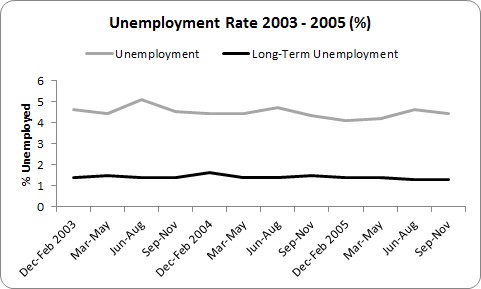
So here is the question:  if such gaps were present eight years ago, surely this must have provided a substantial a disincentive to work – with tons of people choosing to stay on the dole rather than work.  Did it?  No.

Eight years ago, we had an employment rate that was as close to ‘full employment’ as you can get. 
ESRI Tol 2

Not only did we have low unemployment – we had one of the lowest rates of long-term unemployment in the EU.  If there were ‘life-style’ choices being made – better to be on the dole than at work – the long-term unemployment figure should have revealed this.  It doesn’t.

Of course, this includes everyone.  What about those families with children – the claim that a substantial percentage would be better off on the dole would have a foundation in the 2005 data?  However, we find very few families on unemployment payments.

  • There were 6,900 recipients with children on unemployment benefit
  • There were 15,800 recipients with children on unemployment benefit.
  • These recipients made up only 18 percent of all recipients during a period of ultra-low unemployment rates

Of course, many (most?) of these recipients would have been in transition from one job to the next.  Given that there were over 1,000,000 families with a child benefit payment, this doesn’t suggest that higher at-work costs were a disincentive to work.

We will discuss this in more detail below but the point here is that the relationship between unemployment payments and after-work disposable income is not one that ‘disincentivises’ work. 

The Wrong Angle

No surprise that the immediate reaction is that dole payments are too high.  You can make more on the dole than at work.  This discourages workers from taking up jobs where they exist.  What’s the solution?  Why, cut social welfare, of course. 

Oh.  We’ve cut social welfare twice.  In 2010, 38 percent of unemployed suffer from deprivation experiences.  30 percent of children suffer from deprivation experiences.  Further cuts will, of course, drive this figure higher (it will no doubt rise when the 2011 data comes on stream).  Not only is poverty rife among those dependent on social protection, there is a poverty of knee-jerk responses.

The problem is that we are in danger of looking at this problem from the wrong perspective.  There are two issues here.

First, is the level of income from work too low?  Obviously something is wrong when 23 percent of households with one person working are suffering from deprivation experiences. This is higher than the national average.  We never ask are wages low – we seem, for some bizarre reason, to think that’s a good thing, despite the toll it takes on the economy and the Exchequer.

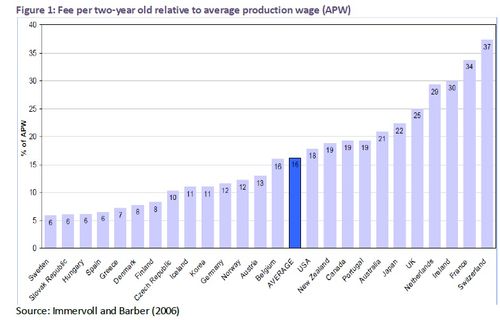
Second, the issue is not that the social welfare system is too generous.  The problem is that it is not strong enough.  The ESRI working paper produces an interesting graph.
ESRI Tol 3

Irish childcare costs are the third highest in the countries surveyed here – twice the average level of costs and 5 times the cost in Sweden.  A strong welfare state would have a universal low-cost public childcare system.  Even the working paper states:

‘Affordable childcare services are also important for the development of the child . . . a safe, stimulating and social environment for children which can have long-term benefits for socioeconomic integration.’

We don’t have this.

Nor do we have other social supports for people in work – notably, free GP care and (low-cost) prescription medicine.  Or a truly free public education system – in other countries school books and transport are free or very low-cost (and they don’t need ‘voluntary’ payments). 

A strong welfare state significantly reduces costs for all people – in work or not.  But we don’t have such provision.  We have some provision for those without a job.  But once you get a job, the welfare state doesn’t exist in many key sectors.  This is the key issue – the lack of a proper welfare state.

* * *

The ESRI working paper suggests that the gap between social protection income and work is not the issue regarding job take-up.  It certainly didn’t exist back in 2004/2005 from which the base data is derived.

What it does show up is the weakness of the welfare state, especially in comparison with other European countries.  Of course, we will get the complaint that we can’t afford a strong welfare state.  As has been argued time and time again on this blog, we can’t afford not to have a strong welfare state.  People’s living standards – whether through low cost childcare, truly free education, state-funded earnings related pensions, strong safety nets – these are not obstacles to recovery, they are essential components of that recovery.

What disincentivises job take-up?  The lack of jobs.  The EU shows that there are 26 unemployed for every vacancy.  That’s as big a disincentive as you’re going to get.  Where there are jobs, the issue of social welfare payments and even low-pay become almost marginal.  People want to work.  They can’t find work because there is no work.

Still, we may be heading back down the same old road we’ve been before – cutting social welfare rates and supports.  If we do, demand will be cut from the economy, jobs will be lost, the recession will be extended which will only result in more calls for cuts.

When will we learn?

15 responses to “The ESRI Paper – Now You See It, Now You Don’t”

  1. Skirmish Avatar
    Skirmish

    Superb response. But will it get the same airplay on RTE as the one that suits the austerity hawks?

    Like

  2. Hosen Avatar

    Appreciate this post. Will try it out.

    Like

  3. SOMK Avatar

    “Irish childcare costs are the third highest in the countries surveyed here – twice the average level of costs and 5 times the cost in Sweden. A strong welfare state would have a universal low-cost public childcare system.” Okay but the graph shows France as having higher childcare costs than Ireland, when as far as I’m aware childcare is free in France no?

    Like

  4. Richard Tol Avatar

    Thanks Michael
    It is indeed odd that, in Ireland, primary, secondary and tertiary education are heavily subsidised while pre-primary child care is exceedingly expensive.
    Our paper is brief on the policy implications. You might as well conclude that taxes etc on the low paid are too high.

    Like

  5. Laura Avatar

    “social organisations” – oh you mean those organisations who remain in existent and create nice jobs for themselves as long as poor people remain poor? The pro-poverty industry is a large part of the problem in Ireland, welfare dependency is reinforcing cycles of poverty and unfortunately government, particularly Labour, are terrified of having to take on the ire of both those and 400+ forgotten people plus others.
    As for the report, there were huge flaws on it. From what I recall, Tol also damned the investment in wind energy despite the fact that we are slaves to external oil and gas producers and have no oil and limited gas of our own. His assertion of 11 euros for lunch alone drives huge questions about the accuracy of the report. Yes, a minority of people do not wish to work, but they are very much a minority and have chosen to live a very meagre lifestyle as a result. Many others really are going through hell. Keeping welfare high to cushion them from taking on lower paid jobs is reinforcing unemployability and deskilling because they do not work, which will only reinforce their long term lack of prospects.

    Like

  6. Laura Avatar

    Richard – the taxes on the low paid are still far beneath what they were in the high unemployment era and following 8 years. People did not simple stop working in Ireland because taxes got higher, in most cases they either never started work or lost jobs.
    Where did the statistic of 35 euro per week on average on clothing come from for examnple? Even when I worked in Ballsbridge lunches were not 11 euro unless you went to a fine restaurant. There is something very wrong with many of the figures produced and using 2004/5 household surveys in 2012 is misleading.

    Like

  7. Alex Wilsdon Avatar
    Alex Wilsdon

    The poverty experienced by some social welfare recipients only proves they are bad with money. The fact that so many do not experience poverty proves that rates are more than adequate. A direct provison model would soon show how generous €188 per week is although pubs and tobacco sales would be hit.

    Like

  8. Jonathan Avatar
    Jonathan

    What an callous comment. The hostility and lack of understanding shown to the unemployed by certain people is sickening. Here’s a comment left by someone who’s unemployed at the Irish Times today: “Had an interview recently for a public service 9 month intern-ship under the jobsbridge scheme, apart from that, I have not received any replies to CV’s I have sent ranging from banks to Aldi, to local shops to multi nationals. I have a business degree and five years experience but the best I can hope for is an unpaid job in the public service and the competition for such roles is massive. I can apply for one of the myriad of scam intern-ships washing cars for 39 hours a week or something similar. So I live on 187 a week in total, after rent and bills I have nothing and in most cases I still owe money. The report in my experience only serves to embolden the hang m high brigade and further alienates the unemployed – myself. Those lucky enough to still have jobs and in particular the public sector in my experience have little sympathy or understanding of the gravity of what’s going on in the labour market. It is now clear to me that it is a race to the bottom for the majority. There are those drawing social welfare who are happy with their lot and that has always being the case, but in reality the vast majority of people want to work. I would do any work at the moment in order to protect my mental health, but I don’t hold out much hope that my experience or education is of any value in the labour market any more. So because of reports like this which pointed out by turkeyforchristmas which has now become a petty isue among a few different personal interests, we become further marginalised and exploited. So if this article effects public opinion and further hardens attitudes towards unemployment and further cuts are made lives already at their lowest will have no lower to go only into depression and possible suicide which is already rampant. This in my experience and as a result is subjective in tone but many would agree, trying to remain objective in society at present is a struggle.”
    Source: http://www.irishtimes.com/newspaper/breaking/2012/0613/breaking21.html

    Like

  9. Shane Dempsey Avatar
    Shane Dempsey

    I think the report is less problematic than the spin that’s being put on it by a government that is planning to cut social welfare and other subsistence payments to the unemployed. The deprivation that Michael Taft is referring to has nothing to do with the differential between salaries in Ireland and other European countries (so-called competitiveness measures) and everything to do with the high personal debt of the majority of Irish people. Simply put, many cannot afford to put food on the table and pay their mortgages (even interest only). If we want to reduce average salaries and benefits then we need personal debt write-downs and regulation of indirect labour-costs such as childcare fees. However, these write downs will merely increase the rate of growth of non-performing-loans in our state-supported banking system. US-style chapter 7 or 13 bankruptcy would be great for individuals but problematic for our bust banks. It seems that almost 4 years into the crisis we have yet to tackle the ideological point of whether we protect the dignity and financial futures of our citizens or prop up our banks at all cost. Some will tell you the 2 points are related but for all but the lucky few with substantial savings, they are certainly not.

    Like

  10. Alex Wilsdon Avatar
    Alex Wilsdon

    Social welfare is designed as a safety net for the individual. Not for the domestic economy. The notion that you should sustain it at high levels to help the domestic economy is utter nonsense. It’s akin to a shpkeeper being their own best customer. It makes no positive contribution. Johnathon: emotion and economics have a few letters in common. No more. Does that person share a house? Do you know exactly how they spend their money? A letter to the Irish times is not a detailed analysis of their money handling skills. (neither is a business degree)

    Like

  11. Michael Taft Avatar

    Alex – I think we can define our different starting points. You premise is that the ‘social welfare’ is a safety net – not for the domestic economy. I don’t agree. The welfare state is for all citizens and is the buttress of a modern economy. Free education, free health, earnings-related pensions – these are part of the welfare state that creates a strong, modern and social economy. Even in income supports – in most EU countries, unemployment benefit for the first six months to one year is earnings-related (but not here). This not only allows the individual to find a new job without a substantial decline in their living conditions, it also allows demand to be maintained in the economy. In this respect, this is an anti-recession instrument.
    When one examines the EU Survey of Income and Living Conditions, we see that it is is the middle-income groups that have been hit hard by the cutbacks in social protection (unemployment benefit, family income support, etc.).
    Social welfare and the welfare state raised the floor for all sectors – or it should. Unfortunately, in Ireland we are crashing the floor under the false idea that the welfare state is for the poor.

    Like

  12. niall moran Avatar
    niall moran

    Well it’s little surprise that the unemployed are the latest ‘folk devils’, as Cohen puts it, as vested interests attempt to create moral panic around the issue of the provision of welfare. The comments of many on associated newspaper articles show just how effective this strategy is. Reference above to direct provision shows just how low some people in the country are willing to stoop.
    While we’re all worrying about how or how not the unemployed/public servants/immigrants are ruining the country, the architects of the recession further remove themselves from culpability and in many cases, prosecution.

    Like

  13. ciaran Avatar

    @ alex
    “automatic stabilisers” google it. Ps your cant compare a national economy to a shop, or indeed a household. Apples and oranges. After all the givernment is in fact the largest employer in all advanced economies and so in a sense is its own best customer.

    Like

  14. tells.it.like.it.is Avatar
    tells.it.like.it.is

    @laura
    “Where did the statistic of 35 euro per week on average on clothing come from for examnple?”
    Nowhere.
    However an average weekly spend of €36.11 on clothing by employed people came from the Household Budget Survey 2004/2005.
    Do try to keep up!
    “Even when I worked in Ballsbridge lunches were not 11 euro unless you went to a fine restaurant.”
    Nowhere in Tol’s paper is it claimed that €11 is spent on lunch.
    The number quoted is €49.10 for take-away food, which includes purchases in the evening, not just lunch. Richard Tol makes this point explicitly in his paper.
    What, pray, were you working on in Ballsbridge?
    Given your facility with numbers and reading comprehension, I’d guess the Property Load Risk Analysis Department in AIB. Am I right?

    Like

Leave a reply to ciaran Cancel reply

Navigation

About

Commentary on Irish Political Economy by Michael Taft, researcher for SIPTU