Notes on the Front

Commentary on Irish Political Economy by Michael Taft, researcher for SIPTU

Fiscal Treaty Files: Lost in Translation

This debate – you wouldn’t know whether to laugh, cry or bang your head on the asphalt repeatedly.  Following the rejection of austerity parties in Greece and France, the Taoiseach says:

‘I welcome the fact that president-elect Hollande has been talking about growth and investment which is what Ireland has been talking about along with a number of other leaders for the last number of months.’

Indeed, since the Treaty debate began Government Minister have been talking so much stimulus you’d fear that the economy will explode with all that dosh the Government intends to pump in.

The Government says one thing.  And then it does the exact opposite.  Let’s look at what the Government actually intends to do – it is anything but ‘investment and growth’.

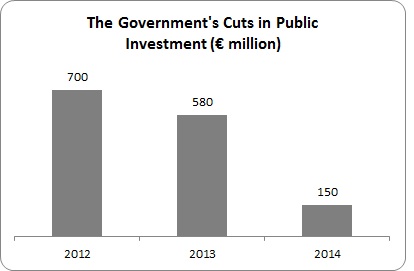
First, the Government intends to continue cutting public investment.
Kenny 2

The Government cut public investment by three-quarters of a billion Euros last year.  This reduced employment by approximately 7,000 direct jobs (and more when demand is factored in).  Next year they’re going to cut over a half-billion of Euros more from investment and even in 2014, they’ll be hitting it again. In total, that another 7,000 direct jobs cut from the economy over the next two years.

Over the period of 2011 to 2015, the Government intends to cut investment in real terms (after inflation) by 32 percent.  The Taoiseach welcomes ‘talk’ about investment – but at the same time his Government is gutting its own investment budget.  I leave you to find the word to describe that.

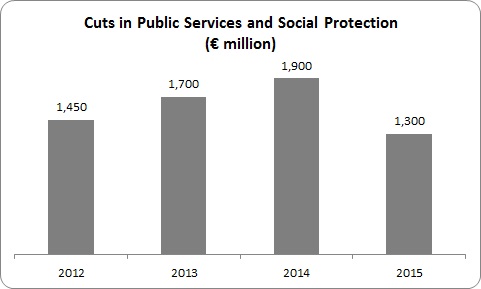
Turning to current expenditure, we find even higher levels of austerity being planned.  Please note – there are primarily only two categories of current expenditure:  public services and social protection (there’s also interest payments but there’s not much the Government can do about that short of debt restructuring).  What has the Government in store for us?
  Kenny 1

 In 2012, the Government cut €1,450 million from the current budget.  They intend to increase these cuts in 2013 and increase them yet again in 2014.  Even in 2015 the Government will be cutting.

This will have a major impact on the economy.  The ESRI found that for every 1 job lost in the public sector, the Live Register rose by 1 in the short-term (with the hope that emigration would reduce that impact in subsequent years).  Cuts in private sector procurement contracts could put more pressure on indigenous enterprise and their employees.  Cuts in social protection could feed into rising levels of inequality and reduce demand in the domestic economy. 

Using the Government’s own estimates, the cuts in public investment, current expenditure and tax increases will reduce GDP by over €6 billion by 2015.  Given that GDP is expected to grow by only €22 billion, that’s a big hunk.

So let’s recap:  the Government welcomes French ‘talk’ of investment and growth.  That’s because they, too, are ‘talking’ investment and growth.  Meanwhile, despite all this chatter, the government intends to cut public investment by 1/3 while cutting expenditure on public services and social protection by over €6 up to 2015, resulting in a considerable loss of growth and employment creation.

That doesn’t sound like an investment and growth strategy.  But maybe something got lost in translation.

3 responses to “Fiscal Treaty Files: Lost in Translation”

  1. Rita Cahill Avatar
    Rita Cahill

    The Government will Fail to get A yes Vote on this Referendum, It is Not a Fair Fiscal Treaty, with no growth or Tax on Bailout Borrowing, it wud put Ireland into very traumatic Diffuculty, or maybe Bust, Mark my Words just before the Treaty, This Government Plans on A Trick Fraud, Game to be Set in Motion to try and force upon us a yes Vote, Enda Kenny has planned on telling the media a few days before the Referendum Vote, the charts will fall on a dilebrate, to force us into a yes vote, wait and see the stunt Game that is planted on the irish people, if this happens then it is all a flawed deficit, i read about Angela Merkel and Endas plan a while back, if enda was uncertain of a yes vote, angela merkel said she wud set a plan in motion to sell a yes vote in Ireland, but we all must say no to this treaty, for the good future of Ireland, this is just a tricker treat to have full control over Ireland, we will not get a look in or a say. The future is for the Good of our Future and Our Childrens Future. no fiscal tricker treat.

    Like

  2. Nessa Childers Avatar
    Nessa Childers

    It seems we are not going to say No. But at a terrible cost to Labour, in particular . Many yes voters are angry with the Government.
    The Red C poll of 1000 voters around the country found that
    53% of voters say they’ll vote Yes – an increase of six points the last poll a fortnight ago. 31% say they will vote no, down four points, while 16% are undecided, down two points.
    When the undecided are excluded, the yes side leads by 63% to 37% with just under three weeks to go until voting.
    In terms of party support, the poll showed that Fine Gael has dropped three points to 29%, while coalition partner Labour is down to 13%. Fianna Fáil is up two to 19%, while Sinn Féin is also up two to 21% – the party’s highest ever Red C rating. Independents and others are unchaged at 18%.

    Like

  3. Ciaran Avatar
    Ciaran

    It does seem likely that the ‘Yes’ side will prevail, as Nessa points out above. People seem to think one of two things (or both): (a) we’re going to get sweets from the EU for being good little children, and not those ungrateful Greeks (or French!) who insist on voting against politicians complicit in implementing austerity; (b) that we have to ‘balance our books’, even though we only ever ran a surplus in the history of the State because of a housing bubble: and most countries that run a surplus, tend to plunge into recession soon after (for example, Spain and, er, Ireland….). We have to move away from the notion that public money is supposed to be budgeted for in the same way as money in a household. Public saving is private dis-saving, and vice versa.
    By the way, Michael, didn’t the Government actually end up cutting more than the promised amount in Budget 2012 (as set out in one of your blogs at the time of the last Budget)?

    Like

Leave a comment

Navigation

About

Commentary on Irish Political Economy by Michael Taft, researcher for SIPTU