
This was originally written for Progressive-Economy.ie
In Saturday’s Irish Times Stephen Collins wrote:
‘Far from outlawing Keynesian economics, what the treaty seeks to do is to put an end to the kind of populist and inept fiscal policies that brought Ireland to the brink of ruin. The treaty on its own won’t achieve that objective but it should at least make it more difficult for politicians to behave irresponsibly in the future – and that can only be a good thing.’
Eoin O'Broin has already pointed out the many flaws in Collins’ piece. Here I just want to examine one point – namely, whether the Fiscal Compact would have either ended ‘populist and inept fiscal policies’ or ‘make it more difficult’ to pursue such policies; and to do so from the EU Commission’s perspective.
Collins is no doubt referring to the structural deficit rule whereby, regardless of a Government’s General Deficit, it must maintain a structural deficit of -0.5 percent or less (-1 percent for countries with a general debt of 60 percent or less). There is also an assumption that the Government’s fiscal policy during the speculative boom period, while in compliance with the Maastricht guidelines, was running structural deficits. If so, this would have inevitably led to a mismatch between revenue and expenditure, as the former would have been bloated by the property bubble.
Therefore, Collins assumes that had the Fiscal Treaty been in place during that period, it would have first, exposed this structural defect and, secondly, required the Government to repair it.
All of this is mistaken – at least according to the EU Commission (see Note at end of post).
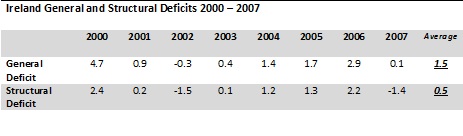
According to the EU Commission, Irish Governments ran, on average, both general and structural surpluses, not deficits. The above estimates come from the latest EU Commission forecasts – not the ones made prior to the recession.
Had the Fiscal Treaty been in place during that period, Ireland would have been allowed a structural deficit of -1 percent since we had a general debt of less than 60 percent of GDP. But only twice during the 8-year period did Irish budgets run afoul of the structural deficit rule – and in 2003 it was quickly transformed into a surplus.
So according to the EU Commission Ireland’s fiscal performance during the period up to the recession was fiscally responsible. Had the Fiscal Treaty been in situ it would have made no difference whatsoever to Irish budgetary policy. Indeed, the ‘inept fiscal policies’ that brought us to ruin would have been vindicated by the Fiscal Treaty.
This should, of course, lead to questions as to how one can trust this type of formulation since the EU Commission completely missed the speculative bubble in the Irish economy. And it was a big bubble to miss. Even years after the fact the EU Commission insists that Irish budgets were fundamentally sound and the economy was performing normally.
Collins could have brought this easily accessible information to his readers’ attention and pointed out, whether one supports or opposes the Treaty, that these measurements are suspect, to put it mildly. He could have also brought to his readers’ attention the Government’s own verdict on the EU Commission’s methodology for calculating the structural deficit – namely that it is ‘highly uncertain’ and ‘unrealistic’. He didn’t.
Instead, he made an assertion that is wholly unsupported by the evidence.
Unfortunately, we are likely to get a lot of that during the debate. Therefore, it is imperative when such unfounded assertions are made in the debate, they are quickly challenged.
On this score, we can only hope that the statement that the Fiscal Treaty would have prevented or modified the budgetary policies prior to the recession is never repeated again.
NOTE: 2001 and 2002 structural deficit estimates come from the Spring 2010 EU Commission estimates as they were not available in the current estimate.
In Saturday’s Irish Times Stephen Collins wrote:
‘Far from outlawing Keynesian economics, what the treaty seeks to do is to put an end to the kind of populist and inept fiscal policies that brought Ireland to the brink of ruin. The treaty on its own won’t achieve that objective but it should at least make it more difficult for politicians to behave irresponsibly in the future – and that can only be a good thing.’
Eoin O'Broin has already pointed out the many flaws in Collins’ piece. Here I just want to examine one point – namely, whether the Fiscal Compact would have either ended ‘populist and inept fiscal policies’ or ‘make it more difficult’ to pursue such policies; and to do so from the EU Commission’s perspective.
Collins is no doubt referring to the structural deficit rule whereby, regardless of a Government’s General Deficit, it must maintain a structural deficit of -0.5 percent or less (-1 percent for countries with a general debt of 60 percent or less). There is also an assumption that the Government’s fiscal policy during the speculative boom period, while in compliance with the Maastricht guidelines, was running structural deficits. If so, this would have inevitably led to a mismatch between revenue and expenditure, as the former would have been bloated by the property bubble.
Therefore, Collins assumes that had the Fiscal Treaty been in place during that period, it would have first, exposed this structural defect and, secondly, required the Government to repair it.
All of this is mistaken – at least according to the EU Commission (see Note at end of post).
|
Ireland General and Structural Deficits 2000 – 2007
|
|||||||||
|
2000 |
2001 |
2002 |
2003 |
2004 |
2005 |
2006 |
2007 |
Average |
|
|
General Deficit |
4.7 |
0.9 |
-0.3 |
0.4 |
1.4 |
1.7 |
2.9 |
0.1 |
1.5 |
|
Structural Deficit |
2.4 |
0.2 |
1.5 |
0.1 |
1.2 |
1.3 |
2.2 |
-1.4 |
0.5 |
According to the EU Commission, Irish Governments ran, on average, both general and structural surpluses, not deficits. The above estimates come from the latest EU Commission forecasts – not the ones made prior to the recession.
Had the Fiscal Treaty been in place during that period, Ireland would have been allowed a structural deficit of -1 percent since we had a general debt of less than 60 percent of GDP. But only twice during the 8-year period did Irish budgets run afoul of the structural deficit rule – and in 2003 it was quickly transformed into a surplus.
So according to the EU Commission Ireland’s fiscal performance during the period up to the recession was fiscally responsible. Had the Fiscal Treaty been in situ it would have made no difference whatsoever to Irish budgetary policy. Indeed, the ‘inept fiscal policies’ that brought us to ruin would have been vindicated by the Fiscal Treaty.
This should, of course, lead to questions as to how one can trust this type of formulation since the EU Commission completely missed the speculative bubble in the Irish economy. And it was a big bubble to miss. Even years after the fact the EU Commission insists that Irish budgets were fundamentally sound and the economy was performing normally.
Collins could have brought this easily accessible information to his readers’ attention and pointed out, whether one supports or opposes the Treaty, that these measurements are suspect, to put it mildly. He could have also brought to his readers’ attention the Government’s own verdict on the EU Commission’s methodology for calculating the structural deficit – namely that it is ‘highly uncertain’ and ‘unrealistic’. He didn’t.
Instead, he made an assertion that is wholly unsupported by the evidence.
Unfortunately, we are likely to get a lot of that during the debate. Therefore, it is imperative when such unfounded assertions are made in the debate, they are quickly challenged.
On this score, we can only hope that the statement that the Fiscal Treaty would have prevented or modified the budgetary policies prior to the recession is never repeated again.
NOTE: 2001 and 2002 structural deficit estimates come from the Spring 2010 EU Commission estimates as they were not available in the current estimate.


 Notes on the Front
Leave a reply to Rita Cahill Cancel reply