
There may be all sorts of reasons to cut public services, but reducing the fiscal deficit is not one of them. I repeat: we can cut the number of public sector employees – but it will have only a trivial effect on the fiscal deficit. It will, however, do considerable damage to the economy.
In the last post, we saw that expenditure on the public services was already, by European norms, woefully under-funded. By 2015, after further cuts, we will fall behind even further.
Cutting public services, however, is premised on repairing public finances, not on improving and expanding those services (or even maintaining them). Yes, it’s tough, but we have no choice – we have to bring our deficit under control; so goes the austerity argument. Here it will be argued that cutting public services in pursuit of fiscal reduction is not a tough decision, it is a wrong one.
Let’s start with a common sense observation. The CSO has estimated that in the last year (up to 1st quarter 2010), the private sector lost 48,000 jobs. This is pretty devastating – loss of output, loss of tax revenue, higher unemployment costs; and that’s before we count the social cost to those made jobless.
Next, the largest employer in the state sheds a further 3,000 jobs on top of that – adding to the loss of output and tax revenue, while increasing unemployment costs. That certainly is not going to come to any economic good. But that’s what the government has done with its own workforce – and intends to keep doing over the next few years.
At a common sense level, it doesn’t make any economic sense to add to employment loss but that is what is happening under the guise of ‘public sector reform’. And because it doesn’t make economic sense, it doesn’t make fiscal sense.
The ESRI has measured the impact of fiscal measures. One measure they looked at was cutting 17,000 jobs from the public sector, equivalent to a €1 billion reduction in public spending. They found it to be one of the worst things a Government could do. It degrades the economy and saves the Exchequer very little. Why is this? Let’s go through some of their findings, using the Government’s programme of reducing public sector employment by 23,500 by 2015.
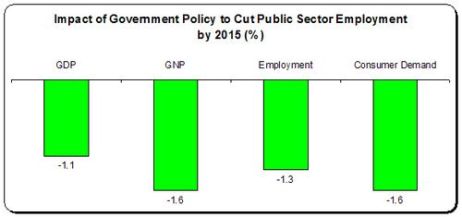
The main categories all turn south. And don’t let the small percentages fool you. For instance:
- A fall of employment of -1.3 percent will mean nearly 25,000 fewer jobs in the economy by 2015.
- A fall of -1.6 percent of consumer spending will mean €1.5 billion less spending – less turnover for businesses up and down the country.
- A fall of -1.6 in GNP means the economy will be generating €2.5 billion less – a significant cut for an economy that is coming out of one of the worst recessions in the EU.
So, with fewer jobs, less spending, less economic activity we will have less tax revenue and more public spending on unemployment. So here is the real killer – when the ESRI factors all this in, the impact on the fiscal deficit is almost non-existent.
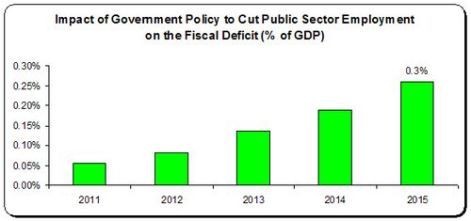
By 2015, after cutting public sector employment by 23,500 (or about 7 percent of the workforce), the Government will reduce the deficit by 0.3 percent. That’s all. 0.3 percent.
The Government is attempting to reduce the deficit to -3 percent by 2015 from its current level of approximately -12 percent. So they want to cut the deficit by 9 percent over the next four years. Cutting public sector employment will only make a contribution to that goal of 1/3 of one percent. 9 percent and 0.3 percent – it’s not much of a contribution; not much at all.
This is what happens when you employ a policy that cuts employment, consumer demand and domestic economic activity. We have made little dent in the deficit but we have further damaged the economy's ability to generate the growth and revenue to actually overcome the deficit.
So what do we have so far?
First, Irish public services are woefully under-funded already, in comparison with EU norms. The Government’s austerity programme will only make that worse.
Second, reducing public sector employment (the main component of public service spending) will have little effect on the fiscal deficit but will continue to harm economic recovery.
In my next post, I will look at an alternative approach to public sector reform and repairing public finances. There has to be a better way than slamming under-resourced public services with little effect on the deficit but with considerable damage to the economy.


 Notes on the Front
Leave a reply to Moncler Rockar Cancel reply