
The Croke Park Agreement’s first annual report found considerable ‘savings’ in expenditure on public services: €289 million was saved on the pay bill due mainly to 5,000 less jobs while a further €308 million was saved in non-pay costs. Even so, Ministers are warning that they will need more, much more. In fact, we’re going to get four more years of Croke Park cuts ‘savings’. If the Agreement is any more successful we will end up with a third-tier, under-funded, anaemic public service.
In this first of three posts on public services, I want to look at spending on public services relative to other EU-15 countries. Spending on public services is made up two elements: (a) employment of public sector workers, and (b) contracts to the private sector for goods and services. The latter is referred to as ‘non-pay’ costs.
This spending does not include social welfare payments (pensions, Child Benefit, maternity benefit, invalidity and unemployment costs, etc.), capital investment or interest payments. It is only concerned with the services the state provides to its citizens – health, education, policing, water and refuse, arts/ recreation, etc. It is the largest component of public spending – over 40 percent of total government expenditure.
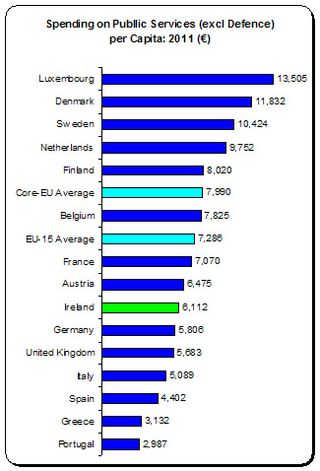 According to the EU Commission, Ireland lags behind most other EU-countries in terms of spending on pubic services per capita (to accommodate the sceptics, I have excluded defence spending). We rank 9th in the EU-15 table, just slightly above the UK and Germany and well behind the average of other EU-15 countries.
When we compare ourselves to the average of core EU countries (that is, those not in a bail-out – Portugal, Greece and Ireland), we sink even further.
- If we wanted to reach the EU-15 average, we’d have to increase spending on public services by 19 percent – or €5.3 billion.
- If we wanted to reach the average of EU countries not in bail-out, we’d have to increase spending on public services by 31 percent – or €8.4 billion.
Increase spending on public services by €5 to €8 billion just to reach EU norms? There is a fundamental failure to appreciate just how under-funded Irish public services are, relative to other EU countries. The obsession with ‘cutting waste’ overlooks the fact that Irish public services are already one of the least-funded services in Europe.
And the gap is growing (the following doesn’t exclude defence spending but as can be seen, the difference is not as much as some commentators maintain). In 2010 – when the cuts started to set in – Irish spending per capita already trailed the EU averages by a considerable amount: -25 percent below the Core countries and -15 percent below the EU-15 average. By 2012, the EU Commission projects this gap will widen to -25 percent and -37 percent respectively.
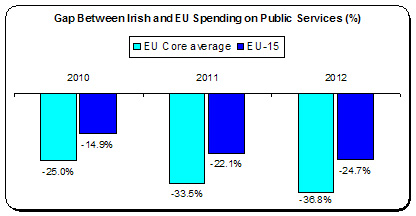
The Government seems determined to continue these cuts. Between 2011 and 2015, the government intends to reduce public service expenditure per capita by 14 percent. If they persist in this, we could find Irish public service spending falling behind by up to 40 percent of EU averages.
Now, there are those who will argue that through ‘getting more for less’ and taking the ‘tough decisions’ we can have European level of services on the cheap – up to 40 percent cheaper. Maybe (hmmm).
Or maybe these people are just using the recession crisis to downsize the public sector out of ideological conviction rather than empirical reasoning. Service quality? Living standards? Access to health and education? These are incidental to the austerity mindset.
Its cut, cut, cut; that’s the ticket. The Croke Party Agreement, Fianna Fail's brainchild, is premised – not on productivity gains, service quality or expanding the range of services to boost living standards – but on cuts in employment and private sector contracts.
If it is any more 'successful' one can only guess at what kind of public service we will have in a few years.
Next post: why cutting public service expenditure will have no impact on the fiscal deficit.


 Notes on the Front
Leave a reply to WorldbyStorm Cancel reply