
A rainy Sunday morning; it brings many thoughts – of outdoor activities cancelled, indoor DIY projects advanced, no football and letting Garibaldy go through the Sunday Independent so that we don’t have to suffer that fate (save for Gene Kerrigan who should always be read in print or on-line).
It also brings to mind the misrepresentations and distortions advanced by employers’ groups and allied commentators – how Sunday is just another working day, how Sunday premium is a relic of a bygone era.
Is Sunday ‘just another working day’? Not according to the latest EU survey.
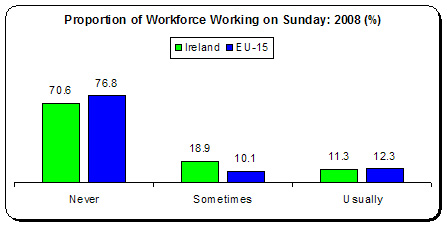
The overwhelming majority (71 percent) of workers ‘never’ work on Sunday, while only 11 percent ‘usually’ work on Sunday. This hardly makes Sunday ‘just another working day’. But we know that, despite claims to the contrary – in the manufacturing, business, most public services – offices and factories up and down the country there is no work done.
But if Irish Sunday working, or non-working, is broadly in line with EU norms, there is one category that is out of kilter – youth workers between the ages of 15 and 19. This is notable. Young workers in this age cohort are likely to work in lower-skilled service sectors (e.g. not likely to work in essential public services, communication, transport, etc.).
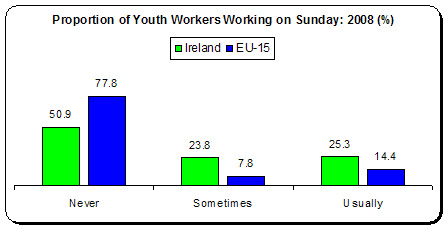
This concentration of youth workers undermines unsubstantiated assertions by employers that Sunday premium results in hourly pay of €20 or more. Youth workers are paid substantially less than the adult basic rate.
Wages for youth and new employees over 18 years are substantially below the basic adult rate (many do no appreciate that in some JLC sectors workers have to work up to two to three years before reaching the basic rate). Even with Sunday premium, wages are below the basic rate that applies throughout the rest of the week.

So much for the employers’ claim that opening on Sunday is too expensive, especially when they claim that Sunday is their ‘busiest’ day.
And what does the Minister want? Among his proposals he wants to remove the ability of Joint Labour Committees to negotiate youth and entry wages. If he succeeds, there is every chance that under-18 wages will fall to the minimum wage floor of €6.06 per hour – a 7 percent cut.
And if he succeeds in removing Sunday premium from JLC negotiation, what chances of young workers getting a time-and-a-third on Sunday in those workplaces without trade union membership (which is most of them – in the Hospitality sector only 6 percent of workers are in trade unions)?
Sunday used to be a day of rest. For most of us it still is, thankfully. However, if the Minister gets his way, Sunday will become a day of ultra-low wages and exploitation.
Sunday will have been Brutonised.


Leave a Reply