
I was never a fan of social partnership. It was based on a flawed economic premise – limiting wage increases in return for income tax cuts; it was hardly a partnership (employers had the legal right to refuse to bargain with workers’ collectively); and it wasn’t terribly social (the social wage never featured – universal health care, universal pensions). It’s gone and its time to move on.
But now we find that ‘social partnership’ ruined the nation. Not reckless bank lending; not the near absence of regulation, not the asset bubble – no, it was ‘social partnership’. How do we know this? Because a lot of commentators – including the Minister for Finance – say so. And they keep saying it. QED.
And the principle agent behind this ruination is, of course, public sector pay. It grew like monsters that stalked the land, ate up all our wheat, and now we are hungry.
Well, at the risk of being denounced as a tool of vested interests, an apologist for a process that I didn’t even support, I thought I’d look up some numbers and measure the length and width of those voracious, public sector-pay monsters.
I take the period 1998 – 2007; I use this period because it is consistent with the CSO’s old series on pay (before they started the transition to the new Earnings and Labour Cost series which makes historical comparisons a bit tricky). In any event, if the monsters were alive, they were really partying during this period – especially as this includes that most ruinous event of all: the 2000 benchmarking.
What do we find?
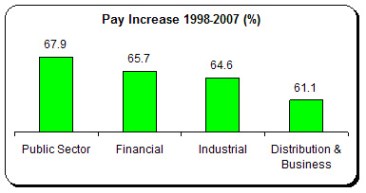 Yes, public sector pay did rise faster than other sectors – but only minimally. If public sector pay only rose at the same rate as the industrial sector – the difference comes down to €2.06 per week every year.
Let’s look at another measurement – our old friend, the EU Klems. This measures labour costs – the cost of hiring labour per hour. What does this have to say? Labour costs between 1998 and 2007 increased by the following amount:
- Public Administration: €7.33 per hour
- Manufacturing: €9.91
- Total Economy: €10.72
So the cost of hiring labour increased in the non-traded public administration sector (which makes up approximately one-third of the public sector workforce) by a lesser amount than the cost in one of the most traded of all sectors – manufacturing; never mind the total economy.
Of course, this only speaks to wage levels and labour costs. However, when there are so many unsupported assertions and downright manipulations being thrown about the place, it’s nice to restart the conversation with something factual.
I have seen the monsters stalking the land, gobbling up our wheat and leaving us broke. But they aren’t nurses and porters, teachers and clerical staff, soldiers and Gardai, ambulance drivers and street cleaners. Nor are they bank clerks, factory-floor workers, electricians, secretaries, retail workers and barpersons, researchers and lorry drivers.
They are not the men and women who are producing the real economic and social wealth in this society.
They are Fianna Fail.


 Notes on the Front
Leave a reply to Niall Cancel reply