
 Pretty grim. Back in March and April we got a lot of commentary – about how the unemployment was stabilising, how we’re starting to turn the corner, how the dismal asphalt of recession is cracking – letting green shoots of recovery to appear. Yes, unemployment remained constant at 13 percent for the two months March and April – down from a peak of 13.3 percent in November last year. But then the great ship Irish Economy started turning south. Unemployment creeped up in June, then July. Now the CSO has released the August figures and, well, they’re grim, now standing at 13.7 percent.
A number of commentators have focused on the changing composition of those made unemployed in the last month. While previously it was craft, production and retail workers who took the disproportionate hit, in July there was a substantial rise among professional and clerical/secretarial occupations. In the first six months of this year unemployment in these two combined categories rose by 4,727. In July alone more than 7,800 in these two occupational categories lost their jobs. And women made up 85 percent of that job loss.
Why is this happening? One explanation is that a number of companies tried to hold on as long as possible to skilled workers – until they could no longer hold on. The moratorium in the public sector could be another contributing factor. In any event, none of this should be too surprising. FGS predicted that insolvencies would continue to rise in 2010 – spilling out beyond construction and retail, and beyond Dublin. The Insolvency Journal.ie’s recent survey showed this trend continuing.
If all this is grim, here’s something grimmer: the jobs recession, even in the best case scenario, will continue until 2020. In reality it will probably last longer. In the ESRI’s high-growth scenario, employment won’t return to pre-recession levels until 2020. In their low-growth scenario (which, in comparison with other forecasts, is more of a medium-growth scenario) it could be as long as 2024.
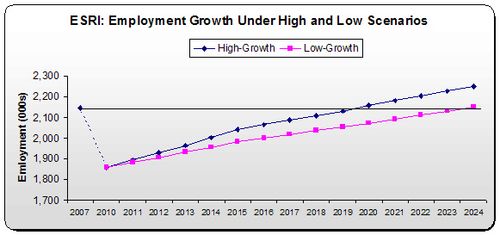
So settle in, ladies and gentlemen – it’s going to be a long decade.


 Notes on the Front
Leave a reply to Conor McCabe Cancel reply