
 Remember a few months ago, when ICTU proposed postponing the target year for Maastricht compliance to 2017? There was a widespread rending of garments and universal condemnation of this most irresponsible and reckless proposition. I recall an interview with our erstwhile Minister O’Dea who went apoplectic at the idea predicting economic Armageddon and the wrath of the Furies (I stepped away from the radio in case he exploded and I got hit by his bodily shrapnel).
Oh, and now the IMF. In their recent report they projected, under current fiscal policy, when the deficit would come into Maastricht compliance. What year? 2016 or 2017. This didn’t get much prominence. I read the newspapers this morning and not one mention (if I’m mistaken, please let me know). Still, when this becomes known, I wonder what the response will be. Condemnation of the IMF? Exhortations to cut even more (Dan O’Brien wants us to have a go at pensioners)? An apology to ICTU? Guess which response is the most likely.
The IMF’s projection shouldn’t surprise us. A few weeks ago, Ernst & Young / Oxford Economics examined the issue and, on current strategy, projected the deficit wouldn’t come into Maastricht compliance until 2018 or 2019. Indeed, I have not met any economist – regardless of their ideological complexion – who, hand on heart, believes that 2014 is a realistic goal.
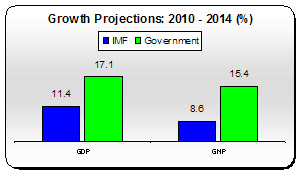 One merely has to compare Government and IMF growth projections up to 2015 to understand why 2014 is merely aspirational. IMF estimates growth to be substantially less than what the Government is predicting; in particular, the IMF suggests that GNP growth, or domestic activity, will be nearly half what the Government expects. With limited growth comes lower tax revenue and higher unemployment expenditure: hence, a consistently larger deficit.
Why would growth be so understated? The ESRI is ready with an answer (from the full commentary, not yet available on-line).
‘The impact on the wider economy [of the Government’s planned €3 billion fiscal adjustment] is to reduce the growth rate by approximately one percentage point. In addition, the level of employment is lower and emigration flows higher than in the absence of such a package. These are real costs attached to the programme of fiscal consolidation being pursued by the government.’
Of course, the ESRI feels we should proceed with the deflationary fiscal adjustment regardless. Why? Because we have to reduce the deficit. But is it reducing the deficit? Not really; it is resulting in sluggishly high deficits and higher overall debt levels. But we have to cut the deficit . . . and so we are trapped in a vicious circular argument.
So if we proceed with deflationary spending cuts to cut the deficit we will reduce growth which will, in turn, create higher than anticipated deficits. How can we escape this deflationary-deficit trap?
The first step, in any agenda, is to establish a starting point grounded in the real world. Therefore, it is imperative that we scrap any notion that we can, or should, strive to reach Maastricht compliance by 2014. We should abandon any strategies that are premised on bringing the deficit to below -3 percent by that date. A credible strategy cannot, by definition, have a fantasy as an endpoint. And if that bothers some of you budget fundamentalists, get over it.
And while we’re scrapping the fantasy 2014 target date, let’s remember what the real key to repairing the public finances is: as Clinton might have said, ‘It’s the growth, stupid’.

 Notes on the Front
Leave a reply to bigred Cancel reply