
Notes on the Front

Commentary on Irish Political Economy by Michael Taft, researcher for SIPTU

Revisitng Headlines – Public Sector Labour Costs. The Recession Diaries – March 2nd

Recession 229 With industrial action in the public sector ramping up a couple of notches, it is worth revisiting a couple of issues in relation to pay. A critical issue is the fiscal benefit or otherwise that accrues to the Exchequer from cutting public sector wages – I will examine this in the next post. Here, let’s take a look at another issue – a comparison of public sector labour costs throughout Europe.

During the last year and a half it has often been asserted that we have, in European terms, a highly paid public sector workforce. My favourite headline comes from the Sligo Champion which, not satisfied with parochial European comparisons, declared:

'We have the highest paid public servants in the World'

Quite a claim – especially when there is no data to back this up.

One of the problems in comparing public sector wages internationally is that there is no internationally agreed definition of ‘public sector’ employee. For instance, in Ireland are ESB workers ‘public sector’? They’re not private sector as the company is publicly owned. However, they don’t fall into the category of ‘General Government Employee’ nor are they paid out of the Exchequer pay and pension budget. Defining these ‘public enterprise’ workers is one of the complications international agencies face when defining ‘public sector’ or ‘Government employees, especially when different countries have widely varying organisational practices.

However, the EU Klems database compiles comprehensive data on total labour costs and total hours worked by various economic sectors. Some of these can be directly related to the public sector – in particular NACE L: Public Administration & Defence. Throughout Europe, including Ireland, it is likely that all employees in this category will be public sector workers (unlike NACE N: Health & Social Work where, in Ireland, only about 55 percent of all employees are in the public sector).

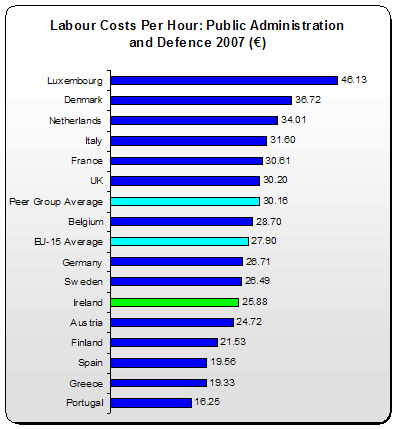
So what do we find when we compare labour costs (wages plus employers’ payroll contributions) in the public administration sector which, in Ireland, makes up approximately 100,000 employees?
Public Sector Workers

  • Irish labour costs rank 10th out of the EU-15
  • Irish labour costs per hour are €2.02 below the EU-15 average – or 7.2 percent
  • When compared with our peer group in the EU-15 (excluding the poorer Mediterranean countries), Irish labour costs per hour are €4.28 per hour below average – or 14.2 percent.

The Sligo Champion might want to revisit their headline.

Of course, this is before both the pension levy (which wouldn’t show up as a pay cut in these tables) and the Budget 2010 pay cuts (which would). So there is a reasonable chance that Irish public sector labour costs will have fallen further behind European averages. (I won’t even go into PPPs, factoring in living standards; Irish public sector wages would fall even further behind European averages).

This data might be surprising for those who give the headlines the benefit of the doubt. But it shouldn’t be. As has been continuously pointed out, Ireland is a relatively low-waged economy – both private and private.
No doubt, the counter-argument will be, ‘Regardless of comparisons, we have to cut public sector wages because of the fiscal crisis we are in’. We will deal with that issue in the next post.

But let’s at least start setting the record straight – a record that has been distorted by unsubstantiated assertions… Irish public sector labour costs are not high, the men and women who have been subjected to an average 14 percent pay cut over the last year, are not by comparison expensive to employ.
If anything, by European terms, we are getting a good deal.

Too bad public sector workers – who offer a considerable amount for relatively low cost – aren’t getting the same deal.

11 responses to “Revisitng Headlines – Public Sector Labour Costs. The Recession Diaries – March 2nd”

  1. David Higgins Avatar

    These figures are what it costs the government to employ people, not what the workers receive. These figures are convincing but is it not possible that we just have really low “employers’ payroll contributions”? Also we have a relatively low tax burden when compared to other EU countries like France. On the other hand, cost of living is high here. Until all these other things are taken into account I refuse to be swayed by these figures, or any other set of numbers that only tells one side of the story.
    Also, even if it is relatively cheap to employ people, we have a huge deficit!!

    Like

  2. Mack Avatar

    David, Michael –
    These figures are convincing but is it not possible that we just have really low “employers’ payroll contributions”?

    That is exactly what it is. You can see that on private sector comparisons as well – where Ireland will fall down the league tables from the position the held on wages alone, once employer taxes are factored in.

    Public sector workers have made great sacrifices for the good of the country over the last two years, but it’s difficult to take arguments that wages weren’t or aren’t high seriously. Pay cuts are demoralising and I’d hope that other ways can be found to manage costs.
    Michael – do you know what the average starting annual income for a graduate in Ireland is? I know in my field – software engineering it was €27,000 two years ago, and has fallen since (& the field of software engineering would have the highest start salary for comp sci graduates). I read somewhere it was around €24,000, does that sound right?
    Any idea how much graduate teachers, nurses are guards earn in their first year once all allowances are calculated? Again I read somewhere that you are looking at around an income over €35k (at least before the cuts kicked in).
    It’s difficult to get a job for in those fields today – I’ve friends and family applying fruitlessly for whatever morsels there are. Lower salaries and more jobs would be better.
    Incidentally – could the salary scales not be reworked. Each year add a new level at the bottom of the scale at a lower salary than the current bottom level. That way current workers would be unaffected, but hiring graduates would be more affordable…

    Like

  3. Paddy Matthews Avatar
    Paddy Matthews

    @Mack:
    Lower salaries and more jobs would be better.
    We are already seeing one of those things. I see no sign of the second following on from the first.
    Each year add a new level at the bottom of the scale at a lower salary than the current bottom level. That way current workers would be unaffected, but hiring graduates would be more affordable…
    What’s to stop existing temporary staff (and most younger teachers are temporary, AFAIK) being let go and rehired at the new ever-decreasing bottom level to save money?

    Like

  4. Mack Avatar

    @Paddy –
    “What’s to stop existing temporary staff (and most younger teachers are temporary, AFAIK) being let go and rehired at the new ever-decreasing bottom level to save money?”
    Any experience should count towards experience and thus level on the pay scale (that is generally the case in the private sector). A graduate teacher temping this year will have 1 year experience next year and would stay on the same salary by moving up and avoiding the newly inserted bottom pay scale level.
    One problem might be that some schools might decide to hire a cheaper grad instead and let the existing worker go. That’s why I’d do it slowly – 1 pay grade per year. So the saving isn’t so great that youth would always be favoured over experience.
    “We are already seeing one of those things. I see no sign of the second following on from the first.”
    Yes I agree, I think the proposed Franco-German Greek bail-out and it’s terms pretty much solidifies the austerity approach – if as we remain in the Euro.
    We might see better alternatives in future if those opposed to austerity full-stop worked to produce better and fairer alternatives within that framework (i.e. cut-backs are inevitable, but we could ensure that we’re making fair structural changes, continuing to invest and maintain service levels as best possible). It may not be possible, but I can’t see this government changing course, and a FG-Lab alternative would come under the same pressure from Europe as the Greeks and would ultimately follow be forced to follow austerity path (in my opinion anyway)…

    Like

  5. Padraic Avatar
    Padraic

    So what are the costs that make up the rest of the employers payroll contribution apart from the hourly / annual rate received by the employee?
    Is there a camparison anywhere of what these are accross the different EU countries?

    Like

  6. Mack Avatar

    @Padraic see pages 3 & 4 in this report – comparing private sector wages, but it gives an idea of employer social security taxes (Sweden, Germany, France, Belgium, Italy all have significantly higher employer taxes).
    http://www.finfacts.ie/biz10/Rumuneration2008.pdf
    @Michael is there any reason why you picked Public Administration and Defence Labour costs?
    Would NATO countries be paying soldiers in Afghanistan extra amounts on top of their base salary (danger money / combat pay?) ?

    Like

  7. Michael Taft Avatar

    The first thing that should be remembered regarding employers social security contributions (ESSC) is that it is rightly regarded by the EU, OECD and Irish data collectors as a benefit-in-kind or more colloquially, the ‘social wage’. The ESSC purchases for the worker a range of benefits – free/low cost GP care and prescription medicine; earnings-related pensions, unemployment sickness benefits, etc.; nursing home care and so forth. When excluding ESSC from the calculations we should always remember that we are excluding part of the workers’ wage.
    Nonetheless, let’s extract the ESSC from the wage and see what we get. In Ireland, there is a basic 10.7%. In Luxembourg, Netherlands and the UK the ESSC is similar (13.2%, 12.3% and 12.8% respectively) so the wage relationship won’t change much. In Denmark, there is no employers’ contribution as such since they don’t have a social insurance system. So in these countries there’s no qualitative change after employers’ contributions. Direct wages are substantially higher than here.
    In Germany, the employers’ rate is 19.5% for wages under €43,200, 11.6% between €43,200 and €63,600, and nothing above that. The maximum employers’ payment is €10,976. Without knowing the distribution of public sector wages its difficult to average this out for all employees. But this suggests that at the average end, wages are similar.
    In France, the ESSC is approximately 40% on most workers (its lower at the upper end – 27% and 23% above €100,000 thresholds). Take away employers contribution at the lower end, and the wages are similar to Ireland. In Belgium the employers rate is 34%, take this away and the wage level is approximately €1 less. In Sweden and Finland, employers’ rate would reduce the direct wage level further, below Irish level.
    All in all, Irish wage – as opposed to labour costs – would remain somewhere in the middle. But there is one thing to take into account. If PPPs were used, Irish wages would fall further since our Euros are not worth as much as in other countries owing to our high living costs.
    Ultimately, labour costs measure two types of wages – a headline wage and a social wage. Strip out the social wage (that is, all the benefits that flow from the ESSC) and Ireland fares badly.
    Mack, you make an excellent point. Strip out the ‘defence’ element of NACE L and you’ll probably find (given that defence personnel are likely to make less than permanent civil servants) that the labour cost gap between Ireland and most other countries will widen. As to why I use NACE L – please re-read the post.
    David – the issue regarding the deficit is an important one. I will address this in a subsequent post. If it could be shown that cutting public sector wages will contribute economically and fiscally to resolving our budgetary crisis, there might be an argument for cutting them. However, they don’t make such a contribution.

    Like

  8. Mack Avatar

    Michael –
    “Mack, you make an excellent point. Strip out the ‘defence’ element of NACE L and you’ll probably find (given that defence personnel are likely to make less than permanent civil servants) that the labour cost gap between Ireland and most other countries will widen.”
    That’s true of Ireland – is it also true of the UK and France etc? where they more long serving high ranking officers, computer networks, spies & supporting infrastructure, larger ministry of defence etc. I googled average salary uk defence and found this –
    http://www.itjobswatch.co.uk/jobs/uk/modaf.do
    I don’t recall ever seeing a defence IT job advertised in Dublin or Ireland..

    Like

  9. Mack Avatar

    Michael –
    Digging a little deeper on that I don’t think the same pay structures pertain in the UK.
    For example on the CPSU site the lowest salary I could find was around €25,00 for a clerical officer and can earn up €41966 staying in that job role.
    http://www.cpsu.ie/images/NewsManager/CPSU_salary_scales_2016_insert.pdf
    This compares with a base annul salary in the defence forces for a new recruit of just €12,740
    http://www.military.ie/careers/pay/index.htm
    In the UK however, Administrative Assistants start on £13,110 and can reach the heady heights of £14,420 if they don’t get promoted. Administrative Officers start on £15,150 (max pay £17,780)
    http://www.csa.gov.uk/vacancies/pay-and-benefits.asp
    Here is an ad for a clerical officer in the NI assembly (Grade 9) £14,890 – £17,099
    http://www.brookstreet.co.uk/nia/Documents/CO_Job_Spec.pdf
    These are substantially below southern Irish rates.
    Soldiers in the British army start on £13,012.80 – roughly the same as an Administative assistant (not less than half as in Ireland). Privates and lance corporals (which I presume aren’t officers) can earn between £16,226.76 to £27,599.28, and officers up to £92,536.56.
    http://www.ehow.com/about_4674497_british-army-pay-scale.html
    The salaries in the army seem to be higher than administative roles in the UK and I imagine that civilian type jobs in the ministry of defence pay better again..

    Like

  10. Jane Simmons Avatar

    payroll contributions are only one part of the story and one must consider all the underlying governmental factors before being drawn into examining the results in my view.

    Like

  11. cheapurbanclothingoidhhzvdlxow Avatar

    i like this site ,i want to share to my friends cheap urban clothing

    Like

Leave a reply to Mack Cancel reply

Navigation

About

Commentary on Irish Political Economy by Michael Taft, researcher for SIPTU