
 175 Boston Scientific jobs to go in Galway, the loss of 200 Bitech Engineering jobs in Louth,a seismic 750 job lost at Halifax, those depressing numbers that Ronan Lyons has pulled up – what are we to make of the state of the labour market only a few weeks into the new year?
Hard to get a full sense from the Live Register as it doesn't tell us how many new people are signing-on each month. For instance, 100,000 new people may sign on in February and 50,000 may sign off – which means the Register increases by 50,000 people. However, if the number of people signing off is 150,000, the Register decreases by 50,000. No difference in the number of new people signing on, though; job losses are just as high.
People sign off for a variety of reasons: (a) they get a job (and there are still vacancies to fill and new jobs being created, even in a recession); (b) people going back to education or entering a training scheme; (c) going on to other social welfare scheme such as Lone Parents; (d) 'administrative reasons' which is code for running out your benefit but failing the means-test for assistance (this happens in two-job households where one partner becomes unemployed) (f) just give up looking for a job; and, of course, the big (f) emigration.
The CSO stopped publishing the inflows and outflows into the Live Register some years ago. The latest data we have is for September of last year from the the FAS Quarterly Labour Market Commentary. In that month, the number of new entrants increased by less than 10,000. But the outflow exceeded 25,000. So did unemployment increase? Yes, Did the Live Register, therefore, increase? No. It fell by 17,000 (unadjusted). On such basis do some commentators talk about 'unemployment stabilising'. Unemployment is not stabilising – its still rising. It's just that emigration and other facts are rising even faster.
There is another measurement that can tell us the level of job loss. The Department of Enterprise compiles the number of redundancy notices each month. To qualify for redundancy, an employee must have been fully insured and working with the employer for at least two years. So this doesn't capture all job losses in a month. But what does it tell us?
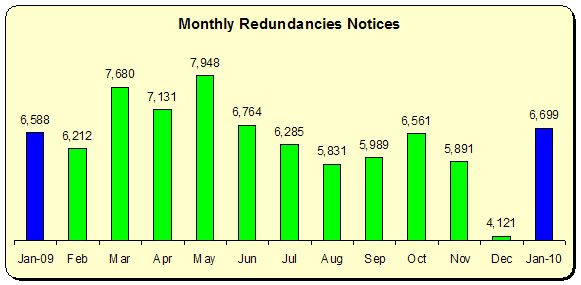
Redundancies increased substantially in January 2010. It was the highest since June 2009 and even higher than the previous January which saw the biggest rise in unemployment in over 20 years. Indeed, the January 2010 figure was higher than the monthly average for the entire last year – over 4 percent higher.
Of course, this is just one month. I doubt this level of redundancies and job losses will be sustained but I say this more out of hope than any prescience. But it could signal another long year where, as the IMF puts it, we have a statistical recovery but a human recession.
So, when I hear commentators saying we have 'turned the corner' I wonder if they're walking the same street as the rest of us.


 Notes on the Front
Leave a comment