
 First, the good news. The rise in unemployment is contracting. From a monthly high of 36,500 new people on the Live Register, the rise last month was a mere 4,300. Okay, still far too high but if unemployment is ever to be reversed it must first be slowed down. And slowing down it is. That’s the good news.
There is a problem, though, in all this. Namely, some of the numbers are missing. Let’s remember that the Live Register does not record unemployment per se. It records those signing on – which will also include part-time, short-time and casual workers, including those signing on for credit. So, while there are 440,000 signing on (not seasonally adjusted), the number of unemployed is, according to the Live Register is 12.4 percent – or probably between 255,000 and 260,000. I use the word ‘probably’ because we won’t get the actual Labour Force numbers for August until late this year so we can’t be sure the exact number this 12.4 percent represents.
And that’s the first problem we encounter. While the Live Register is published monthly, we don’t get the actual Labour Force numbers until months later. And this means that when we come up against the following set of figures we have to start interpreting (thanks to An Saoi for pointing me to these numbers).
The Department of Enterprise and Employment publishes redundancy notice figures each month. Briefly, you are entitled to redundancy if you have worked for the same employer continuously for at least two years. Therefore, the Department’s redundancy notice figures represent job losses for those in work for at least two years.
So, in January of this year, when the numbers on the Live Register went up by 36,500, the number of ‘actual’ redundancies was 6,601. Given that there might be some time-lag between actual redundancies and signing on, we can see that those with two years service plus made up 18 percent of the increase on the Live Register. Fair enough – the remainder may have been unemployed with less than two years service (e.g. young people), those short-timed, etc.
However, something curious is happening between the numbers increasing on the Live Register and actual redundancies.
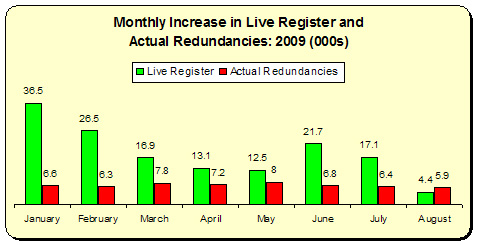
While monthly increases in the Live Register have fallen considerably since the beginning of the year, actual redundancies have remained fairly constant. So much so, that redundancies exceeded the increase in the Live Register in August. This might seem peculiar – the increase in the numbers signing-on are less than the number of those receiving redundancies.
Another problem we have is that we don’t know the inflows and outflows on the Live Register. It only gives us the net situation. For instance, in August the Register increased by 4,400. However, if 10,000 new people signed on, but 5,600 signed off – it would leave us with the balance of 4,400.
Why would someone sign off? First, they found a job (and, yes, there are jobs to be found). Second, they returned to education. Third, they left the workforce; this is likely to happen with young people and women in households where there is working income. Under means-test rules, they might not get any assistance but could still sign-on for credits. But these credits are largely for pension benefit and people may not feel it’s worth the trouble.
Or, people have started emigrating.
The problem is we can’t really tell at this stage and the numbers that would let us breakdown the problem won’t start arriving until much later. The Quarterly National Household Surveyprovides information on the size of the labour force and overall employment. The problem is that we only have data up to the end of March. However, this is what they tell us about the labour market. In the six month period between the 3rd quarter of 2008 and the 1st quarter of 2009:
- The labour force – which includes employed and unemployed – fell by over 78,00
- Employment fell by 141,500
- Unemployment increased by 63,400
The question is – what is happening to all these people. The labour force is shrinking and the participation rate (which includes employed and unemployed) is falling – from 64.2 percent to 62 percent in the six month period.
One can’t help but conclude that a large proportion is emigrating but we don’t know by how much. The CSO will be publishing migration figures later this month – but it will only take us up to April. Still, we it will give us some insight into trends.
A Department of Finance official told me some months ago that Ministers are praying for emigration. Emigration can solve a lot of problems. It can reduce social welfare costs, reduce demands on social services (e.g. health, education, housing, etc.). It can massage a whole load of figures. We may find that while the numbers of people signing on is increasing, the net figures will look better – because people are leaving, or dropping out of the Labour Force.
Based on the figures to date, it looks like the Ministers prayers are being answered.


 Notes on the Front
Leave a reply to Paul Cancel reply