
 Maybe it’s the Leveller in me, but when times are hard we should all put our shoulder to the wheel, share out the pain and protect the lesser able in our community. Listening to the great debate over wages you’d think that everyone was a Leveller. There is so much ‘share the pain’ going around you’re likely to keel over on your way to the local newsagent. But, as always, in this crazy, mixed-up world, there is ‘pain’, there’s ‘paaaiiinnn’ and then there’s no pain at all. Now, thanks to the CSO’s latest Earnings and Labour Cost Survey, we can measures these gradations of pain or otherwise.
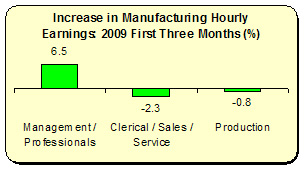 Our first stop is the manufacturing sector. We find that in the first three months this year basic hourly earnings increased by 2.7 percent. However, these gross figures don’t tell the full story. The CSO helpfully breaks down hourly earnings by strata. What do we find then?
Well, management and professional staff, who make up less than 25 percent of all employees in the manufacturing sector, took a substantial increase. All other employees took a hit: clerical workers who earn only on a little over €37,000 took a 2.3 percent reduction, while production workers, who make up 60 percent of all manufacturing employees and who earn a little over €31,000, suffered a reduction of nearly 1 percent.
Now, we shouldn't begrudge anyone a pay increase. If an enterprise can afford it, they should do it – good for the Exchequer, good for the economy, good for the employees. But what’s good for some should be good for all in something approximating equal measure.
However, what we seem to be witnessing here is not only that some – who just happen to be at upper end of the enterprise food-chain – get increases while most others don’t; the majority of workers will lesser incomes are subsidising the pay increases of those with more.
Truly, those who have, receiveth more. And those who have less get less, indeed – they get more taken away. So let me speculate – admittedly, without any data to justify this, just a gut feeling; that were the Management strata broken down we would find managers earning more than the professionals and associated professionals; and that their increases would be higher still.
 If there is pain to be had, it should be shared; and if there is some small benefit to be had in hard times, it should be shared as well. So what would happen if the total wage increases in the manufacturing sector were shared equally among all employees? It would come to an increase of 34 cents per hour which would, as can be seen, would disproportionately benefit those on the lowest wages.
I’m not proposing some kind of ultra-Maoist, everyone-eat-their-dinners-in-communal-barracks wage structure. But surely, especially in a recession, it makes more economic sense to ensure that those on the lowest wages get proportionally more as they are more likely to spend their money. If it goes to the highest groups, they are more likely to save it, or spend it on import-dense products and services.
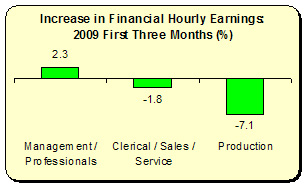 The Financial sector paints a similar picture. There was a general 0.6 percent increase in wages. The Management / Professional strata – which makes up nearly half of all employees in the Financial Sector and earns an annualised €72,000 a year – was the only beneficiary of wage increases. Clerical staff, who earn less than their counterparts in the manufacturing sector, and Production workers (yes, there a few in the Financial sector) took a hit.
Again, and this is more pertinent in the Financial Sector, we might well find, if we had the data, that staff at the upper end of the Management strata gained an even higher percentage increase over the remainder in this strata.
Were the total wage increase shared out among all employees, the percentage increase for Clerical and Production staff would be 1.5 percent. This would at least help protect their living standards – which the Government was planning at that time to reduce with increased levies.
Ultimately, it’s a bit galling to hear these lectures from the upper economic echelons – especially as they continue to ‘grow’ their incomes at the expense of lower-paid employees in their own establishments.
And how irritating is it when the representatives of the managerial strata give out about employees’ pay, including public sector employees. As we saw above, the managerial strata gained while others fell. And public sector employees?
The marginal increase in public sector pay shouldn’t fool anyone. During this period the pension levy was applied which, because it’s not counted as a wage shift, does not show up. But cut wages it did. Public vs. private sector workers? The real divide is those that have the power to increase their wages and those that don’t – and most public and private sector employees are on the side of don’t.
So the next time you bump into IBEC or ISME or some Dublin Consensus-ist on the street, urging you to ‘share the pain’ – just laugh in their faces and tell them to sort out their own house first.


 Notes on the Front
Leave a reply to Tipster Cancel reply