
Notes on the Front

Commentary on Irish Political Economy by Michael Taft, researcher for SIPTU

May 14th Morning: The Recession Diaries

Recession 168 Here is my challenge to the real devaluationists. Will any of them take it up? Real devaluationists claim that, since we can’t devalue our currency, we must devalue other inputs into the economy. Wages feature prominently as in cutting wages will increase our competitiveness. Many of these ‘real devaluationists’ are grouped around Irisheconomy.ie (Alan Ahearne was a leading figure until he went off to advise Brian Lenihan). Garrett Fitzgerald, one of the few commentators who have distinguished themselves in the debate over the recession, has unfortunately fallen into this thinking, too.

So here’s my challenge: please explain the devaluationist argument in the context of facts, rather than assertion. I will offer space on this blog to any or all of them to write a guest post on this subject. For much of the arguments regarding wage cuts rests on the assumption that wages are uncompetitively high. Is this the case?
Wages 1

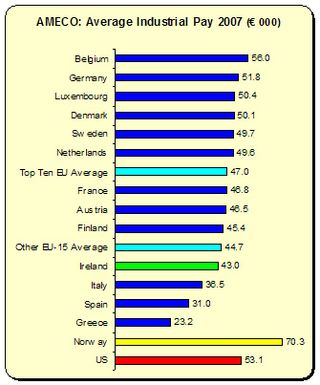
Let’s start with two databases. First, AMECO – the database of the European Commission's Directorate General for Economic and Financial Affairs – compares annual industrial employee compensation, a key figure in that it incorporates major sections of our export base.

As can be seen, Ireland ranks well down the league tables when it comes to average industrial pay – 10th out of the 13 countries reporting for 2007. Irish industrial wages are 4 percent below the other EU-15 average and over 9 percent below the average of top-ten EU economies (of which Ireland is one). In addition, we rank well behind other advanced industrial nations – Norway and the US.

The following, courtesy of a link from a friend, comes from Destatis, the German Statistical Board. This examines labour costs per hour in the 4th quarter, 2008 and covers private sector earnings.
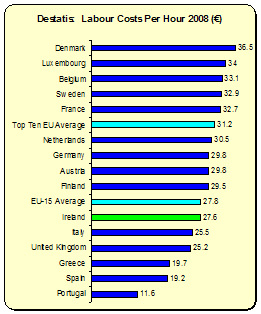
Wages 2 Again, we see Ireland coming in slightly below the EU-15 average, but significantly behind the top-ten EU average – 12 percent below.

Of course, we have to be careful regarding some the national figures. The UK, for instance, experienced a fall of 10 percent in labour costs in 2008. However, this is due to statistics being enumerated in Euros. The UK fall is a result of currency exchange rather than cuts in labour costs (there own devaluation experience). But there is another little insight in these figures.

While German labour costs come in below the top-ten EU average, the national distribution varies considerably. For instance, the former German Federal Republic (i.e. West Germany), manufacturing wages average over €46,000 while in the New Lander (i.e. formerly East Germany) the average wage comes in at €29,600. In the powerhouse region of the German economy, therefore, labour costs are higher than is stated in the above table.

'Real devaluationists’ (along with IBEC, ISME, Forfas, etc.) may point out that Irish wages have been increasing at a faster rate than other EU countries. In one respect, they are correct.

Between 2000 and 2007, Irish industrial wages increased by 38.9 percent while the other EU-15 average increased by 24.4 percent. So do they have a point? Not as much as this stat might initially suggest. There are three things to look at:

First, individual workers’ wages did not necessarily rise by that amount. A contributing factor is the changing character of the industrial base is changing. A number of indigenous enterprises and low/mid-skill multi-nationals have closed down or left. These would have been relatively lower-paid. They have been replaced by enterprises with higher-skilled, higher-value added jobs.

Second, there is a catch-up or ‘convergence’ factor at work. A crucial part of the argument to enter the EEC back in the 1970s – and to continue approving subsequent EU-based referenda – is the benefit of the Irish economy converging with the rest of the EU; in particular, with the top economies. Though we have some ways to go, this process is in train. So if convergence was a laudable goal in the past, why is it considered an obstacle now? It’s only an obstacle if we believe that Ireland will prosper only if we remain a relatively low-waged economy.

Third, there is considerable statistical manipulation going on here. For instance, in 2008 overseas ‘tourist trips to Africa increased by 39 percent while trips to Europe only increased by 5 percent. So are the Irish abandoning the romance of Paris for the challenging terrain of the Niger hinterlands? Hardly. Actual trips to Africa rose to 56,000, while trips to Europe increased to over 1.3 million. That’s the fun and games you can have when playing with statistics. So let us get up to our own fun.

Between 2000 and 2007 Belgian industrial wages increased by 25 percent while Irish wages increased by 39 percent. Obviously, our wage competitiveness has deteriorated substantially vis-à-vis Denmark. Or has it? Actually, Danish wages increased by €11,300 while Irish wages increased by €12,000. The actual cost difference to Irish employers is €100 annually. No one can seriously argue that €100 a year constitutes a ground for ‘real devaluation’.

At the end of the day, when wages make up approximately 6 to 8 percent of the manufacturing base, it’s hard to imagine how the real devaluationists think that lower wages will make any difference to Irish competitiveness – especially as Irish industrial wages are below average to start with.

Not only do the real devaluationists avoid this they avoid another consequence of wage slashing: the fiscal damage. With the Government flailing about over the collapse in tax revenues, real devaluationists want to cut revenue even further.

Let’s say we cut wages by 7.5 percent. Using Colm Keena’s table of income and tax revenue for 2008, this could, on average, reduce tax revenue by €1.2 billion. And this doesn’t count reduced PRSI contributions and spending tax revenue. And this doesn’t count the negative multipliers – reduced economic activity, driving enterprises dependent on domestic demand even further to the wall, or through it. And this doesn’t count the proportional rise in debt.

The real devaluationists count none of these things in their pursuit of the wild goose of competitiveness. And that’s the real problem – for if we go down their road, not only will we find ourselves in a cul de sac very soon, we will be amassing even more problems for ourselves.

So this is my challenge. Please explain how cutting wages will improve competitiveness when – on a cost basis – we have are a relatively low-waged economy. Please quantify the direct cost to the Exchequer and how exacerbating the fiscal deficit will help. Please examine the cost to the economy, through the negative multipliers and their impact on those parts of the economy dependent on domestic demand.

And please explain how slashing our living standards in pursuit of a highly contestable proposition will do anything else but impoverish people more.

So, to all the real devaluationists, you have been invited.

12 responses to “May 14th Morning: The Recession Diaries”

  1. Mack Avatar

    Hi Michael,
    I’m confused by these stats. The CSO puts average industrial earnings in Ireland for June 2007 about 30% lower AMECO’s figures for the whole of 2007 (there is a similar gap between the CSO’s annual figures for 2006 and AMECO’s figures) . Wikipedia puts the US median household income for 2006 10% lower than AMECO’s average industrial wage for 2007.
    http://www.cso.ie/releasespublications/documents/earnings/current/indearn.pdf
    http://www.cso.ie/statistics/indearnings.htm
    http://en.wikipedia.org/wiki/Median_household_income
    Is there a definitive set of figures somewhere? Or a reason for the divergence with the CSO defined averages?

    Like

  2. Gerard O'Neill Avatar

    Not sure I’d call myself a real devaluationist Michael: more of a deflation fatalist perhaps. The problem with comparing industrial wage levels is that: a) most private sector Irish employees don’t work in industry, and b) their costs are therefore a higher share of operating costs than in your manufacturing example.
    From numerous conversations with people running services businesses (like myself), there is clearly downward pressure on wages and salaries. Only a minority of employers have cut them as such, reducing overtime, temporary staff and even permanent staff instead.
    But as today’s CPI data shows, deflation has a firm grip on our economy and it is affecting the revenues of many businesses that are cutting prices (hence the falling CPI). When staff are the largest cost that you have, and you have to cut prices to keep customers, then it is only a matter of time before you have to cut staff costs.
    The way I see it, businesses will cut staff numbers if they think the recession is going to get worse, but they will instead cut wages if they think it is near the bottom and they’ll get through if they are prudent. Neither is exactly an indicator of economic health, but the latter is probably better for employees (in the short to medium run) than the former.
    The public sector are, of course, out sourcing the recession to the private sector (I’ve had previously signed contracts with the public sector effectively torn up and told to take a lower price or else). The same for most other suppliers to the public sector.
    The medium term outcome will be a widening gap between private sector and public sector pay – though the inevitable collapse in income tax revenues will make even this government consider temporary salary reductions (or more pension levies).
    Where we stack up against wage levels in other countries in this scenario is, alas, entirely academic.

    Like

  3. Conor McCabe Avatar

    Interesting point Gerard, about the public sector outsourcing the recession. Tell me, did they outsource the boom as well? Just that, if they didn’t, I can understand why you would say that the public sector is outsourcing the recession – i.e. passing on the cuts to the private sector. However, if they were handing out contracts during the boom, and at boom prices, well, that’s the rough and tumble, no?
    The second point is that you mentioned how the average industrial wage is untypical of Irish service-based wages – how true! Over 30% of all Irish workers earn less than 15,000 a year.
    Finally, can I just ask what is the nature of the service that you provide to the Public Sector. There are many different types of services. Is it cleaning, catering, short-term contract administration?
    It’s just, in order to get a handle on how typical your experience is, it would be helpful to know what it is you provide.

    Like

  4. Michael Taft Avatar

    Mack
    I think you may have been looking at the old series of CSO industrial earnings. A problem with the old series, which causes confusion, is that the CSO headlined wages for production workers as the average industrial wage. For instance, in June 2007 – the production workers wage was €32,604. That would account for the 30% gap. However, the average wage for all employees in the industrial sector (including clerical and managerial) was 36,660. This statistic, however, was buried in the tables.
    The CSO has changed the series into the now Earnings and Labour Costs series. The old series only published regular pay. The new series adds a number of other elements – notably, irregular earnings (such as irregular bonuses). The two series have slightly different methodologies – the old one used a series of weightings from their survey, whereas the new series covers all enterprises over 20 employees and an extrapolation below that number. The new series gives a more accurate picture. However it has one drawback as the old series gave valuable information on the sub-categories (e.g. Food, Chemical, Transport equipment, printing, etc.). The new series doesn’t.
    Looking at the new series, it states that the average industrial wage (which also includes management) for 4th quarter 2007 is €40,509 (among production workers only, the average wage is 33,888). AMECO would also use the average of all workers. Also, nominal compensation in AMECO may well include employers and or employees PRSI. In addition, different databases sometimes ‘merge’ the different methodologies from national sources. For instance, Ireland surveys all companies with more than 20 enterprises. Other countries might use different methodologies.
    That’s why it is tricky using figures from database and comparing it with another. But the CSO, under the new series, is close to AMECO database – especially if PRSI is included.
    As to the Wikipedia figure – median is not the same as average. Median is the wage level at which 50% of employees are above and 50% are below. For instance, in the CSO’s National Employment Survey 2006, it shows average (or mean) manufacturing wage to be €17.58 per hour but the median wage is €15.01. In other words, despite the average, 50% of all manufacturing workers earned less than €15.01 per hour. Averages can be misleading so the median wage is a helpful measurement (and this CSO measurement uses a different methodology than the one in the Earnings and Labour Cost survey).
    Earnings and Labour Cost Survey 1st quarter 2008: http://www.cso.ie/releasespublications/documents/earnings/2007/earnlabcosts_q42007.pdf
    National Employment Survey: 2006 http://www.cso.ie/releasespublications/documents/earnings/nes2006/nesoct2006.pdf
    Hope this has helped.
    Thanks for the comment, Gerard. And don’t be too fatalistic – you know the old Gramsci saying: pessimism of the intellect, optimism of the will. Though I take your points, I don’t think the comparisons are academic when the argument is whether we are internationally wage competitive. Yes, in other sectors, labour makes up a high element of costs – but the German Board figures related to labour costs in the private sector, not just industrial wages which was the AMECO figure.
    One of the problems we have is the lack of data regarding what is happening in the market sector. Instead, we have to rely on anecdotal evidence – such as yourself and your own experience of other workplaces; surveys, etc. The Industrial Relation News posts the companies that have paid (and continue to pay) the first tranche of the wage agreement but this is not a survey. I know that in many branches in private sector unions, workers would not have come out on the national day of action as their companies were wage-compliant. So the situation is rather cloudy.
    No one can dispute the fact of deflation but, again, we have to have some perspective. While the headline CPI rate is -3.5%, when mortgates are excluded, the rate improves to -0.3 and when all housing is excluded (including rents) inflation is flat-lining, not deflating. However, that businesses are being badly affected is beyond doubt.
    Don’t forget, Gerard, the biggest supporters of prosperous, thriving, efficient and expanding enterprises – both public and private – are workers and trade unionists. It’s only in such enterprises can good wages, benefits and working conditions emerge. That’s why I have argued (as well as ICTU) for pro-active policies to protect our enterprise base. For instance, payroll subsidies based on the Dutch and German model, to top up short-time wages and prevent redundancies. Also, I can’t understand the Government’s reluctance to help out the indigenous export companies with a temporary sterling stabilisation fund. No doubt this can’t be a long-term solution – but so much of our indigenous exports go into the UK and any currency-related adjustment should be stretched out into the medium and long-term. If companies like these go to the wall, it will be very difficult to create new ones in the years to come.
    I’m not going to get into the public sector-private sector wage gig here as it is not the point of this post. But there will be plenty of opportunities to chew over this one. Besides, with such pro-enterprise policies as the two I pointed out (there’s much, much more where those came from – sustaining demand through state-led job creation, social protection increases, enhancing disposable incomes, social infrastructure investment, etc.) we might yet turn you into a Keynesian, Gerard.

    Like

  5. Mack Avatar

    Thanks Michael, that’s a very useful clarification of the data.
    I’m still surprised by the US figure, as the multi-income household median (perhaps this assumption is wrong) is still well below the single income average. Presumably down to either huge high-end salaries heavily skewing the average, or lower-paid jobs being excluded from the latter calculation, or the fact the former came from wikipedia!

    Like

  6. Pavement Trauma Avatar
    Pavement Trauma

    I’d say the differential depend to a large degree on the nature of the average industrial work in each country.
    Does the average industrial worker in Germany work at a more skilled level than the average Irish industrial worker? Conceivably, yes.
    The output per unit labour would ideally be the basis of comparison but this is subject to a lot of distortion due to the influence of transfer pricing and similar practices.
    So the problem may not be that we have become relatively expensive in absolute terms but have become expensive for the type of work we’re doing.

    Like

  7. rdlp715 Avatar

    Are their any statistics out there on the productivity to wages ratio of workers?
    I know I have seen them in places for example cheap Chinese workers are less productive than Germans(who isn’t?) hence the Chinese economy has lots of room to find efficiencies and grow.
    This would put the argument over wages to bed once and for all now that it has been clarified we are not actually oh so well paid.
    In fact, if we are/were so well paid in a low tax economy then why was there such a grab for credit, overdrafts, loans that we now cant pay back? Supposedly more disposable income than anyone in the world AND insanely high personal debts? Makes no sense. The rightwing deflationist argument is trying to have its cake and eat it too.

    Like

  8. Michael Taft Avatar

    Pavement Trauma – that’s a good point. I have tried to track down, through the EU Klems database, the comparative high tech employment. Ireland ranks well but I suspect that this doesn’t tell the full story. In Germany, companies, in addition to employing high-tech labour will also include comprehensive R&D, innovation, etc. departments – something we lack as we are part of a global chain in our foreign-owned modern manufacturing sector. So such comparisons can only get us so far without more detailed data. However, I would point out that labour cost figures relate to all the private sector – even those sectors which wouldn’t rely in high-tech productivity (retail, hotels/restuarants, etc.).
    rdlp715 – the problem with productivity comparisons is, as Pavement Trauma rightly points out, are skewered by the operations of multi-nationals. Indeed, when Forfas did a productivity comparison, they didn’t even bother assessing Irish productivity in our modern sectors – they just took US productivity as a surrogate. It’s quite a situation where our economic base is incapable of being concretely assessed – welcome to the world of tax-laundering corporate rates. However, your larger point is correct. Wages here are, on average, lower than in other advanced industrial countries. And though the Right point to high levels of take-home pay, what they omit is the much higher cost of living which Irish workers face. In addition, they fail to factor in the fact that Irish workers have to seek out in the private market many services that workers in other countries consumer through social provision (e.g. GP fees, prescription medicine, pre-primary education, childcare, pensions, etc). Once these numbers are crunched, its no wonder that many households had to resort to credit to obtain many goods and services.

    Like

  9. Mack Avatar

    Michael –
    What’s the best way to get the cost living down? If companies can’t give pay rises now, our standard of living could still rise if prices fell. Is it possible to manage this without causing (or adding to) a deflationary death spiral?

    Like

  10. Caelen Avatar

    I’m not sure if wage deflation is the way to become more competitive, however I am certain that we either need to become a lot more productive or cut cost a lot.
    Last year I went out and got pricing for some tele-marketing work that we didn’t want to do internally. Prices from Irish call centers came in at about €35 an hour and prices from US call centers at $25. We did our due diligence and quality was on a par and US call volumes were slightly higher. At the time the euro was stronger than it is now and the US worked out at under 50% of the Irish price.
    I have no idea what factors caused Ireland to be uncompetitive in this instance. However, in my mind either we need to decide that we don’t want the call center industry or it has to become competitive with the US.
    Does this mean we have to cut our wages? I don’t think so. However, a lot of other costs will have to be reduced and our productivity needs to increase.
    No matter how we go about doing it, it doesn’t feel like it is going to be easy.

    Like

  11. CMK Avatar

    This is an interesting debate and, in particular, the above comments raises a few issues.
    My point here is not related to costs or how to cut, or whether to cut etc.
    But rather with the notion of improving productivity without compromising social justice and fairness. I.e without slashing wages, benefits, good working conditions etc. I, perhaps foolishly, believe that it is possible to have competitive businesses, productive entreprises and a fairer and more just society. Indeed, the former are only possible and sustainable when predicated on the latter. Scandanavian countries could be the target, but it’s possible to go even better.
    But one pre-requisite to achieving this, in my mind, is a more self-critical, reflective, socially conscious business class. One which realises that the only road to personal enrichment is through building businesses within the context of just society. Business, at all levels, in this state gets a total pass on this and similiar aspects of economic life. In the morass of mindless ‘pro-business’ commentary that we live in this issue will be overlooked. But it’s as important as any other issue in creating a more sustainable economic future.

    Like

  12. Michael Taft Avatar

    Mack, it is possible that some people’s incomes may rise as prices fall – but this will not be across the board. For instance, the main driver in Ireland’s deflation is falling mortgage costs. Those on low incomes are not going to benefit all that much.
    We could, however, target some of the costs that directly affect businesses: the government’s policy of artificially inflating electricity prices; the high cost of telecommunications under Eircom’s control; the cost of commercial rents. These are not easy (accept the electricity prices which only requires a change of policy). A more forensic analysis of business costs are required on a sector-by-sector basis – such as that done by Forfas when analysing the cost of retail enterprises. That would be a start in addressing this vexed question.
    Caelen, different sectors and different competitors will throw up a varied range of policy problems and prescriptions. Take for instance the US tele-marketing sector: they have the advantage of relatively low wages (real wages have been under attack in the US going back to the 1980s), an anti-union culture, much less holidays and social protection measures. In these sectors, they will have cost advantage. We have three options when confronted with such sectors: (a) compete on the basis of superior service, (b) social protection measures for the low-paid, (c) move on to other sectors where competition over race-to-the-bottom wages are not an issue. These are not mutually exclusive. But, again, this demands a forensic analysis of where we can compete and on what basis, and what supportive policy tools we can put in place. There are, in some sectors, no easy answers. Though I believe that a number of UK companies are returning their telephone service supports back to the UK, realising that while other countries may compete on wages, they are not competitive in other areas – such as customer service.
    CMK, far from being ‘perhaps foolish’, I would suggest that a debate that is not centred on the excellent points you have made will be foolish. There is little debate on our business culture. Somewhat surprising since our indigenous sector is so weak – weak to the point that we are primarily driven by foreign-owned companies – many of which might be considered foolish by some contributors to the national debate on competitiveness.

    Like

Leave a comment

Navigation

About

Commentary on Irish Political Economy by Michael Taft, researcher for SIPTU