
 I’ve been trying to get away from this topic – the whole deflation thing and its impact on the economy and the budget. There are, after all, a hundred and one other issues in the Fianna Fail playbook to consider, deconstruct and reconstruct in a progressive fashion. But it seems that everyday we are drawn back to the Government’s fundamental failure by new reports, projections and analysis. Now the EU Commission’s Spring Economic Forecast is pulling us back with a ferocious wrench. Let’s recap.
Back in October, the Government introduced the Income Levy, along with spending cuts (e.g. medical cards for the elderly, etc.) to bring the deficit under control.
In January they had to rewrite the budget numbers because the October projections were overtaken by a rapidly contracting economy (in October, the Government actually believed GDP would fall by less than 1 percent). Shortly afterwards, they imposed the public sector pension levy to cut expenditure further.
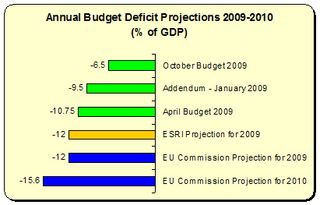 Still, as the economy contracted, the deficit grew. At the time, the Government projected that if they did nothing, the deficit would grow to 12.75 percent. So the April budget was introduced to try to hold the -9.5 percent line (which had apparently been agreed with the EU Commission) but this proved impossible. They set a new target of -10.75 percent and, to this end, introduced further levy and other tax increases, combined with more spending cuts.
The ESRI’s Spring Quarterly Report is now predicting that the -10.75 percent deficit target is history. They project it will be 12 percent (just shy of the do-nothing line the Government was so afraid of weeks earlier). The EU Commission makes the same projection.
But, the EU Commission, based on current policies, is now projecting the deficit to balloon (swell? distend? bloat?) to an incredible 15.6 percent by next year, This is on the basis of the economy contracting by nearly 12 percent over the next two years with unemployment rising to 16 percent.
Hello! Hello! Is anybody taking this on board? Are the great economic gods trying to tell us something? (P O'Neill over at Irishelection.com has twigged it.) The problem with the EU Commission’s projection for next year’s deficit is that we can’t be exactly sure if they are including the Government’s intended ‘adjustments’. They announced in the April budget that they would take another €4 billion out of the economy: €1.75 billion in tax increases, €1.5 in current spending cuts and €750 million in capital spending cuts. There’s an argument that the EU Commission has factored this in (their projections include the new April budget targets).
If this can’t convince anyone that the deflationary policies are failing, not only to reverse the economic slide, but the fiscal slide as well (which they were intended to arrest) I don’t know what will. This does not, ipso facto, mean that the only recourse is stimulus policies – but, in truth, there are not a lot of options.
But what it does mean that we should give it up. It’s one thing to flog a dead horse. It’s quite another to dress up the poor beast, prop it up at the Cabinet table, and pretend that it has something constructive to contribute.
Deflationary budgetary strategies are dead. Let’s get over it. Now can we please have a debate on the strategies that get to the heart of our crisis – economic contraction, rising unemployment, falling consumer spending and collapsing investment. We may still disagree but there is a better chance of something productive coming out of such a debate.
In the meantime, let’s give the deflationary horse a decent burial.


 Notes on the Front
Leave a reply to Michael Taft Cancel reply