
Notes on the Front

Commentary on Irish Political Economy by Michael Taft, researcher for SIPTU

April 27th Morning: The Recession Diaries

Recession 162 Ronan Lyon has written an instructive post on the ‘Thorny Issue of Teachers’ Pay’. So useful, in fact, that it was highlighted on Irish.economy and in the Sunday Business Post. And boy has it stirred comments on both websites. Cutting to the quick, Ronan concludes that Irish primary school teachers are paid too much – at least, when compared with teachers in other EU countries. Therefore, in these cash-strapped times, if we want to increase investment in education then we must address the issue of those over-paid teachers. This might be valid if Ronan’s conclusion on pay is correct.

There are three basic statistics derived from the OECD’s Education at a Glance upon which Ronan bases his conclusion.

First, he highlights the fact that Irish school teachers – after 15 years of service – earn considerably more than their peers in Eurozone countries. He doesn’t put exact numbers on this, but his graph tells his story.

Second – and here he does put numbers on it – Ronan shows that Irish teachers earn more per day than teachers in Eurozone countries. Even after the pension levy, Irish teachers are the highest paid. Ronan says:

‘ . . . the amount paid for every day spent teaching in Ireland looking pretty unsustainable. Factoring in the pension levy only scratches at the surface of the problem.’

Third, he calculates teachers’ net pay – after tax and PRSI. This, if anything, shows that Irish teachers’ pay is higher still.

Do his arguments stand up?  Let’s investigate – using primary school teachers' pay scales.

Do Teachers Earn More Annually?

Do teachers earn more annually than teachers in other countries? Well, yes and no. Already, Ronan’s conclusion begins to fray. Why? Because he selects only one pay grade, whereas the OECD presents data for three. Looking at all three grade scales, the situation becomes a little more complex.
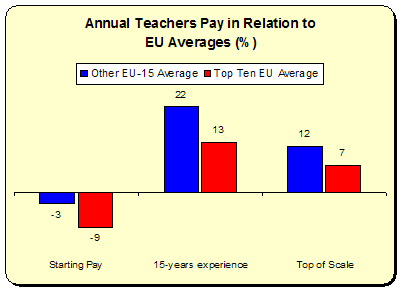
Teachers 1 Ronan’s contention seems to be confirmed when we examine teachers with 15 years experience – Irish primary school teachers earn 22 percent above the average in other EU-15 countries, and 13 percent above the average in the top ten EU economies (of which we are one).

However, starting off, Irish teachers are paid below average – in the case of the top ten significantly so: 9 percent. At the top of the pay scale, Irish teachers are better paid but less than those on 15 years experience. So we can conclude:

  • Irish teachers start off earning below average, but through the years – due to increments and other pay benefits that come with experience – become higher paid. However, at the top of the scale the ratio between Irish pay and other EU teachers contracts.

Exactly where in that pay scale Irish teachers turn from being below-average pay to above-average pay the OECD doesn’t state. So we don’t know the extent of any savings that might accrue to the Exchequer through aligning pay with the EU average because we don’t have the comparisons to hand.

What we can conclude, however, is that Ronan selected the one category that fit his conclusion – teachers with 15 years experience. Had he selected starting pay, he would have to conclude that Irish teachers are paid below average. Had he selected the top pay scale, he could have stated Irish teachers are above average – but not significantly so (only 7 percent when compared to our peer group). In common parlance, this is called skewering the evidence to fit your conclusion. It’s not a practice designed to aid the debate, only a partisan position in that debate.

Pay According to Working Time

The second piece of evidence Ronan produces is pay per day, based on the OECD’s data for the number of days spent teaching. From this, Ronan shows that Irish teachers earn more per teaching day than teachers in any other Eurozone country. It’s interesting that he selected this category but didn’t use the others that the OECD presents – specifically, the number of working weeks and the number of hours actually spent teaching. For instance, Irish primary teachers spend approximately the same number of days teaching as the average EU teacher. Ditto for the number of weeks per year teaching.

But, as we know, the Irish work longer hours than their EU counterparts. Is this the case with Irish teachers? Yes. Irish teachers work longer hours instructing children than teachers in any other EU-15 country (as well as teaching the highest number of pupils per class). So how does Irish pay per teaching hour stack up in comparison?
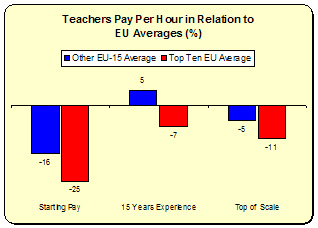
Teachers 2 As can be seen, for starting teachers, their hourly pay is substantially less than their counterparts in the EU-15 and the top-ten EU economies: 16 percent less than the former and a sizeable 25 percent less than the latter.

 For the teachers with 15 years experience, we find that they are no longer ‘highly’ paid. In comparison with the EU-15, they are paid 5 percent more than the average, but in comparison with the top-ten EU economies they are paid 7 percent less than average.

As for those at the top of the scale – Irish teachers earn less than the hourly average.

So whichever way we spin it, pay per teaching hour is lower in almost all categories of teachers, regardless of the benchmark Again, Ronan didn’t refer to this category of working time – it wouldn’t have suited his argument. If teachers’ hourly pay were aligned to EU averages, than we would be actually be increasing pay across most scales. Of course, we could reduce their working hours but that would mean hiring more teachers – more public sector workers; I’d be interested to hear Ronan’s thoughts on that one.

There is a category for ‘working time required at schools’ but a large number of countries are absent from this data. More importantly, it doesn’t tell us the actual time teachers spend at school. So I can understand why Ronan didn’t refer to this data.

Net Income of Teachers

Ronan provides us with his own calculations on net income for teachers in the Eurozone which doesn't feature in the OECD data (at least, I can’t find it; if it is there, I would appreciate it if someone could point it out). Unfortunately, Ronan doesn’t explain how he arrived at these figures.

I’m guessing he took tax percentages supplied by the OECD Benefit and Wages database and applied it to the Education at a Glance salary figures. This is not without some justification, but the problem is that these are two different methodologies using different currencies (national currencies in the OECD Benefits database, dollar-PPPs in the OECD Education figures). If this is what Ronan has done, it should be treated as an approximation. And it would explain why he uses Eurozone comparisons, as the Benefit database uses national currencies for non-Eurozone EU countries.

That’s a minor quibble – telling people how you arrive at figures (something that should be done as a matter of course). But Ronan has opened up a wider debate that goes beyond teachers’ salaries; namely, how we consume services in society. Irish tax/PRSI levels are low – and so are the monetary benefits of public services.  In other EU countries, it’s just the opposite – high taxes/social insurance in return for free or below-market cost services.

In Ireland we get to keep a lot more of our gross pay (which, in the private sector, is low by EU standards) but out of that we

  • Have to pay GP doctors’ bills and prescription medicine at market rates 
  • Don’t get the same pension coverage and retirement income 
  • May have to pay out enormous sums for nursing homes and elder-care for our relatives
  • Pay one of the highest levels of childcare costs
  • Suffer some of the poorest infrastructures (public transport, tainted water, cultural and recreational activities, etc.).

Not to mention fundraise – along with-teachers – for basic equipment in our notionally free primary schools.

I’ve always wondered what a survey that took account of all these costs would say about comparative living standards and ultimate cash-in-hand – never mind the security of social protection and services.

Now, if Ronan is suggesting that once we get out of the recession we should start increasing tax levels so we can get free health and medicine, subsidised childcare, PRSI earnings-related pensions, etc. – well, I’m with him. But let’s be clear: this will mean higher corporate and payroll taxes, higher taxes on capital and wealth, in addition to higher income taxes and PRSI contributions.

In short, to look at one side of the equation – low taxes – without looking at the other side – foregone consumption of important services for free or at non-market rates – doesn’t get us very far. For it is an equation that goes beyond data sheets and to the heart of the debate over the failed low-tax, low-spend, low-investment, low-service model that Ireland has pursued.

* * *

So where does all this leave us?

  • Ronan’s selection of data was just that – selective. He presented only those categories that might suit his argument and ignored other, more inconvenient ones.

  • Were Irish primary school teachers’ pay aligned with the hourly EU average – we would be paying most teachers more and/or cutting their working time in the classroom. If the latter, this would require employing more teachers.

  • Most of all, Ronan does the debate over public sector pay a disservice by employing these sleigh-of-hands and not discussing the full range of data.

What both Ronan and I have done is analyse the raw salary tables.  Neither of us have factored in the working conditions of teachers (Irish classrooms are some of the largest in the industrialised world).  And even Pat Leahy accepts:

'. . . the consistently high scores achieved by Irish pupils in international rankings suggest that they (teachers) should be paid more than in many other countries.'

Were these two factors accounted for, we might come up with a more complete – and completely different – picture than what Ronan presents.

If there are pay anomalies let’s find out what they are. I, for one, wouldn’t be surprised to find them. In fact, the shocker would be if there were none – either in the private or public sector; especially given that we have one of the highest income and wealth inequalities in the EU. Anomalies feature in even the most efficient and egalitarian systems.

It’s one thing, though, to do the hard work to bring those anomalies to light, never mind address them in a rational and beneficial manner. It’s quite another to selectively use data to support a misleading (to put it mildly) generalisation.

Ronan recommends that we look up the ‘facts’ on the OECD website:

‘. . . even if you hate absolutely everything I’m saying here, do take the opportunity to wander around its facts and figures.’

I’d recommend that Ronan do just that. And this time, look at all the data – not just those he doesn’t hate.

27 responses to “April 27th Morning: The Recession Diaries”

  1. James Conran Avatar
    James Conran

    Peter Connell also did a bit on this (in response to Ed Walsh’s piece in the SBP yesterday) over at Tasc’s econ blog, in which he noted:
    “A secondary school teacher in Ireland with 15 years experience earns a salary equal to 1.2 times GDP per capita. This places the Irish teacher at 14th in the international league table of 30 countries reviewed by the OECD.”
    He also makes some interesting remarks on the issue of social welfare fraud:
    http://www.progressive-economy.ie/2009/04/league-tables-and-losing-plot.html

    Like

  2. Ronan L Avatar

    Hi,
    Interesting analysis. Needless to say, I’m not a big fan of some of its content, and would vehemently disagree about some of the statements about my research, but I wouldn’t disagree with some of the points you’ve made. Rather than go through everything point by point, I’ll leave it to people to read both analyses and use their own judgement as to the final conclusion.
    You ask at one point:
    “Of course, we could reduce their working hours but that would mean hiring more teachers – more public sector workers; I’d be interested to hear Ronan’s thoughts on that one.”
    That’s precisely my point – if we are prepared to tackle the issue of teachers salary, we will have to impose less in the way of service cuts. If teachers salary is brought back into line with teachers elsewhere in the eurozone, then we can still provide those fringe services which are currently under threat from job cuts.
    Despite some badgering and name-calling on a number of sites following my research, I’m not a blinkered market-at-all-costs merchant. (In fact, only today I was making the case for higher taxes http://short.ie/tax1 which I presume will make me equally unpopular with an entirely new crowd!)

    Like

  3. Ronan L Avatar

    Oops, sorry, forgot one thing I did want to mention, in terms of substance. My analysis was an average of three teaching scales: primary, lower secondary and tertiary.
    The above makes reference to it being an analysis of solely primary teachers’ salaries.

    Like

  4. bigred Avatar

    Good anaylsis all round and good to see Ronan’s response. Perhaps some sane and sensible analysis commencing now after all the obsfucation of recent months re the public services.

    Like

  5. D_D Avatar

    NOTF readers may be interested in the Alternative Economic Agenda to be launched by the People Before Profit Alliance tomorrow evening. It can be found at
    http://www.indymedia.ie/attachments/apr2009/pbpa_alternative_economic_agenda.pdf

    Like

  6. Michael Taft Avatar

    Ronan, thanks for dropping in on and making a comment. I accept the mistake in referring your data to primary school teachers. I did assume you brought all three categories together.
    As to ‘bringing teachers back into line with the EU’ – as I showed from the OECD data, this would mean either (a) increasing teachers’ salaries to raise them to the average hourly pay, or (b) cut their hours. Regarding the latter, if you cut starting primary school teachers’ working time by 16 percent, that would bring them into line with average hourly pay. But as a consequence you would have to hire more teachers at the same pay. Either way, you end up with a higher public sector paybill. So I’m not quite sure the point you’re making.
    As to raising taxes, I’m for it in the medium-term – though starting wealth, unearned income and unproductive wealth. However, in the short-term I would argue strongly that all levies that were increased in April budget should be repealed – except for those on the highest incomes. I cannot understand the proposition that reducing low and average disposable income is somehow going to help stop the recessionary slide when all it will do is further hit enterprises reliant upon domestic demand, thus increasing job losses, short-timing and liquidations. That, too, raises eyebrows – a progressive arguing for tax cuts (at least for low and average income earners).

    Like

  7. Tomaltach Avatar

    Looking at pay alone: At year 0 Irish teachers earn less, but by year 15 they are well ahead. So somewhere in between they cross over into positive territory. At the top of the scale they are still ahead. I presume this is somewhere around 25 years later. Without further data points it is impossible to say, but a fair guess is that after they get ahead, say perhaps after 7 to 10 years, they stay ahead. It looks like the Irish teacher would earn considerably more during their career. But that cannot be said with certainty without way more figures.
    Of course as you state, when it comes to hours the picture is different. Can you provide any more detail on the figures for hours worked by teachers or where you picked them up?

    Like

  8. WorldbyStorm Avatar
    WorldbyStorm

    Great analysis Michael. Reading the original piece by him over on his site I was struck by how much was cherry picked. Tomaltach, one further point is class sizes. That’s not to be discarded – not that I’m suggesting you are doing so. In other words we’re talking about pay/hours/nature of conditions. On all those axis the situation is markedly different from that presented by Lyons in his original piece. So different in fact that it’s a profoundly selective piece.
    One interesting side effect of pieces like RL’s original one and the Ed Walsh piece in the SBP the other day is the comparison with ‘other European countries’. Hmmm… I can’t help but feel that that would fundamentally undermine their supposed argument. Or rather would work in the opposite direction to the way they suppose.

    Like

  9. Michael Taft Avatar

    James – you are right to point out Peter Connell’s excellent analysis of Brendan Walsh’s contentions. It is a model for commentary that is grounded in fact, not supposition, not partisan selectivity.
    Tomaltach – there are two ways you can access the OECD data. You can go to the main report at http://www.oecd.org/dataoecd/23/46/41284038.pdf. The section on working time is on page 458.
    You can also access the Excel tables on the synopsis page of the report at: http://www.oecd.org/document/9/0,3343,en_2649_39263238_41266761_1_1_1_1,00.html.
    On the issue of when Irish primary school teachers pass the EU annual average – your estimate is probably pretty accurate.

    Like

  10. CMK Avatar

    Re: comparison with other European countries when are we going to see the issue of corporation tax analysed and dissected by Ronan and others?
    Given that we have the second lowest corporation tax rates of all the member states of the EU I’m sure those commentators busy making comparisons with the EU averages in social welfare payments and teachers wages are working furiously on their arguments for benchmarking corporation tax with the EU average. From my, admittedly crude, calculations the average EU corporation tax rate is 21.77%. That’s a full 9.27% higher than the Irish rate.
    It would be interesting, since we’re discussing averages and comparisons, to see what, for example, tax is paid by an Irish SME of between 15-50 employees versus a similar one in Germany or the Netherlands.
    Since everything is up for discussion, I’m sure it’s only a matter of time before we start the discussion on comparative tax rates and the Ronan and others will be calling for rates to rise in line with EU averages??

    Like

  11. Mack Avatar

    CMK –
    What do you think the effect would be of raising corporation tax in Ireland?
    I think there are very few people who are ideologically attached to the notion that company profits should be taxed at an exceptionally low rate. Most people support low corporation taxes out of pragmatism – because they believe they benefit the economy as a whole.
    If our economy could sustain it (and continue to provide relatively high wages for our citizens), I’d much prefer higher corporation taxes and lower personal taxes. However, I think it would kill off one of our big comparative advantages and do untold damage to the economy. Do you disagree? I’d love to hear a convincing argument as to why it could be done without such damage.

    Like

  12. CMK Avatar

    Mack,
    I raise corporation tax because if comparisons between Ireland the rest of the EU are going to be terrain over the debate is carried out, then it’s only fair to extend that debate to all conceivable areas where valid comparisons can be made. Corporation tax is one such area.
    My reaction when I hear that teachers pay here is higher than the EU average is “so what!”. Ditto with social welfare payments or public sector pay.
    Social welfare payments, teachers pay, corporation tax etc, are all the results of domestic, Irish political and economic debates and considerations that have taken place over the past few decades. They’re domestic issues in the first instance and domestic responses to domestic problems.Therefore, in my opinion, it’s meaningless to make comparisons to other EU states – it might be diverting and entertaining for right wing economists and bloggers with time on their hands, but it’s not, in any way, a positive contribution to the debate on the current crisis.
    From a purely progaganda perspective these comparisons are attractive as they ostensibly support the arguments that we need to cut pay, living standards. But when subjected to analysis, as they are here, they start to crumble and are revealed for what they are: ruses to divert anger towards the public sector, social welfare recipients etc and away from business, the banks and developers.
    And, yes, corporation tax should be raised if only by one or two per cent. It would be symbolic that business is prepared to “share the pain”.

    Like

  13. Mark Conroy Avatar

    Michael,
    This was a very interesting analysis and one that has found favour on the notice board in my staffroom.
    On thing, however, that you missed out on, is how many teachers will have to teach for more than 15 years before they get paid what at 15 years’ experience teacher will receive.
    Take my case for example (and there are many like me): I worked for five years taking substitute positions – sick leaves, maternity leaves, etc. – before I got my own hours in a school. It is only in the past two years, so, that I have been on the increment scale. This will mean in effect that I will have done 20 years service before I get to the level of pay on the scale that a person with supposedly 15 years service gets.
    I wrote a small comment about this on indymedia – http://www.indymedia.ie/article/90104#comment240319 – a while back. This paints an even worse picture of teachers’ pay than you have.
    Again, thanks for such a refreshing take on the issue.

    Like

  14. Michael Taft Avatar

    CMK and Mack – you have opened up a can of worms which is the low corporate tax rate. Worms because once you look inside – whether one wants to increase, keep them the same or work to a long-term strategy to increase but not just yet (the last being my position – we see that it contaminates our entire enterprise stategy. The low corporate tax rate is little more than a tax-laundering policy, one which robs workers and economies in other countries. It is unsustainable in the long-term but the key question is how do we disengage ourselves from it without doing our own economy considerable damage (this was the case even before we entered the recession). I will attempt to address this soon in a post.
    Mark, thanks for that. Let me state that I am no expert in teachers’ pay, increments, irregular working, etc. I just wanted to take the same data as Ronan used and show that (a) his conclusions were unsustainable, and (b)that this is a long line mainpulating data for an ideological purpose. I have no doubt that were one to really bore ito the details – and not just teachers’ pay or even public sector, but all workers’ wages – one will find a far different story from that presented by the orthodoxy. That is certainly what I have discovered when countering the nonsensical claims by IBEC, etc. that private sector wages are somehow ‘uncompetitive’.

    Like

  15. Mark Conroy Avatar

    Indeed, and since Ronan says he ‘wouldn’t disagree’ with ‘some’ of your points, I think he has a duty here (and in the SBS) to says which ones he agrees with, since, to be honest, you whole article disagrees with him. It’s a total cop out as far as I can see for him to say, we’ll let the readers decide – he knows most of his readers won’t be reading this, more’s the pity.

    Like

  16. CMK Avatar

    Mark,
    Your comment above and the one on Indymedia were both insightful.
    What’d I’d like to see addressed, particularly with regard to secondary teachers, is the degree to which that profession is being actively de-skilled. With thousands of, for want of a better term, ‘casual teachers’ scrapping for every bit of subbing they can get; the colleges pumping out hundreds of H.Dips every year with virtually no chance of job; my suspicious mind tells me, hopefully incorrectly, that the state and employers are readying for an assault on teachers conditions and have, to use a marxist term, a reserve army of labour ready with just that purpose in mind. The media and blogosphere attacks on teachers pay are just one element to that campaign at the moment.
    Such developments highlight to me again the intrinsically contradictory nature of the Irish right. Contradiction is built into the very premises from which they seek to argue.
    So, we have them looking to slash teachers pay, casualise the teaching profession while at the same time develop a ‘smart economy’ built on a hugely expanded fourth level, which is impossible unless you have an adequately resourced second level, which you won’t get when science and tech graduates see the crap teachers have to take and will decide not to go into teaching, leading to less and less students taking science and tech subjects at leaving cert, less and less progressing to college and very few progressing to fourth level, meaning no viable structure upon which to base the smart economy.
    That’s the central stupidity of right-wing logic. One that Ronan and co are buttressing….

    Like

  17. Martin O'Dea Avatar
    Martin O’Dea

    Excellent post CMK, this is an example of the essence of the right; I feel it is worth looking at what can explain these leanings. Hopefully without coming across as a lecture – just relating a number of studies i have encountered – we are all heavily programmed to be conservatives, and self-serving at a base level.
    We like things the way they are because that requires little work and allows us go auto-pilot through much of our lives while concentrating on what we enjoy. Tell a Liverpool supporter you have a scientific way to assist them win the title -then tell that person that you have found a position for their toothpaste and sink in their bathroom that will save them tweny seconds per morning!
    Coupled with that, we fear change – due to an evolutionary caution (early man would not pick up his first sightt of a snake to see if it was cuddly.
    Add to this mix the fact that when we don’t think things through for ourselves we like to be on the consensus side of things (just you two pick that snake up first and see if its cuddly) then i will do so.
    On the self-serving element; well our brain is divided into its reptilian side which looks at things like breathing and sleeping etc. our mamallian side which is for all the world like our own homer simspon (feed me itch me, very irrational and emotionally strong on most everything and very weak on rationality).
    So it is fair enough to see how all of these elements combine. And we can sumise we that we are really what we deserve. But there is still left our human side.
    So, a countering set of observations is that the majority of people from little kids to people on their deathbeds are, of course, predominantly good and caring creatures. In thei human element of their brain they have a wonderful sense of justice and fairness. They cry when they hear stories of sickly people queueing and dying, they are hurt when they hear of others pain; and they are in the vast majority generous to a fault.
    So who would possibly try to manipulate this weaker group mentality that requires less thought and want to take steps that do anything other than help all and sundry (and so ultimately is easier to communicate thorguh simple fear to) – well ultimately its the same old problem then – its those that have and so naturally want to conserve.
    In reality conservatism does in fact make sense to the wealthy and those who have entered a world where their’s is an unequal large share. It is certainly not in the interests of the other 95% to be conservative.
    We really shouldn’t loose hope though. Who are the most loved U.S. presidents for example; lincoln, kennedy, obama? who are the leading candidates for person of the last century; mandella, ghandi?
    I am convinced that people do care and that they do not admire people who just want steerage to stay where it is.
    From feudal society through to the information age we the paupers are learning more and more; and the more our ears absorb the more we want to move from kings and subjects to equals. In the information age, in fact, someone like FF or FG would probably need to move to where Labour sits now and Labour will move more to eqaulity again in the decades to come. Blogs like yours Michael carry elements of these truths. The non-lazy way of looking at things that expose the self-serving paradigm we operate in.
    But, ultimately, just the moral and right way of looking at things, at ourselves and others. Dermot Ahern feels that it is appropriate to talk of blasphemy while victims of clerical abuse and rape go uncompensated and abandoned by society.
    Again, Michale apology for this second ourburst, but put a vehicle to your ideolgy – get Eamon and company to lead us and I feel that many will now follow, do not let FF confuse us as the months go by into thinking that things might be worse without them, that as bad things are lets keep the status quo.

    Like

  18. Mack Avatar

    CMK –
    I agree comparisons with Europe aren’t the most helpful as it is the domestic economy that generates the money to pay wages and in which the wages are spent. Though you mention “these comparisons are attractive as they ostensibly support the arguments that we need to cut pay, living standards”. Living standards are falling anyway – the tax rises reduce living standards for all affected, redundancies and pay cuts in the private sector reduce household incomes too (as does the pension levy in the public sector). Public sector pay is a big issue because it’s part of the cost, everyone else’s tax rates are rising (living standards falling) to pay those wages – so it is understandable that there is a desire to examine them. My reading of the situation is we were living way, way beyond our means and this was unsustainable. For me a commenter on Slugger put it well when he said, “for the last 8 years, we didn’t have an economy we had an overdraft”.
    I’d love to hear a convincing argument as to how we can generate real wealth quickly to sustain our current standard of living. However, I fear we were living in a dream world sustained only by cheap credit.

    Like

  19. Mark Conroy Avatar

    CMK,
    I don’t think the education sector is being de-skilled. I take on board and agree with the rest of what you say.
    In my own case, for example, I hold an honours degree (first class in in English), an honours Masters (passed on first submission (equates really to first class honours)), and an honours PGDE ((Post-Graduate Diploma in Education, formerly HDip) again first class honours). If I lose my job (which looks very likely) I’ll probably try to get a PhD done. Many that I teach with also hold masters degrees and post grads. Most that I speak with get in to teaching for admirable ideological reasons, not for money. This gives me much hope, to be honest.
    It’s a pity that life can get in the way, bringing on what Derek Walcott calls ‘the prejudice, the evil’.
    Don’t get me wrong, though. This doesn’t mean that the teaching profession is choc-a-bloc with full-blown lefties – we’re few and far between. Talk in the staffroom is quite critical of ‘the fuckin’ do-gooders’ with much support for the status-quo – a change a personnel might be welcome (ie Fine Gael in stead of Fianna Fáil) but not a change of system.

    Like

  20. Ronan L Avatar

    Hi guys,
    Looks like the debate is continuing on here and indeed branching out into issues such as corporate taxation.
    As I mentioned on twitter recently, I’ll be coming back to the issue of teachers pay in the near future. This issue is important, as it is at the core of what needs to be done to fix our economic woes.

    Like

  21. CMK Avatar

    “I’ll be coming back to the issue of teachers pay in the near future. This issue is important, as it is at the core of what needs to be done to fix our economic woes.”
    Ronan,
    Why is it more important that, say, a once-off wealth or windfall tax? Why is it more important than raising corportation tax? It’s a blindingly obvious non-sequiter that teachers pay “is at the core of what needs to be done to fix our economic woes”? So, on your reading, NAMA, the bail-out the billions wasted on recapitalising the banks are LESS important than teachers pay. Wow, I suppose each to his/her own, but that’s a very selective view of our economic problems. The obvious answer, then, is cut teacher pays even more and, hey presto, our problems are solved? Let business carry on as before, let the workers (they should be grateful they have a job!!!) of this country pay a very significant slice of their income for next several decades in paying off and servicing the debt accumulated by the private sector and taken over the state. I’m more and more convinced, as I follow this debate on various blogs and in the media generally that a complete lack of any kind of awareness of how a society functions, as opposed to an economy, is a pre-requisite for economic commentators. Are
    economists looking to provoke social unrest??

    Like

  22. Mack Avatar

    CMK, Ronan –
    While in my opinion Irish teachers are well-paid, I agree with CMK that other issues may be more important. Clearly with a huge budget deficit analysis of government spending is important. I’d at least like some sensible justification as to why some public ‘servants’ are paid between 5 and 10 times the average wage? Just because private companies pay their CEO similar or higher wages doesn’t mean that structure should be replicated in the public sector at our expense. Should we pay any public worker more than 100k (or over 3 times the average wage)?
    How much do the top public paid doctors get paid? How much extra do they make out of other fees? Would we be better off simply paying Doctors a normal salary? Why is it so difficult for students to study medicine in Ireland? Are potentially good med students turned away to keep Doctor’s wages artificially high? On a related subject why are legal fees (and the fees for other professional services) in this country so high compared with Northern Ireland / UK ?

    Like

  23. Mark Conroy Avatar

    Ronan,
    Before you do your next, oh so important article, you could do worse than have a read of this.
    http://www.markconroy.net/External_Images/cost-of-teachers.jpg
    Regards,
    Mark C.

    Like

  24. Ronan L Avatar

    Hi Mark,
    Thanks for the link, will definitely take that on board. Not so hot on the sarcasm! :)
    CMK – I take your point, but whether and by how much we are overvaluing ourselves as a small trade-dependent nation to me is the heart of the matter.
    I’m trying to find out how much we’re overpaid and how much we’re undertaxed.
    On the wealth/windfall tax suggestion, previously, and with very little comment, I looked at the 4bn or so a property tax could raise (http://ronanlyons.wordpress.com/2009/04/07/a-e4bn-budget-day-suggestion-just-how-much-could-an-irish-property-tax-raise/).
    Mack, interesting point re public/private comparisons, as that’s the only reason public sector wages (such as teachers) are as high as they are now – because they were compared to the private sector at the height of the boom. My initial point about public sector pay (http://ronanlyons.wordpress.com/2009/02/04/public-sector-pay-in-ireland-the-e50000-question-its-not-that-difficult/, and apologies for the link-baiting) was that if that’s our system, it should apply on the way up and the way down.

    Like

  25. Nike Air Jordans Avatar

    Wow an interesting model. Thank you for sharing.

    Like

  26. Nike Frees Avatar

    Anything handmade shows the individual you might be giving it to that

    Like

  27. Nike Lunar Max Avatar

    Maybe, in one day, we will make life tortures of callousness, but when we walked a laughter and tears, lonely and stray after, can discover: and such an eternal feelings, so that we understand — there is love, there is happy!

    Like

Leave a reply to Nike Lunar Max Cancel reply

Navigation

About

Commentary on Irish Political Economy by Michael Taft, researcher for SIPTU