
This was originally written for Irish Left Review
 Dear Sarah
I read with interest your recent Irish Times column - 'Nemesis for decades of cosy consensus on tax‘. I was particularly struck by the following:
‘When asked who should pay tax so that there’s enough money to fund the most generous social welfare payments in the EU, we are back to – you’ve guessed it – the tax exiles.’
I’m assuming you mean that the Irish social welfare system makes the most generous payments in the EU. What do you base this on? What is your source for this statement? I would clearly appreciate knowing because the data I have come across suggests, far from being the ‘most generous’, the Irish social welfare system is one of the more parsimonious.
The OECD produces an interesting cross-country comparison of wages, taxes and unemployment benefits. The latest year it has data for is 2006. This is the information it produces.
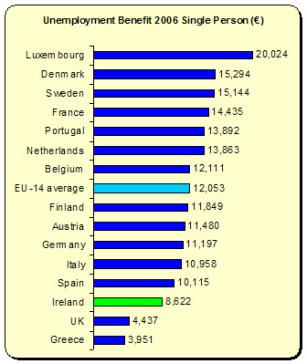 If you are an unemployed single person, you’re not doing well in Ireland. We are the third least generous in the EU-15. Our basic unemployment payment is 29 percent below the average of other EU-15 countries. Even poorer countries such as Portugal and Spain make higher payments. Now if we were Luxembourg, you’re argument about the ‘most generous‘ might hold water.
In addition, Irish welfare payments to the single unemployed makes up only 34 percent of net take-home pay, again the 3rd worst in the EU-15 tables. The average in the other countries is 58 percent with, again, plucky Luxembourg paying out 85 percent of net take-home pay.
Just a couple of notes on this data:
-
First, these figures relate to a wage of approximately €29,960 – the average private sector pay in Ireland (you might be interested to know that we Irish are paid substantially less than our EU-counterparts; the average private sector pay in the other EU-15 countries is €33,798; we are paid over 11 percent below average. If we compare ourselves to the average pay in the ten wealthiest EU countries, we fall over 23 percent below average).
-
Second, I have focused on the base unemployment payment, excluding housing benefit for all countries. While we have rent and mortgage supplements, a large majority of the unemployed don’t receive these payments and of those that do, most do not draw down the maximum amount available. This creates some problems in comparison since in some countries, housing costs are calculated in the basic unemployment benefit (e.g. France), but the explanatory tables to the OECD data don’t suggest this skewers the data by a significant amount. We are still paid well below average.
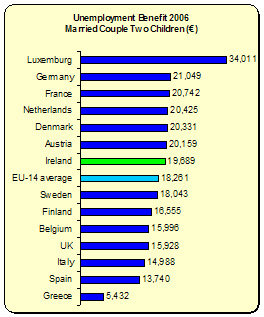 When it comes to comparing payments for a married couple with two children (and here I use the Irish average industrial wage of €38,000) Ireland does better, thankfully. Payments are somewhat above average – in the mid-table. But, again, I would hardly describe this average performance as the ‘most generous‘ in Europe. And still, we don’t manage to pay the average replacement rate as pertains in the other countries. An Irish couple with two children will only receive 52 percent of their net take-home pay. In other EU-15 countries the average is 59 percent.
However, none of the above takes into account living standards. This is important to factor in because, as I’m sure you are aware Sarah, a Euro in France or Spain goes a lot further than a Euro in Ireland when it comes to buying goods and services. To factor this in we have to apply Power Purchasing Parities (PPPs) which evens out living standards throughout all countries and makes comparisons more valid. What happens when we do this?
Well, for the single person in Ireland, the unemployment payment they receive is worth even less in comparison with EU-15 countries. In Ireland, the payment would be worth €7,245; in the other countries – €11,699. That’s 38 percent below the average.
And when you apply PPPs to payments made to couples with two children, the Irish payment falls below the average in the other EU-15 countries.
Now, of course, you might have been referring to other aspects of our ‘most generous‘ social welfare system. Maybe you had in mind old age pensions. But the OECD’s database, Pensions at a Glance, shows that Irish replacement ratios (pension income as a percentage of pre-retirement earnings) is less than half the OECD average. In Ireland, an average income earner can expect 38 percent of their pre-retirement income as a pension; the OECD average is 76 percent.
Maybe you had in mind lone parents – except that lone parents are more at risk of poverty here than almost anywhere else in the entire EU.
Maybe you had in mind disability benefits, but I suspect we would see similar patterns since these benefit levels are pegged at our low unemployment payment levels.
The fact is, Sarah, that we do not have a ‘generous‘ welfare system, we have an anaemic one. But what would you expect? We have a relatively low-waged structure. Historically, we have a low level of public expenditure (though this is changing slightly with rising levels of unemployment driving the fiscal deficit). Indeed, low-tax, low-spend countries – of which Ireland has been the global poster child – don’t have generous welfare systems, or generous public services, or top class infrastructures.
I look forward to hearing how you substantiate your assertion that Ireland has the ‘most generous‘ welfare system in the EU. Or, failing that, reading your correction in your next Irish Times opinion piece.
Yours sincerely
Michael Taft
PS. You also mentioned that ‘you have no idea what middle-income means’. The following might give you some idea. The latest EU Survey on Income and Living Conditionssuggests that the ‘middle income’ household – with three people (one person working full-time, one working part-time or a dependent, and one child) – earned a little over €35,000 per year from work in 2007. In addition, they received €12,000 in social transfers (pension, Child Benefit, etc.). After tax-income for the entire household was €43,000 for three people to live on. Okay, this is a statistical construct – but it captures the ‘middle-income’. After mortgage/rent, utilities, VHI, childcare, transport to work, and, of course, purchasing the Irish Times, it ain’t much. And this is before the recession kicks in!


 Notes on the Front
Leave a reply to Hugh Green Cancel reply