
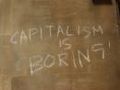
 The slogan 'Capitalism is boring' was championed by the Laboratory of Insurrectionary Imagination (though whether they first came up with it, I don' t know; I suspect workers down the ages must have thought it at one time or another). The Laboratory is a network of artists, activists and ordinary folk engaged in provocative protests of cultural and economic resistance. And, like the Clandestine Insurgent Rebel Clown Army, they can be both fun and thought-provoking.
So I'm kind of with them when they say 'capitalism is boring'. But not completely. For capitalism has its moments, transcendent passages that show us what life is like beyond the ordinary and everyday. Take Collateralised Debt Obligations (CDOs), for instance. Who would have guessed that this recently invented and, until recently, obscure investment-grade securities backed by a pool of bonds, loans and other assets had the capacity to bring the international financial system to its knees? And all of us with it.
So, just as the scientists over at the Laboratory or the foot soldiers of the Clown Army can put the grotesque into perspective, I wish to vindicate capitalism's potential to fill the theatres of the absurd.To aid me I reproduce below the best explanation of CDOs, which I received as an e-mail from someone who prefers to remain anonymous. Hopefully, it will get wide circulation (if it hasn't already).
* * *
Linda is the proprietor of a bar in Cork. In order to increase sales, she decides to allow her loyal customers – most of whom are unemployed alcoholics – to drink now but pay later. She keeps track of the drinks consumed on a ledger (thereby granting the customers loans). Word gets around and as a result increasing numbers of customers flood into Linda's bar.
Taking advantage of her customers' freedom from immediate payment constraints, Linda increases her prices for wine and beer, the most-consumed beverages. Her sales volume increases massively.
A young and dynamic customer service consultant at the local bank recognizes these customer debts as valuable future assets and increases Linda's borrowing limit.He sees no reason for undue concern since he has the debts of the alcoholics as collateral.
At the bank's corporate headquarters, expert bankers transform these customer assets into DRINKBONDS, ALKBONDS and PUKEBONDS. These securities are then traded on markets worldwide. No one really understands what these abbreviations mean and how the securities are guaranteed. Nevertheless, as their prices continuously climb, the securities become top-selling items.
One day, although the prices are still climbing, the bank's risk manager (subsequently fired due to his negativity) decides that slowly the time has come to demand payment of the debts incurred by the drinkers at Linda's bar.
However they cannot pay back the debts.Linda cannot fulfil her loan obligations and claims bankruptcy. DRINKBONDS and ALKBONDS drop in price by 95 %. PUKEBONDS performs better, stabilising in price after dropping by 80%. The suppliers of Linda's bar, having granted her generous payment due dates and having invested in the securities are faced with a new situation. Her wine supplier claims bankruptcy, her beer supplier is taken over by a competitor.
The bank is saved by the Government following dramatic round-the-clock consultations by leaders from the governing political parties (and vested interests).
The funds required for this purpose are obtained by a tax levied on non-drinkers.
* * *
Capitalism may, ultimately, be boring. But, at times, it is, well . . . curious.

 Notes on the Front
Leave a reply to liam Cancel reply