
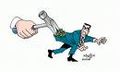
 Imagine you are the proverbial 'business owner', selling goods and services in 'the neigbourhood'. Your customer base is deteriorating fast – people losing their jobs, wage freezes and cut, shorter working hours; your customer base doesn't have as much money to spend on your goods and services. Your business suffers and you're just hanging on, hoping to ride it out.
And then, along comes a political party (they're called 'Tribe of the Irish' but let's use another vernacular: Fine Gael) who say they have the answer. They're going to cut the wages of even more of your customer base – approximately one-in-six. What's the effect on your business? Not good. What's your reaction? Well, despair; and then you look out for a political party who's going to do the exact opposite – with proposals that will increase people's spending power, not cut them.
That's a vignette from a rational world; now let's return to the Irish world where the two main parties outbid each other in how much public spending they're going to cut, how many public servants they're going to fire, how much of the public sector wage bill they're going to slash. At the weekend, Enda Kenny upped the bid:
'The country cannot afford the national pay deal. It is as simple as that. This deal must be suspended for 12 months and reviewed after that. It was negotiated in a different context with different expectations. I am calling on Government and public service unions to implement a complete pay freeze for 12 months.'
This is meant to sound significant, the words of a leader who will take 'tough' action. Except that when you really study, it's hard to know what he's talking about.
-
Freeze public sector wages for 12 months? Public sector wages are already frozen for 11 months. All that chest beating for an extra 30 days?
-
Suspend the deal for 12 months so that the first public sector pay tranche doesn't come into effect until August 2010? Oooh, now that's tough.
Except that when he was invited on This Weekto clarify his proposal, all Enda would say is that it would include increments, which suggests merely an extra month. But then he claimed it would 'save' the taxpayer €500 million; this suggest that he's proposing no pay increase at all in 2009 – a suspension of the deal. So which is it?
Don't do your head in trying to figure out the logic because it's all of a piece. Several months ago, Fine Gael proposed that a public sector wage deal should be confined to low and average income earners. As recently as only a few weeks ago, Enda was calling for a pay freeze for public servants earning more than €50,000. He also used the €60,000 threshold. Now, he wants to freeze all public servants. This is make-it-up-as-you-go-along policy; doing the populist bit and damn the coherence.
But let's cut to the core – freezing public sector wags. Never mind that the net return to the Exchequer is substantially lower than the top-line. Is it a good idea. No. Just ask the proverbial 'business owner'. There is one sector at least, which we have democratic control over, that can boost jobs and income – the public sector. This is not just about public sector numbers or the wage bill; were the Government to launch an infrastructural drive funded by increased borrowing, it would, in effect, be increasing the amount of wages and jobs dependent on public funding. It wouldn't appear on the Government's books as public sector jobs or wages, but they would be public sector dependent.
So a progressive government would have two important tools at its disposal to increase economic activity, jobs and disposable incomes – all of which are desperately needed today to maintain demand in the economy: direct and indirect public sector pay and jobs. Cutting wages and jobs in both these areas is a recipe for lengthening and deepening the recession. Full stop.
However, there is another debate: is the current pay deal appropriate for these times? The answer to that is no. If you want to increase spending in the economy you focus wage increases on the low and middle income groups. They have a higher propensity to spend, while higher income groups have a propensity to save. You want the former, not the latter – at least for the short term. However, the current pay deal doesn't achieve this – in fact, it does just the opposite.
The same percentage increase applies to all income groups (never mind the low-pay provision – it won't affect many people and it amounts to 5 cents per hour before tax and PRSI). So someone on €30,000 will get an extra €1,000 on an annualised basis. Someone on €70,000 will get two-and-half times more – €2,450. Not terribly focused.
So, do we blame the big bad trade union movement? Actually, ICTU entered the talks seeking a flat-rate increase, which would have disproportionately benefited low and average income groups (Mandate led the charge demanding €30 per week). The talks broke down because the Government and employers wouldn't concede that. When the talks resumed, they still wouldn't concede that. The trade union movement couldn't make ground on this necessary claim.
Now the unions are backed into a corner, defending a pay deal whose structure was determined by IBEC and the Government, not the unions themselves. Fine Gael, who can't even clarify a simple question, will exploit the situation for all its worth. Fianna Fail, not to be outdone on this issue, will renege on pay increases next year (it's been done before so there are precedents). This will cut people's disposable income in real terms, reduce spending, reduce consumer confidence, take money out of the economy at a time when we should be putting it in.
The proverbial business owner will suffer declining sales. She or he will have to lay off workers, or short-time them, or cut their wages. This will further reduce demand in the economy and we spiral ever downwards.
And throughout Enda's mutilation of facts and arguments – where is the Left? It has an opportunity to make a coherent economic argument, champion expansionary policies, while at the same time gain political kudos from 350,000 employees in the public sector who under attack every day by the Right. To my mind, that's win-win-win.
At least it would be in a rational world.


Leave a Reply