
 Spare a thought for Robert O’Byrne. He resents being made ashamed that he is a member of the middle class. He complains that when the homeless die in the streets, they feature in the Irish Time whereas middle class folk dying in their own homes doesn’t even merit a mention. And to top it off, he can’t afford a taxi. Tough times, indeed. So thorough-going is his despair that Donagh’s thorough response will be little solace to Mr. O’Byrne who, I fear, is destined to repeat fashionable stereotypes and misjudged analysis.
Shame, though. For middle income earners are being squeezed. But Mr. O’Byrne doesn’t seem to know exactly how, never mind why.
The recent publication of the EU Survey on Income and Living Conditions for 2006 provides an opportunity to revisit the theme I developed in previous posts – namely, the continued decline in the living standards of the great middle strata. I use ‘strata’ purposely. There is a long-term and important debate on the nature of social class (which Mr. O’Byrne tries to access, only to completely misread and misinterpret Conor’s more considered contribution). However, I want to short-hand all this by using the CSO data to look at the fortunes of people who earn a little money, a little bit more money and a lot of money. This doesn’t equate to class. Nor does it describe wealth. But it does show something just as important.
Using the CSO data, we can group people on the basis of working income per adult (this is different from ‘household income’ which can include two and even three income earners). Let’s call the top 20% income earners ‘Upper Income’ and the lowest 20% ‘Low Income’. The rest – the vast 60% – we’ll call the middle strata. This is circumscribed by the data presented in the CSO report, but this breakdown certainly corresponds to the ‘we’re all middle-class now’ perspective. What does this tell us?
 First, the vast majority of working people earn less than the average income. The range of weekly income for the middle strata is between €473 and €711. Even if we take middle strata earners at the upper end, it equates to less than €37,000 per year. To be middle income is not to make a whole lot of money.
Second, the gap between the middle and lower strata is less than €300 per week, while the gap between the middle and upper strata is more than twice that amount. The wealthy really are different from you and me. In terms of growth we can see that the middle strata are falling even further behind.
 We should be cautious when analysing the figures for low income groups – not only because they start from such a low base, but because even slight changes in wages and working hours can distort percentages. Nonetheless, it is clear that the middle strata is (in percentage terms) faring worse – falling behind the upper strata and the average increase.
Let’s put some Euros and cents on all this. This puts that 16% increase for low income groups in some perspective – it amounts to a weekly increase of €13 per year between 2003 and 2006.
 And the great middle strata? They managed to earn an extra €23 per week each year. Needless to say, that is below average. In fact, it is around one-third of the increase doled out to the upper strata.
There’s one more turn of this screw. What do the increases mean in the real world – that is, when inflation is taken into account? This tells a depressing story. Accounting for inflation, the middle strata managed to earn an amazing €8 per week on an annual basis over the three years for which we have CSO  data.
data.
Ponder that for a moment – €8.
No wonder we hear that refrain so often – ‘The economy is growing but I don’t feel myself better off.’
So now our our final stat – how much was the average annual growth in people’s income? The vase bulk of working people earned increases of about €400 or less per year. And that’s before tax, PRSI and local charges.
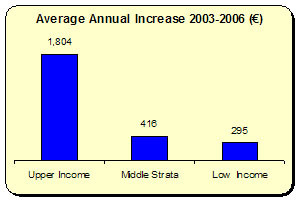 At the risk of sounding clichéd, it does seem that the more you have, the more you make.
A legitimate question is – can this really be the case? Do the vast middle 60% of the working population actually earn, on average, only €572 per week? This seems counter-intuitive, especially when reading the Irish Times shopping supplements.
As always, we should take care with these, and any other, results: they all have their methodological idiosyncrasies:
- For instance, the EU Survey is conducted by the CSO throughout the year but interviews people at a particular point in time. It could be that, at that particular time, they are between jobs or between contracts, thus lowering their income at that moment, but under-estimating the total year’s income.
- All surveys based on information supplied by the interviewee can be, quite innocently, mistaken.
- The survey doesn’t pick up income from ‘borrowings’ – whether credit card or property equity (neither does it pick up the inevitable ‘repayments’) – so this can’t be read as a comprehensive living standard measurement.
- And, of course, it’s not likely that black-market income will feature.
But despite these rather minor caveats, the results mirror other reports. The CSO’s 2006 Employment Survey states that 50% of all wage earners in the private sector make less than €13.80 per hour. This amounts, on a full-time basis, to €28,000 per year. It further states that more than 2/3 earns less than the average national wage.
Even if wage levels are relatively moderate, nearly 30% of employees in the non-financial service sector are part-time according to the Annual Services Enquiry – so their annual income will necessarily be limited.
And there’s little succour for the self-employed: the EU survey states that 50% of all income from self-employment flows to the top 10% of households in the country.
When we connect the dots from various reports we get a picture, a broad landscape – of an economy where people are relatively low-waged, relatively low-income, struggling and juggling to make ends meet. And this period we have been examining was marked by high economic growth. What will happen in the next few years with commentators suggesting that our growth levels will be substantially lower? If a few bob after inflation is that most people could manage during the good times, what will be the returns during the less-than-good times?
So if Mr. O’Byrne wants to call all these people ‘middle class’ because they own a home (or part of the equity in their home), because they eat out more often, because they take a holiday in Lisbon (a cheaper bet, even with air fares, than Galway), because they stayed in education longer than their grandparents – then so be it. It doesn’t tell us much, it doesn’t enlighten us, it doesn’t move the debate on.
Which, as I said, is a shame. Because there’s a real story to be told.


 Notes on the Front
Leave a reply to Michael Cancel reply