
Demands for cutting taxes on energy are growing. And the Government appears to be listening.
‘The Taoiseach has strongly hinted that cuts to excise duty on fuel are being considered to help households with the soaring cost of energy as a result of the war in Iran.’
This would be a mistake. A cut in VAT and / or Excise duties would disproportionately benefit high-income groups.
In a previous post I argued that an infrastructure of energy price accountability should be established to prevent opportunistic pricing and price-gouging. The recent and curious 50% rise in home heating oil is a case in point.
It is clear the Government will not establish such a price regulation regime and are turning to what kind of supports should be introduced for households. Back in 2022 the ESRI estimated the distributional impact of energy supports for households. First, they looked at cutting VAT from 13.5% to 9%, and cutting Excise duties on petrol and diesel by 50 cents per litre.
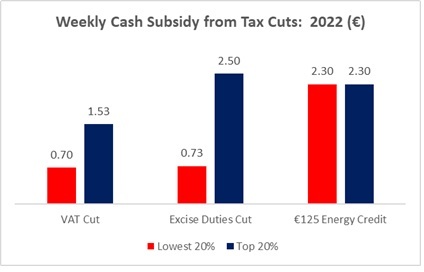
The VAT cut would deliver twice as much cash to the top 20% households as the lowest 20%. The cash subsidy from cutting excise duties is even more regressive, delivering more than three times the cash benefit to the top 20%.
An electricity credit, on the other hand, would deliver the same benefit to households, regardless of their income. That’s because it is a flat-rate payment.
The debate over energy supports for households has focused on the universalism of electricity credits; that is, everyone gets it even if they don’t need it. However, cuts to VAT and excise duties are also universal, directing even more money to households don’t need it.
Means-Testing
Next, the ESRI looked at supports delivered through the social protection system – a once-off doubling of social protection payments (similar to the Christmas bonus) and a doubling of the fuel allowance. Unsurprisingly, they found these measures to be highly progressive.
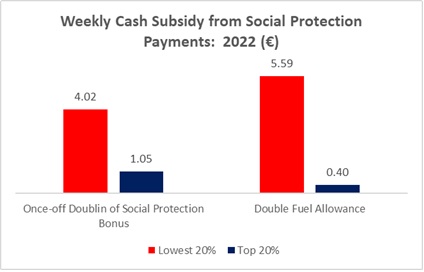
Whie these measures would greatly benefit current recipients, the problem is that it excludes hundreds of thousands of households who are already struggling with energy bills, never mind the increases that may result from the US/Israeli invasion of Iran. These include low and middle income households who are in work.
More than Just Hope
If a household supports are deemed necessary, the best energy package would be a combination of social protection measures and a household energy (electricity) credit. This would be progressive and would direct resources into low- and average-income households.
Progressives, however, should oppose cuts in indirect taxes – VAT and excise duties. They are regressive and inefficient.
It is imperative that any package brought forward by the Government be based on evidence; namely, the distributional impact. They have the tools to do so.
Ultimately, though, we need a government that has a long-term perspective, rather than just jumping from crisis to crisis. The Tánaiste’s’ response to the overnight increases in home heating oil doesn’t instil much confidence:
‘All I’m saying is, if you [companies] were able to hike up the prices that quickly, if we get to a situation there’s some stabilisation in oil prices, I hope those who hiked things quickly would be as quick to reduce things’.
We have to do better than just ‘hope’.
 Notes on the Front
Leave a comment