
Minister Peter Bourke was out recently lauding the record of job creation. However, the Irish Times took a more nuanced approach:
‘ . . . there is a risk here of looking in the rear-view mirror. More recent indicators suggest a slowdown in jobs growth . . . ‘
Given that much of Ireland’s economic data is near useless (for instance, GDP), commentators have suggested we track employment to assess our economic health. Doing this, we find the economy may be getting a bit under-the-weather.
For private sector employment has, over the last year, stagnated, generating no new net jobs according to the CSO’s Earnings, Hours and Employment Costs Survey.
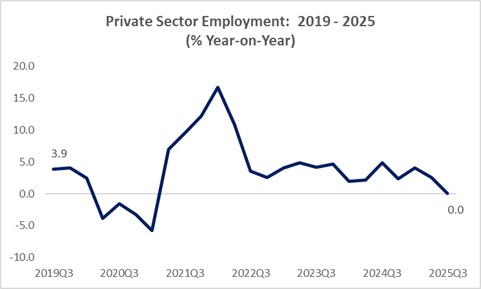
Just prior to Covid, the private sector employment was increasing by 4%. After the lockdown-related job losses private sector employment rebounded and following the bounce was growing at a healthy 3.5% clip. But now, it has ground to a halt. While we should be cautious about inferring too much from short-term developments, especially with base effects, this is the lowest quarterly growth in the last six years (Covid quarters excluded).
This trend is confirmed by another CSO database – the Monthly Employee Series from Administrative Data Sources.
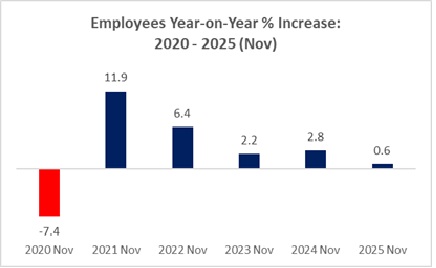
This follows a similar pattern: a fall during the lockdowns followed by a bounce back, and then a three-year decline with growth last year below 1%.
That employment growth is slowing is not surprising. The Government projected employment growth to slow to 1% over the next few years. The only problem is that the slowdown might be coming earlier than expected.
There are steps that we can consider:
- State-supported employment increases in critical areas: construction employment fell by 3,000 in the last year which should be strange given the demands for labour in housing, infrastructure and retro-fitting. And we will need more carers as society ages.
- Boost the quality of employment throughout the economy: wages and working conitions. This would also include collective bargaining in order to reduce wage inequality and redirect current resources into low- and average-income households.
- An active enterprise policy that redirects labour from low value-added sectors (e.g. hospitality) into higher value-added sectors (e.g. manufacturing and just about any other sector given hospitality’s low value activity).
There are a range of measures we should be debating. But the first step is to acknowledge what is happening on the jobs front and what we are going to do if job creation continues to trickle down to zero or even turns negative.
 Notes on the Front
Leave a comment