
While the VAT cut on food services was farcical, the tax cuts for property developers was insidious. It was framed as necessary measures to increase apartment construction viability. But the real story is that developers threatened the Government: if you don’t give us more subsidies, we won’t help you meet your housing targets. And the Government blinked, constrained by its own ideological limitations and the lack of an over-arching alternative.
However, you interpret it, the developer tax cuts represent a significant transfer of public money to powerful private interests.
Developer Profits
The Department of Housing estimates developer profits in its Total Development Cost Study. It looks at five case studies from the Greater Dublin Areas, two of which are apartments.
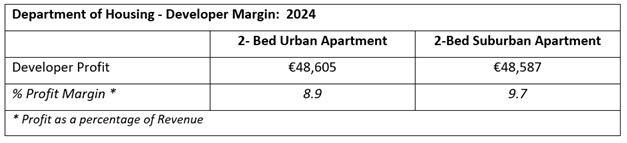
In 2024, developers’ profit represented nearly €50,000 profit on each apartment unit, whether urban or suburban, in these case studies. We can look at two developers’ accounts to see if these case studies hold up: Cairn Homes and Glenveagh.

The two developers are solidly profitable. In 2024, the two generated profits of over €200 million – a significant increase over previous years. Profit margins are also increasing, running at between 11 and 13 percent. Of course, the two developers build more than just apartments. However, this provides, at least, some support for the Department’s case studies.
The Minister for Housing stated:
‘If there was even a small profit, people should be building apartments.’
Well, that benchmark has been achieved. So, the question is similar to that of McDonald’s and the hospitality VAT cut – do Cairn Homes and Glenveagh need a VAT cut?
Is the VAT Rate Too High?
Is the VAT rate on construction too high compared to other EU countries? Hardly. If anything, it is far too low, even before the cut to 9 percent.
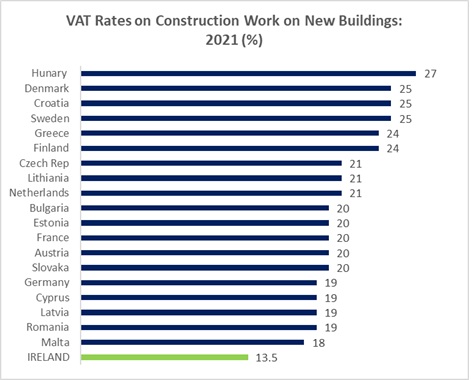
Ireland already has the lowest VAT rate on construction work on new buildings, at 13.5 percent. Now it’s dropping to 9 percent. How is it that developers/builders can survive in other countries with much higher VAT rates, while here we need to cut an already low rate even further?
Effect of VAT Cut
How much is the VAT cut worth? An approximate estimate is that the VAT cut will be worth approximately €18,000 to €19,000 for suburban and urban apartment respectively, using the Housing Department’s estimates.
The Government has made it clear that the VAT cut is not about ‘affordability’. That seems reasonable; if the VAT cut went towards reducing price, it would only amount to 3 percent – falling from €592,000 to €572,000.
So what’s the intention? According to the Minister for Finance:
“This reduction will help address the viability gap in apartment construction as part of a social policy to deliver more and higher density apartments.”
‘Viability gap’ – what’s that? According to the Housing Agency:
‘A viability gap is where the cost of building an apartment, or a house is higher than its market sale price.’
By this definition, where is the viability gap? According to the Housing Department and companies’ own financial accounts, there appears to be increasing profitability; that is, viability.
The Actually Existing Market
What might the impact of the VAT cut be in the actually existing market? First-year economics (and every-year common sense) tells us that if you throw money into a market where demand outstrips supply, you’re likely going to feed supply prices. According to UCD’s Orla Hegarty, that’s what is likely to happen.
‘The VAT cut adds €20,000 to this [developer] profit margin, for every apartment . . . more government interventions that are inflationary, that drive up land values, that shore up dysfunction, and that worsen the housing crisis . . . a sweetener for developers that will be absorbed into margins and land values, worsening structural problems in sector . . . ‘
The VAT cut could boost developer incomes – increasing profits by nearly €20,000, and increasing the profit margin from 8.9 percent to 12.4 percent in the Department’s case studies.
Cairn Homes’ CEO believes the benefit could be even higher.
‘Michael Stanley, chief executive of Cairn Homes, said a suite of budget measures announced on Tuesday, together with new apartment construction guidelines unveiled during summer, are probably worth about €70,000-€80,000 per apartment.’
The construction guidelines he refers to reduced the size of studio apartments (to the size of two car parking spaces with less window light!), allowing a higher proportion of studio apartments in a complex at the expense of two and three-bedroom, accommodation suitable for families. If Stanely is correct, developer margins could increase even further.
This is also likely to lead to higher land prices as more profitable units can be squeezed into a site. Land prices make up a significant proportion of apartment costs, even more than the developers’’ profits: €70,000 per urban apartment unit, or 11.9 percent of total development costs. If land values are pushed up in a supply-constrained market we could be inflating prices which should be the last thing the Government does.
A Developer’s Bonanza
The VAT cut was only one of a number of tax cuts for developers. The others include
- Exempt Cost Rental Income from Corporation Tax
- Enhanced Deduction for Certain Costs incurred on Apartment construction
- Extend Residential Development Stamp Duty Refund Scheme
These four tax cuts will amount, in a full year, to €563 million. Over half a billion Euros are being thrown at a dysfunctional market which will boost developer margins, enhance land values, and potentially drive-up prices. You couldn’t make this stuff up.
A Starting Point for an Alternative
The powerful developer / landowner lobbies put it up to the government. Either give us more money or we threaten not to build more accommodation (an ‘investment strike’). The Government without any other tools I its policy tool box, gave into this – just as they gave into demands for degrading apartment quality.
But the market is trying to tell us something. The nursing home sector cannot not provide affordable nursing home places without massive state subsidies (80% of revenue coming from Fair Deal). Without state subsidies the childcare market could provide affordable childcare ; 60 percent of providers’ revenue comes from public subsidies.
The housing market may be telling us something similar – that without considerable public subsidy, it cannot provide affordable home, whether for purchase or rent. We are faced with, broadly, two options:
- Throw even more money at private agents in the hopes they will build affordable homes
- Or, provide affordable homes directly through government agencies
Here’s a small insight from the Government’s Development Cost study to get us started on that answer.
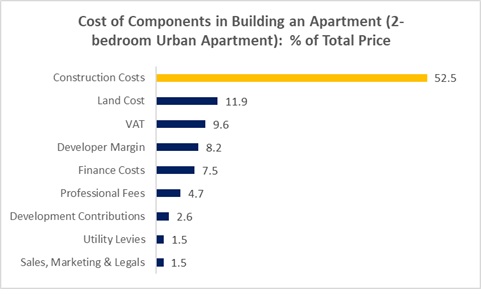
The actual construction costs of a 2-bedroom urban apartment are only about half of the overall price. Land prices and developers’ margin make-up 20 percent of the overall price. If public agencies built housing on public land, developers’ margin and land costs could be largely removed – two big steps towards an affordable home.
Yes, the market is trying to tell us something.
Note: thanks to Orla Hegarty for pointing out the Housing Department’s development cost study and the ensuing analysis. She can be found on Bluesky.
 Notes on the Front
Leave a comment