
The Government intends to launch a drive to ‘de-regulate’ business activity which could put the public interest at risk. The Programme for Government is filled with commitments:
‘. . . [reduce] the cost and regulatory burden on business . . . eliminate unnecessary bureaucracy [to]facilitate business operations . . . identify regulations that are now redundant to reduce unnecessary red tape. . . Reduce where possible the regulatory burden simplifying EU rules for the SME and farming sectors.’
With the EU Commission leading the de-regulation charge, all the chatter is about burdens, red tape, paperwork, market barriers, and so on. Here at home the argument is that Irish business is hamstrung by over-regulation. Remove those road-blocks and business will flourish and innovate, creating jobs and value-added.
How likely is that? According to Alberto Alemanno, Jean Monnet Professor of European Union Law & Policy at HEC Paris, not much – at least at a European level.
‘. . . the commission’s deregulatory turn could undermine investor confidence and regulatory stability. . . effective regulation has driven economic and social progress and bolstered the bloc’s global influence. Massive deregulation could prove to be a self-inflicted debacle that impedes the EU’s ability to protect Europeans and severely undermine what remains of its credibility as a rule-maker. The EU’s simplification effort . . . aims to enhance Europe’s competitiveness, but is bound to have the opposite effect.’
Nonetheless, our own Government seems to have bought into the assumption that culling regulations will boost productivity and competitiveness. There’s just one problem with this narrative.
- Ireland already has one of the least regulated economies in the EU.
The OECD measures the regulatory impact on economies through its Product Market Regulation Database. This covers administrative ‘burdens’, state-induced distortions, barriers to domestic and foreign entry, barriers to investment and setting up businesses costs, etc. The following table ranks Ireland in two indicators: overall product market regulation, and ‘Administrative Requirements for Limited Liability Companies and Personally-owned Enterprises’. The higher the value the stronger the regulatory regime.
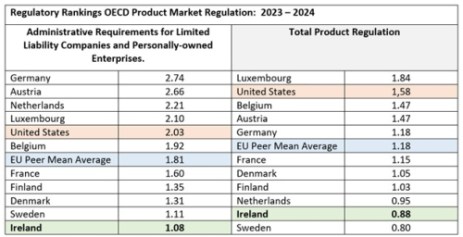
Ireland ranks at the bottom of administrative requirements for companies and self-employed businesses. In terms of the overall product regulation, Ireland ranks second to the bottom. Indeed, the US – which is held up as a pro-innovative, regulation-free zone – has a stronger regulatory regime than Ireland and all other high-income EU countries, bar Luxembourg.
This hardly suggests Ireland is ‘over-regulated’.
Question: if a ‘light’ regulatory regime produces higher productivity, why does the Irish domestic sector have such poor productivity while other small open EU economies have both stronger regulations and higher productivity?
The battleground in all this will be extremely opaque. There are numerous regulations across a variety of dimensions, many of which impact on very detailed aspects of production, distribution, consumption, marketing, transparency. The EU economy commissioner Valdis Dombrovskis stated:
‘Reducing unnecessarily complex EU rules is a vital part of our plan to make Europe more competitive. This simplification agenda is not about deregulation. It is about achieving our goals in a smarter and less burdensome way.’
Who could argue with that? However, in pursuit of ‘simplification’ we have seen in the last few weeks:
- The European Commission is seeking to remove 80 per cent of firms — around 40,000 — from an annual requirement to disclose their climate risks.
- The Commission is getting rid of mandatory penalties for companies that fail to prevent human rights or environmental abuses in their supply chain in the corporate due diligence directive. It intends further restrictions which could render the directive relatively toothless.
- The Commission intends to remove a couple of hundred thousand companies from the new carbon border tax which will now apply only to major buyers of iron, steel, aluminium, cement and fertilisers, or those importing 50 tonnes or more per year.
This is not about ‘simplification’ or ‘reducing complexity’. This is about abolishing regulations, using exemptions and thresholds to achieve this. The Commission estimate savings to European companies of €4 to €6 billion which, while it sounds a lot, only comes to 0.03 percent of turnover for large EU companies. And the ‘savings’ rarely includes the cost of abolishing regulations – environmental costs, workplace abuses, etc.
Why should this matter? Regulations operate to protect the public interest: environment, labour conditions, workplace health and safety, consumer safety, financial transparency, and so much more. Deregulation (or, if you prefer, ‘simplification’) could end up putting these interests at risk.
This is not about competitiveness. It is about subordinating the public interest to corporate and oligarchical agendas.
And if that were to happen, it would be one more bad day for democracy.
 Notes on the Front
Leave a comment