
A common complaint heard, especially during the recent election campaign, is that while we are a ‘rich country’, there are a lot of people not feeling it. This is certainly the case – a lot of people not feeling it. But what if the premise is wrong? What if we’re actually not all that rich; at least, not households.
Adjusted gross household disposable income is a bit of a mouthful. This measures the amount of money flowing into households on a per capita basis, factoring in living costs and in-kind public service benefits (e.g. health, education, childcare, etc.). So how do we rank in the EU?
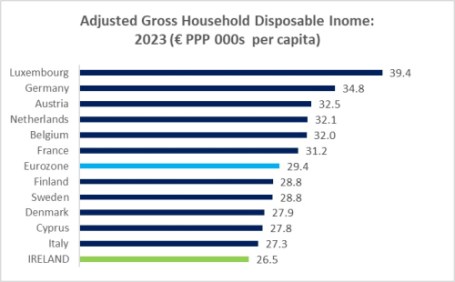
We are below the Eurozone (and the EU) average. Our ranking in the EU is middling and well below what we might expect. To reach the Eurozone average in 2023, households would need an increase in income of 11 percent. In Euros and cents, this would mean an increase of €4,300 for every woman, man and child. With that kind of increase, more and more people would start ‘feeling it’.
There are a number of factors involved in this disappointing outcome.
- First, we have one of the highest living costs in the EU which degrades household income. In nominal terms, without factoring in living costs, we are over 20 percent higher than the Eurozone average. However, living costs reduces this advantage to such an extent that, when adjusted, we fall to nearly 10 percent below that average. We have the veneer of high income but that’s all – a veneer, an inflationary-fuelled mirage.
- Second, wages are the main components of household income but over the long-term wages have fallen behind productivity. And given that we have one of the highest levels of wage inequality, a lot of people are getting a fair share of the value they are producing.
- Third, Irish public services play less of a role in supporting household income than in other EU countries. This is about more than just social protection payments. The above adjusts for free services or services delivered at below market-rate such as health, education, childcare, public transport are factored in. This plays a two-fold role: increasing resources to households and reducing living costs.
Therefore, raising Irish household income to average EU levels means not only increasing wages and social protection payments, but reducing living costs and expanding free public services.
It will be interesting to see how, or even if, the new Programme for Government addresses this. But first we have to acknowledge there’s a problem – that despite the dizzying numbers produced around GDP, GIN*, Modified Domestic Demand, etc., Irish households are poorer than the Eurozone and EU average.
What is the incoming government going to do about that?


 Notes on the Front
Leave a comment