
As the main parties resume their negotiations for a new government, what are the options for a new policy approach to childcare? The option of direct provision of childcare services through the public sector was raised during the election campaign. Fine Gael, for instance, committed to creating 30,000 public places in early education and childcare services. Other parties made similar commitments.
A key backdrop to all this is high levels of profits being generated in the childcare sector – private profits being generated in what is basically a public services. A look at these profits levels should help focus the government negotiations.
The following tracks the fortunes of the top 10 private childcare providers in the sector. The financial data comes from the Companies Registration Office, provided by the private sector providers themselves.
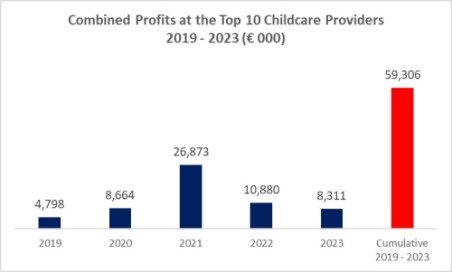
Two things stand out:
- First, over the five years, €59 million in profit was generated by the top childcare providers.
- Second, the covid years were highly profitable for the top providers – with €27 million generated in 2021 alone.
That’s a considerable amount of private money being generated from a highly subsidised public service. The Department of Children estimate that 69 percent of income to early years providers comes from state subsidies; only 30 percent comes from parent fees.
Profits are not the only way for owners to extract value from companies. Another source of revenue is directors’ remuneration – payments made to directors.
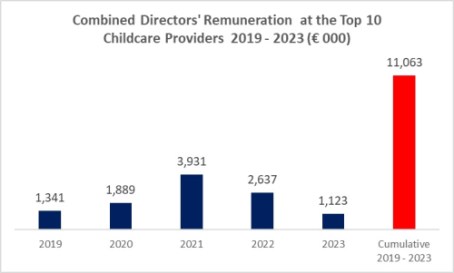
Over the five years, directors at the top 10 private childcare providers have taken over €11 million in directors’ remuneration. Given that there are usually only two to four directors in a company that is, again, a significant amount of mostly public subsidised money going into the pockets of a handful of people.
And, again, directors’ used the covid / lockdown years (e.g. 2021) to pay themselves well over the annual average for the five years.
The owners of childcare companies can use their profits, cash holdings and borrowing facilities for activities that have nothing to do with childcare. My favourite example comes from a company, among other things, diverting resources to invest in luxury property. From Links childcare 2021 accounts:
“The company advanced an initial loan of €1,500,000 to connected undertaking P. Kelly Villas Limited in a previous financial year and has advanced further loan funding in the current financial year. The loan balance receivable by the company at the financial year end amounts to €3,064,667 (31 October 2020 – €1,500,000) . . . P. Kelly Villas Limited is a company which is registered in Republic of Ireland and is a connected party by virtue of common shareholders and directors.”
Kelly Villas specialises in luxury property rentals in places such as Florida, Lanzarote, Marbella, etc.
Extracting profits, remunerating directors, funding expansions in the childcare sectors (and sometimes in Lanzarote luxury villas) does not sit easily with a public service. In fact, it shouldn’t sit at all.
Further, the idea that the provision of quality early years’ services to parents in any part of the country should be based on ‘market’ considerations (i.e. is there enough money to be made in Carlow or Mayo or North Dublin?) is one that should play no part in any childcare policy that emerges from the Government talks.
So what should emerge? A commitment to rolling out direct public provision. Where to start?
- First, where there is growing demand but limited supply;
- Second, where National Development Plan money is being spent on new childcare facilities (these shouldn’t be gifted to private interests); and
- Third, where a provider is closing down (sometimes for understandable reasons such as owner retirement) – the public agency managing childcare provision should have first call to purchase the ‘business’; so as to turn it into a public service.
A complementary policy of having the Government pay the wages of workers throughout the entire sector would also be key. Employees are still experiencing low wages and the sector is suffering from high staff turnover and an ability to attract employees. Only the state has the resources to invest in professional wages in addition to skills, training and career development. And the great advantage of this approach for households is that direct state payment of wages will relieve providers of that expenditure and, so, enable fees to fall by up to two-thirds (e.g. fees could fall to €50 to €60 per week).
This is the pathway to an affordable, accessible and quality early years’ service.
Hopefully, the government negotiators will start walking that path.
* * *
NOTE: the accounts of the following childcare companies were surveyed: Giraffe, Sherpa Kids / Sunago, Davencrest / Kids Inc., Park Academy, Cocoon, Safari, Grovelands, Little Rainbows-Monica Campbell and Tiger Time.
 Notes on the Front
Leave a comment