
Maybe it is true: the more you have the more you get. That’s if recent CSO data is anything to go by. The statistical agency’s Annual Earnings database provides a breakdown of annual earnings growth, including the top 1 percent and the top 10 percent.
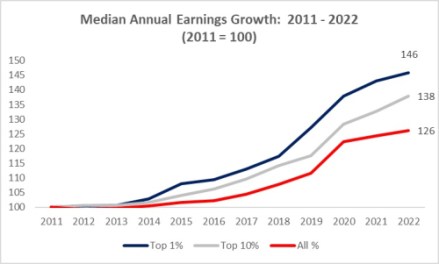
Between 2011 and 2022, the earnings of the top 1 percent increased by 46 percent while the top 10 percent grew by 38 percent. The earnings for all of us increased by only 26 percent. That is a significant gap.

In terms of actual median earnings, the top 1 percent took in over €283,000 in 2022 – up €89,000 since 2011. This is more than double the earnings of the top 10 percent. The top 1 percent earn 6.8 times that of all earners – up from a ratio of 5.9 in 2011.
In all likelihood this understates the gap between the top 1 percent and the rest of us. The above refers to earnings and doesn’t include capital gains and other capital income. Most capital gains flow to the highest income groups. Revenue Commissioners report that 73.8 percent of capital gains tax is paid by the top 10 percent of income earners.
Unsurprisingly, men in the top 1 percent earn more than women but only marginally so: 2.9 percent. However, among all earners, men earn 20.5 percent more. So the gap between the top 1 percent and the rest of us is larger among women owing to low earnings.
How much do the top 1 percent in each sector earn?
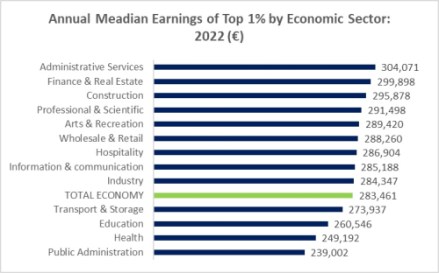
The top 1 percent in Administrative Services earn the most, at €304,000. This would probably be due to salaries in the aircraft leasing sector. Top earners in finance and construction round out the top three.
At the other end, the lowest earning among the top 1 percent work in the education, health and public administration sectors – sectors dominated by the public sector.
Wage inequality is a feature of the Irish economy. Ireland has one of the highest wage inequality ratios in the EU, ranking 6th out of 27 countries. Among its peer group in the EU, other high-income economies, Ireland leads the inequality table by a considerable length.
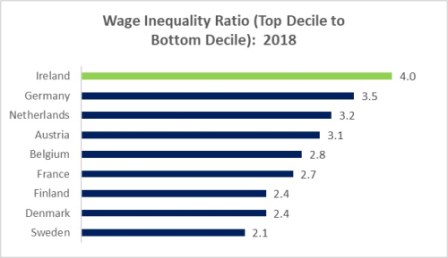
These Eurostat surveys are taken every four years. Ireland’s wage inequality ratio has remained constant. In 2006 the ratio was 4.0, the same level as 2018.
A number of reasons have been put forward to explain this inequality; in particular, the presence of multi-nationals which drive up wages at the higher end, and the lack of collective bargaining rights which can depress wages at the lower and average levels. These and other reasons need to be teased out.
But here’s one example: Sweden has a high level of multi-nationals operating in its economy, with 22 percent of its workforce employed by multi-nationals (Ireland is not that much higher at 28 percent). Yet Swedish wage inequality ratio is half of the Irish level. The big difference is not the level of multi-national employment; rather it is the high levels of collective bargaining and employee voice in the Swedish economy – at over 90 percent, nearly three times the level of Ireland.
At the end of the day, Inequality is a political choice.
 Notes on the Front
Leave a comment