
The background noise in the public debate is that since inflation is ‘easing off’, prices should start coming down. We have heard this in the coverage over the meeting between the Government and representatives of the food sector. However, this misrepresents how inflation impacts on living standards.
If the rate of inflation falls this doesn’t mean prices fall. It just means prices are rising at a slower level. The inflation of last year and this year becomes embedded in our living costs going forward.
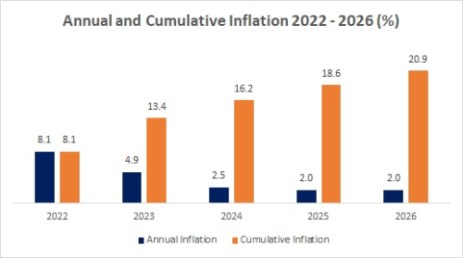
Last year, inflation ran at 8.1 percent. This year inflation is projected to slow to 4.9 percent. However, this only means that prices are rising at a slower pace. Over the two years, inflation will rise by 13.4 percent. By 2026, while price rises are projected by the Government to settle down to 2 percent annually (a manageable and desirable level), prices will have risen by 21 percent over the five-year period.
Of course, within this mix there will be some products or services where prices actually fall back. For instance, energy products have fallen by 6 percent since their high point in October 2022. Still, non-energy prices have continued to rise.
Inflation’s legacy will be a drag on household living standards for years to come.
There are two ways to overcome this crisis: reduce prices and/or increase income. That profits have been driving prices is discussed here. Increasingly, the debate has turned to price controls though it is hard to see the Government going down this route. They refrained from doing this with energy costs. What chance they will start with bread?
The second way is to increase incomes. Gross wages will have to rise by 5 percent each year between 2023 and 2025 to match inflation by 2025. Even if this were achieved, this would only bring employees back to 2021 levels in real terms. A number of years of income growth will have been lost.
Even so, wage increases of 15 percent between now and 2025 looks to be a steep hill.
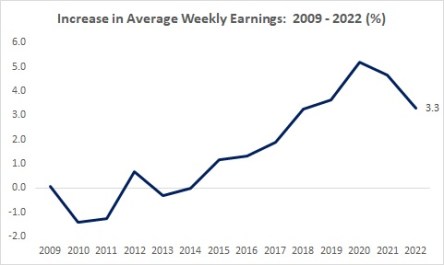
During the period of recession and austerity, average weekly earnings fell. They started rising (slowly) in2013. In 2019, the year before the pandemic, average earnings increased by 3.6 percent. They increased further in 2020 and 2021 but this would have been affected by compositional changes. Last year average earnings rose by 3.3 percent.
Wage growth of 5 percent for an extended period might be achievable in the context of a tight labour market – low unemployment, full capacity. An increase in union membership would also help. But it will be challenge.
Some will argue (as the Taoiseach has) that cutting income tax will ‘put more money in people’s pockets’ and, so, assist in fending off price increases. This is a poor argument.

For the single average earner on €46,000, the gross wage increase was 3.3 percent. When tax cuts are factored in, the increase rose slightly – to 3.5 percent. For the single average earner in the wholesale/retail sector, the tax cuts made only a fractional difference.
The dangers of going down the tax-cut route are two-fold: first, it diverts resources away from reducing prices in public services (e.g. public transport fares, childcare, free textbooks at secondary level, etc.). Second, such tax cuts are potentially regressive.
Let’s say we were able to increase wages across-the-board over the next three years to bring them back to inflation. We have another, larger problem. Namely, that we already have the highest living costs in the EU.
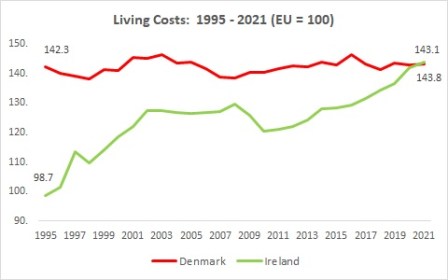
In 1995, Irish prices were below the EU average. However, over the years, living costs have increased to the point that they are now the highest in the EU. They are even above Denmark which has always been a high-cost economy. The Danes, however, have compensated their high costs through higher nominal wages, better resourced public services and a more generous social protection system. We haven’t.
The current cost-of-living crisis will subside, either through market equilibrium or the ECB raising interest rates even if they push European economies into recession. This crisis will pass, though it will leave considerable economic and social damage in its wake.
The point is this. Even after the current cost-of-living crisis we will still be in a . . . cost of living crisis. We will still have one of the highest living costs in the EU, if not the highest.
The question, therefore is: what do we do then?
 Notes on the Front
Leave a comment