
Pat Leahy, in describing the ‘intricate dance of the pay deal’ (referring to the upcoming negotiations over a new public sector pay deal), refers to the ‘hefty public sector (pay) premium’:
‘When it comes to average rates of pay it’s a fact of life that public sector workers are better paid than their private sector counterparts . . . ‘
Better paid? A fact of life? Hardly. This particular fact is not a fact at all.
The CSO publishes average rates of private and public sector pay from its Labour Force Survey (Table EHQ08).
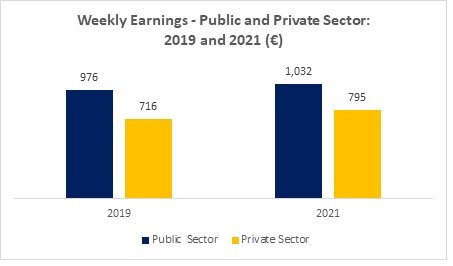
Pre-pandemic, public sector pay was 35.4 percent higher than private sector pay, while last year this gap was closed to 30.5 percent (though pandemic wage volatility may not have fully washed out). So does this prove the ‘fact of life’? No.
The most fundamental rule of comparisons is that they must be done on a like-for-like basis – otherwise, you could end up with apples, oranges and mangoes. For instance, in the public sector there are no occupations comparable to hospitality and retail. Conversely, there are no equivalent occupations such as Gardai and defence forces in the private sector.
Mr. Leahy seems to get some of this. He points out that large enterprises pay more than small ones, and that there is a premium associated with trade union membership – things that characterise the public sector. Fortunately, we don’t have to rely on anecdote or intuition.
The CSO has done (on three occasions) a like-for-like comparison between public and private sector pay.
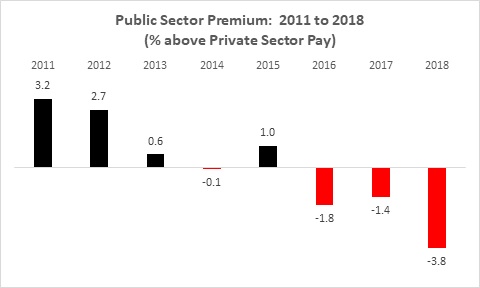
In 2018, public sector pay was, on average, nearly 4 percent below private sector pay. There was a public sector premium back in 2011 but at 3 percent, it could hardly be described as ‘hefty’. The ‘fact of life’ that public sector pay is higher than private sector pay hasn’t effectively been a ‘fact’ for years.
Why the difference between the straight comparison between public and private sector pay and the like-for-like comparison? In producing the latter, the CSO does a deep-dive into the variables that impact on the differential:
- Gender
- Nationality
- Age
- Full-time/Part-time status
- Supervisor status
- Temporary/Permanent status
- Shift work status
- Usual Hours worked
- Overtime Hours
- Length of service with current employer
- Union Membership Status
- Occupation
- Size of Enterprise
While overall public sector workers earn nearly 4 percent below their like-for-like counterparts in the private sector, the gaps widen when we focus on gender.
- Males in the public sector earn 10.3 percent less than their private sector counterparts
- Females in the public sector earn 3.3 percent more
For males, that is quite a gap. For females, the public sector still retains a small (not hefty) premium but this may be due to the fact that the public sector has been more successful in reducing the gender pay gap.
- Total gender pay gap throughout the economy: 3 percent
- Private sector gender pay gap: 0 percent
- Public sector gender pay gap: 1 percent
A contributing factor to the low (but still too high) gender pay gap in the public sector is collective bargaining – something that exists throughout the public sector but which private sector workers are largely denied. It should also be noted that the gender pay gap in the Irish public sector is the 6th lowest in the EU. However, the Irish private sector pay gap is the 8th highest.
The latest like-for-like data we have is from 2018. What’s happened since then? We have to be careful regarding data for 2020 and 2021 given the pandemic-impact on the composition of the labour market.
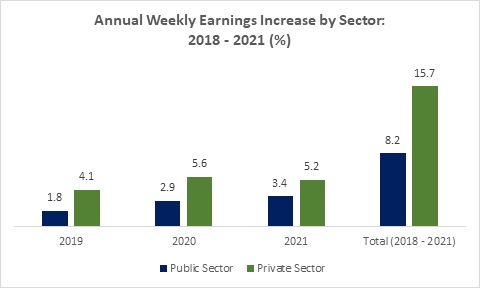
Private sector pay has increased at nearly twice the rate of the public sector. However, some of this increase could be compositional change (e.g. fewer hospitality workers would slightly increase the overall percentage increase in the private sector). However, we can safely say that public sector weekly earnings are, on average, not keeping up with private sector earnings.
* * *
None of the above is intended to suggest what pay increase either public or private sector workers should receive this year or next. It is only intended to show that the so-called ‘fact of life’ – namely, that public sector workers earn more than private sector workers – is clearly and demonstrably wrong.
It is imperative that commentators and analysts should, when making public statements, attempt to accurately describe the context. This doesn’t mean we will all agree on the optimal policy position. However, misstatements of facts skewer and degrade the public debate, and can potentially lead to socially inequitable and economically inefficient outcomes.
The remedy? Do a little research.
 Notes on the Front
Leave a comment