
After the achievements at the Tokyo Olympics and the ensuing celebration at home, we now return to the hard work of putting sports at the heart of a recovery strategy. We have a long ways to go. Ireland is a chronic under-funder of sports and recreation activities compared to our peer EU group.
As a proportion of national income, Ireland spends less than any other EU country. The average EU spend on sports and recreation is 0.5 percent of net national income; in Ireland it is less than 0.2 percent. This may appear to be a marginal difference but it would mean that Ireland would have to spend an additional €500 million plus a year to reach the average. To reach the top spender – Hungary – we’d have to spend an additional €2 billion per year.
Another perspective is the average expenditure per capita within our peer group.
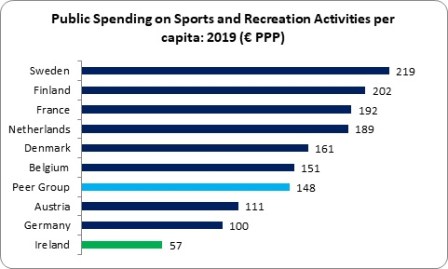
Our peer group spend nearly three times more on sport and recreation than Ireland with the table topper – Sweden – spending nearly four times what we do.
According to the Eurostat classification pending on sports and recreation covers a range of activities: sporting pursuits or events, recreational facilities, passive sporting pursuits (e.g. chess), grants and loans to teams or individuals and spectator facilities.
The Government’s National Sports Policy presents evidence that sport has a number of individual, social and economic benefits:
‘We now have a much better understanding of sport’s positive contribution to so many aspects of Irish life including health and wellbeing, social and community development, economic activity, educational performance and life-long learning.’
Such evidence includes:
- For every €100 invested by Government in sport, it received €149 in return in taxes
- Sport-related volunteering activity is estimated to have an economic value of between €322 million and €582 million annually
- ESRI research found a positive association between playing sport and Leaving Certificate performance among a sample of 1,200 students
- Research found that engagement in sport was associated with higher incomes among a sample of nearly 6,000 graduates. It also found that enterprises benefited from increased team working, communication skills, motivation, competitiveness and resilience by those engaged with sporting activity
- Research published in The Lancet in 2012 estimated that physical inactivity was responsible for 14.2 percent of all-cause mortality in Ireland. In 2014 this would translate into approximately 4,000 deaths in that year being attributable to Irish people not engaging in enough physical activity
- Physical inactivity has been estimated to cost the health budget approximately €1.5 billion per year.
The policy document found that sport also plays a role in tackling societal challenges around anti-social behaviour, particularly when offered as part of broader personal development programmes or in conjunction with community and youth services.
With all these benefits why doesn’t the government invest more in sports and recreation? The National Sports policy promises more resources but it is extremely modest. It proposes to increase spending on sports by a mere €100 million over the period 2018 to 2027 – a little more than an additional €10 million per year. This will keep Ireland at the bottom of the table.
However, were we to increase sport investment we should note the flaw in the Irish model of public spending. Like almost all other categories, Irish sports and recreation spending is highly centralised.
- In the EU, local government accounts for 81 percent of sports and recreation spending; in Ireland, it is 26 percent.
Spending through local governments can create greater accountability and more responsiveness to local need. This, however, is part of a larger issue with our anaemic local government structures.
Even the Government has shown the considerable benefits from increased investment and participation in sporting and recreational activities: better health and reduced health costs, increased tax revenue, better educational outcomes, increased social interaction and reduced anti-social activities. The good news is that investment in sport and recreation generates returns greater than the initial outlay.
Now what we need is a society-wide dialogue on where such investments should be directed: high-performance and amateur sports, age-inclusive activities, traditional and minority sports, public facilities and affordable access to participation.
That would be a fun conversation.
 Notes on the Front
Leave a comment