
The Minister for Social Protection, Regina Doherty, wants to guarantee everyone an adequate minimum income. Good. This would entail substantial redistribution to those on the lowest incomes. Fine. Hopefully she can convince her Cabinet colleagues. If she can, great. According to the Irish Times:
‘Signalling an intention to end traditional across-the-board welfare increases on budget day, the Minister said she wanted a far more targeted approach to guarantee a minimum basic income for everyone . . . Ms Doherty argued that the welfare system should guarantee a minimum essential standard of living (MESL) for everyone.’
Obviously the Minister has been poring over the Vincentian Partnership for Social Justice’s new release of their Minimum Essential Standard of Living (MESL), a detailed survey of what constitutes an income floor. The MESL is the minimum needed to live and partake in society, meeting the physical, psychological and social needs of individuals and households. It calculates the actual weekly cost of over 2,000 items (goods and services) needed to enable a socially acceptable minimum standard of living.
Much attention has been devoted to the Minister’s discussion of the gap between the living standards of pensioners in different parts of the country, but this misses the main point (I’ll return to the pensioners below). The Minister’s ambition would greatly expand the social protection budget. Let’s look at how much additional expenditure might be needed. The VPSJ lists 7 household types (of which two are pensioners), sub-divided into urban and rural. They then estimate the MESL required (the minimum level of expenditure), calculate the social protection income and show the ‘adequacy gap’. If the gap is negative, then that is the increase needed to reach the MESL.
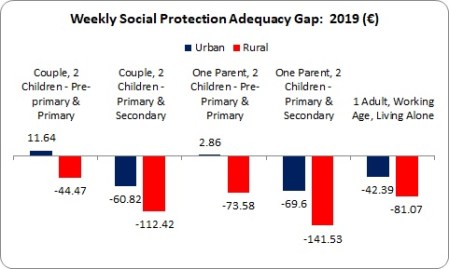
Out of the 10 household types, only two have a minimum essential standard of living – none in the rural areas. For instance, a couple with two children (in primary and secondary school) in an urban area would need a €61 weekly increase to reach the minimum essential income (or €3,200 annually); in a rural area they would need an additional €112 per week (or €5,700 annually). A lone parent with two children, similarly in primary and secondary school, in a rural area would need an additional €142 per week (or €7,400 annually).
These are massive sums. The Minister said she wants to move away from the €5 weekly across-the-board increase to one that targets household types in order to bring them up the MESL. This would entail significant increases for most categories.
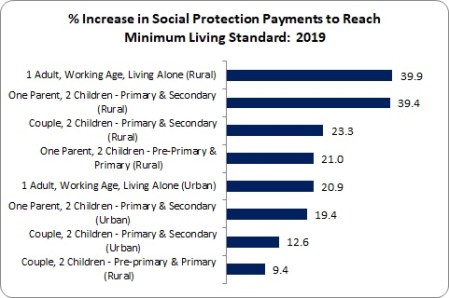
An across-the-board increase of €5 would mean a 2.5 percent increase. Compare that to the percentages needed to bring households up to a minimum living standard. The Minister referred to ‘targeting’ households. If that is her approach, then the Government would be targeting just about everyone.
Even the two household types with an adequate income – they’re not overly adequate. For an urban couple or single parent with two children in pre-primary and primary school – they are only 2 and 1 percent above the minimum living standard level respectively.
Another aspect that comes through in these household types is the difference between costs in the urban and rural areas. This was especially highlighted by the Minister in her references to state pensions. Again, the Irish Times reports:
‘It is not “fair” that some older people receive State pensions that are more than they need while others on the same amount live in poverty, Minister for Social Protection Regina Doherty has said.’
Let’s look at this ‘unfairness’.
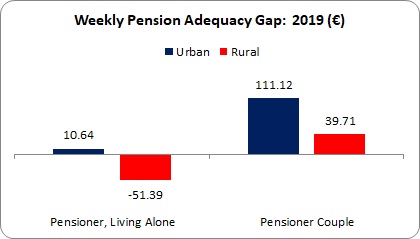
Pensioners in the urban areas have incomes above the minimum essential though for a single pensioner, but not much above. For those living in rural areas, single pensioners are below the minimum essential living standard while couples lag considerably behind their urban counterparts. The Minister homed in on this disparity.
‘The same payments for similar households in different parts of Ireland may not be appropriate, she said, adding that political and public “buy in” would be needed to explain to the “lady in Donegal” why she was going to get “more, or less” than “the lady somewhere else” in the State.’
Clearly, all rural households are disadvantaged. Is that because ‘costs’ are higher in the rural areas? Not really, not in the plural. There is only one significant cost difference.
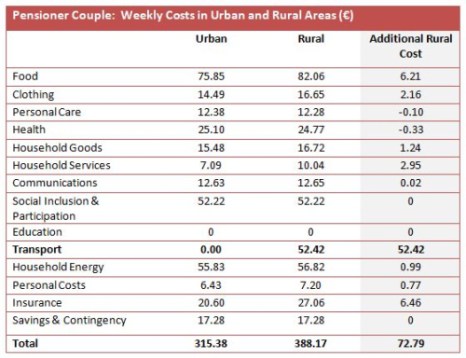
The overall cost difference is €73 weekly of which transport makes up 72 percent. VPSJ assigns no transport cost in urban areas since there are easily accessible public transport systems (with the Free Travel scheme). These systems do not exist in the rural areas. If we exclude transport, the difference falls to less than €20; or 6 percent higher costs in the rural areas – a gap but not a significant one.
The Minister appears to be seeking to equalise treatment among pensioners. The simplest way is to provide a €50 supplement for those with a car in the rural areas. This would significantly close the gap. Distinguishing between urban and rural areas would not be new. As late as 1988, rural recipients of basic social protection payments received 4 percent less than their urban counterparts – probably based on an old logic that people in rural areas could provide food from their own plots.
What would be the cost of bringing all households up to a minimum essential living standard? Let’s assume a 20 percent increase. Excluding pensioners, this would cost €1.4 billion (using Social Justice Ireland’s calculation for a 4.4 percent increase in 2020). That is significant but feasible.
This doesn’t include costs for all household types. For instance, it is reasonable to assume that people with a disability or long-term illness would have additional expenditures above average households. There are still the cuts to young people’s social protection benefits that are waiting to be restored. When all the myriad household types are accounted for, the social protection budget may need to expand even further.
One can’t help speculate whether the Minister is seeking to challenge the Taoiseach’s proposed tax cut, which would cost €3 billion over the next five. If only half of this were assigned to social protection benefits, the Minister’s ambition could be fulfilled.
However it is to be paid for, the goal of raising everyone up to the Minimum Expenditure Standard of Living would be a great stride towards eliminating poverty and redistributing income in society. If that is the Minister’s intention, she should be fully supported.
 Notes on the Front
Leave a comment