
With all the commentary understandably focused on a ‘hard border’ it is easy to forget that even in a soft Brexit, with a satisfactory outcome to the border, the hit to the economy could be substantial. We need a progressive response to the issues – one that goes beyond merely throwing money at exposed companies in the hope that some of it will be used ‘smartly’. The following outlines some proposals – but the most provocative one I’ve saved for last.
For a public housing drive can be of great assistance to softening the edges of a bad Brexit (and all Brexit outcomes, unless Britain remains in the custom union, are not good).
1. Sectoral Partnership Schemes
A number of manufacturing and service sectors have been identified as being relatively or highly dependent on the British market and, so exposed to a bad Brexit: food & beverages, traditional and materials manufacturing, printing, some pharmaceuticals. Further, financial, communication and IT sectors could also be affected.
A Sectoral Partnership Scheme would direct state aid to sectors and companies to help them adapt. This could be through goods and market diversification, niche marketing in the UK, production efficiencies, finance accessing, R&D and innovation initiatives, etc.
Sectoral committees (based on specific sectors such as food, printing, etc.) would be established with employer, employee and government representatives who would oversee these supports. All stakeholders would be involved in the design, implementation and monitoring of public supports. Employee participation in particular, through representative agencies such as trade unions, makes common sense since employees are the largest group of stakeholders affected. With input from employees, firm and sectoral strategies are likely to be improved.
2. Short-Time Working Scheme
The Government should introduce a short-time working scheme (similar to ICTU’s proposals re: the construction sector in 2009). Germany used this approach during the early part of the last recession. This would help ensure that workers remain in work. Where there is a fall in firm output owing to a Brexit-caused market hit, instead of laying people off, working hours would be reduced with the state subsidising the employer/employee for the wage loss. This would operate for a temporary period but it would give time for firms to adjust (e.g. for instance, under the proposed SPS above) or for job creation agencies to develop alternative employment in the area affected.
3. Strengthen Automatic Stabilisers – Introduce Pay-Related Unemployment Benefit
Unemployment Benefit acts as an automatic stabiliser when unemployment rises. Income from social benefit replaces income from work so that consumer demand can be maintained and the household’s income loss is ameliorated. However, Ireland’s automatic stabilisers – unemployment benefit – are weak. In other EU countries, unemployment benefit is pay-related – up to 80 percent of previous wage for a period of time; in Ireland, it is flat-rate and represents less than 25 percent of an average full-time employee’s previous wage.
Unemployment Benefit should be reformed to introduce a pay-related element (e.g. 75 percent of previous wage for a minimum of nine months). In the event of job losses arising this measure would help maintain consumer demand and, so, ensure that further job losses don’t occur because of educed consumer spending. It would also cushion the job-loss impact on household’s finances.
4. Public Housing
Public housing can be an important instrument in both resolving the housing crisis and reducing the hit from a bad Brexit; namely, a dedicated and substantial drive to construct public housing that can meet the housing needs of people both in and out of work.
There are two issues here. First, if we enter a downturn (not necessarily a recession) with a housing crisis, it is likely to be exacerbated and, so, cost even more to resolve on the other side of the downturn. In this instance, a public housing drive can be seen as cost-reducing measure over the medium-term.
More importantly, a public housing drive can replace the reduced growth arising out of a bad Brexit. Let us assume that national income gets hit (GDP or GNI or GNI*). Consumer spending, domestic investment and employment are reduced with negative consequences for public finances: falling tax revenue, increased public spending through rising unemployment payments, etc.
A recent study from the Irish Fiscal Advisory Council provides evidence that a public housing construction drive could drive up GDP in the short-term.
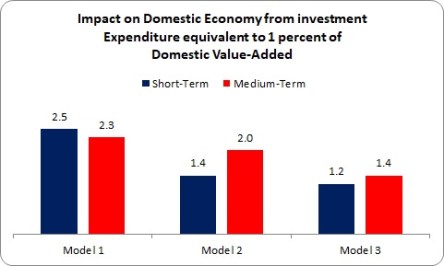
What this graph – taken from the Fiscal Council data – shows is that for every increase in investment equal to 1 percent of the domestic economy, the benefits will be nearly doubled in the short to medium-term in terms of domestic economy growth. Model 3 is lower because this measures the entire economy – both domestic and foreign-owned. The foreign-owned sector is unlikely to benefit from any such increases as they rely on foreign demand.
Over the long-term, the benefits disappear as is usual with once-off increases. But the issue here is to ameliorate any damage in the short-term from a bad Brexit. We can expect to see GDP/GNI* rise along with tax revenue; expenditure will fall given that more jobs are being created by the investment.
There are further, secondary, gains from a public housing drive that these multipliers wouldn’t pick up. For instance, more public housing would reduce expenditure on Housing Assistance Payments (HAP) and other subsidies to the private sector. Secondly, if cost-rental housing is rolled-out, then the savings on rents for tenants (which could come to hundreds of Euros a month) would be redirected back into the productive economy, increasing spending on goods and services.
What all this points to is the need for substantial and cooperative intervention to counter an external threat; substantial in terms of state resources, and cooperative in terms of employee involvement. That this can help resolve a pressing social need – housing for those in need – shows how a progressive response can lead the national response to a crisis manufactured in Britain.
 Notes on the Front
Leave a comment