
Everyone is aware that Irish GDP figures are highly inflated and largely irrelevant. Ditto for Gross National Income. That’s why the CSO devised their Modified Gross National Income (or GNI*) measurement. They removed all that multi-national noise; in particular Intellectual Property.
Capital investment data is also pretty skewered save for Government investment. In 2017, capital investment totalled €69 billion under the standard measurement. But under the CSO’s modified measurement, capital investment falls to €40.5 billion.
Productivity in the multi-national sector is also unusable. In the pharmaceutical sector, each Irish employee produced €900,000 in value-added; the figure for most other high-income EU countries was less than €200,000. In the chemical sector, the Irish figure is €650,000; all other high-income EU countries are €200,000 or below. In 2015 – the year a new EU accounting method was introduced – labour productivity in the foreign-owned sector nearly doubled.
All was not lost. At least with indigenous-owned enterprises (save for the aircraft leasing sector) we had fairly reliable data. Until now.
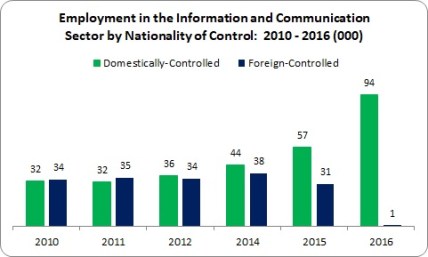
Eurostat data (which is collected by the CSO) shows that between 2010 and 2015 there was an average of 34,000 employed in the foreign-controlled Information & Communication sector. Then, suddenly, in 2016 this figure falls to a mere 750.
So what happened? Did the big tech firms – like Google and Facebook – slink away unnoticed to be replaced by domestic usurpers? Were these foreign firms nationalised?
No, they’re still here. And expanding. All that has changed is the ‘nationality’. A number of multi-nationals have headquartered here – either by transferring from their home countries or establishing new companies. Under the reporting rules, they have re-classified as ‘domestic-controlled’. Is Facebook controlled within Ireland? Discuss.
This doesn’t just affect one sector. Throughout the market economy, official data shows the numbers employed in the foreign-owned sector has fallen by nearly 200,000 between 2014 and 2016? Of course, this didn’t happen – it was just a matter of reclassifying.
This makes a mockery of enterprise data. We are all familiar with the fact that key information (productivity, value-added, profits) in the foreign-controlled sector is well-nigh unusable given the accountancy practices of multi-nationals. But at least we could work with indigenous sector data.
Not anymore – at least in the Information & Communication sector (and the aircraft leasing sector). But it also casts doubt on data from other sectors. For instance, did we really lose 2,000 jobs in the multi-national food sector in 2016? Or were they just re-categorised as ‘indigenous’. And there are so many sub-sectors where the data is not published for confidentiality reasons.
Why does all this matter – beyond wonky number-grubbing? If we want to map our economy, identify the strengths and weaknesses of, in particular, our indigenous sector (where most employment occurs) and compare our performance with other EU countries, we need reliable data.
For instance, in 2015 over 30 percent of employees in the indigenous market sector worked in retail and hospitality – relatively low-value added and low-wage sectors. In the EU the figure is less than 23 percent. There is higher manufacturing content to other countries indigenous make-up – meaning higher wages, greater value-added and potentially more exports. In this regard, Ireland lags.
But we can’t even make this calculation for 2016 since the indigenous retail sector is blacked out for confidentiality reasons (?!).
Once again, we must call on the CSO to save us. Just as they devised a modified GNI figure to filter out the noise of multi-national activity that is largely irrelevant to the economy, we need them to do the same for enterprise data. One dataset that is helpful is the Annual Business Survey of Economic Impact published by the Department of Business, Enterprise and Innovation. There is none of the disruption and reclassification in the indigenous and multi-national sectors that Eurostat suffers from. But this data is limited as it deals only with export-facing companies. We need reliable information for the entire economy.
Otherwise, we’ll be working with data that no longer reflects our reality.
 Notes on the Front
Leave a comment