
Put the cat out, pop the popcorn and pull up a chair: the great pre-budget tax debate is commencing. For the past few years we have heard that our income taxes are high, very high, too high and this is creating all sorts of economic havoc. Enjoy the show.
One example of this is the claim that Irish taxpayers enter the top rate of tax earlier than any other EU country (bar Denmark). This is true – but the claim that this shows Ireland has high income taxes ignores two issues.
First, in many EU countries low-paid workers pay a much higher marginal tax rate (marginal tax rate is the tax you pay on the next Euro you earn; it is not the effective tax rate – that is, the tax paid as a percentage of income): For example, at €30,000, Austrians pay 35 percent marginal income tax rate while Belgians pay 40 percent; and this doesn’t include much higher social insurance (PRSI) rates. In Ireland, taxpayers pay only 25.5 percent. So, yes, Irish taxpayers enter the top rate of tax earlier than Austria and Belgium – but they pay much lower marginal tax rates on lower income.
A second issue is that most other EU countries have more than two tax rates; therefore, their taxpayers progress through a number of tax rates before reaching the top. Ireland has only two rates (discounting USC): 20 and 40 percent. For instance:
- Austria has six tax rates – from 25 percent at entry level to 50 percent at the top
- Belgium has five tax rates – again, from 25 to 50 percent
- France has four tax rates – from 14 to 45 percent
- Netherlands has four rates – from 8.9 to 52 percent
Luxembourg tops them all – with 18 tax rates from 8 to 38 percent. The point here is that the reason Irish taxpayers enter the top rate of tax early is that there are no intermediate rates between entry and top level.
But you won’t hear any of this in the debate. You’ll get sound-bites and ‘oh, isn’t this terrible’; but an analysis of comparative tax structures will be lacking.
Fortunately, we can make relatively robust comparisons between Irish personal tax levels and other EU countries courtesy of Eurostat’s informative Taxation Trends in the European Union. The two ways of measuring this tell similar stories.
First, we look at employees’ personal tax (including social insurance and sur-taxes like the USC) as a percentage of gross, or aggregate, wages.
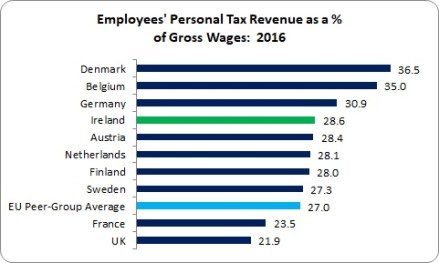
We find that personal taxation on Irish employees is slightly higher than our peer-group average. It ranks 4th and is ahead of ‘high-tax’ Sweden (which surprises many). When we look at employees’ personal tax as a percentage of national income we see a similar story.
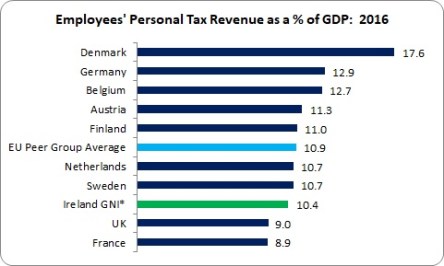
In this measurement we see Ireland (using the CSO’s special GNI*) falling below our peer-group average – but only marginally so. These measurements do not speak to the progressivity of different tax systems – they just take the total amount of personal tax revenue as a proportion of wages and national income.
In essence, both these measurements show that Irish employees’ personal taxation is approximately average.
We will still hear arguments – about how the Irish personal taxation system is a disincentive to employment creation. The broad parameters of the tax system have not changed in the last four years, although there has been a slight reduction in marginal tax rates with the cuts to USC. And yet during that period employment has increased by 270,000, or 14 percent. That doesn’t look like much of a disincentive.
Or your will hear that our tax system is a disincentive to earning more. Yet, in the last four years we see the weekly income of managers and professionals – who are likely to be in the top tax rate – rise by 11 percent compared to an economy-wide average of five percent. Again, the tax system doesn’t seem to be a disincentive to top rate taxpayers.
Could we devise a more efficient taxation system? Yes, of course. Is personal taxation a priority in this budget? No. We are an average personal–taxed economy, and clearly our structure is not a disincentive to employment creation and wage increases.
The priorities lie in housing, childcare and education; in infrastructural deficits; in the quality of our public services and in a social protection system that can provide security to everyone – including those in the workforce.
Next up: the ‘we-spend-too-much’ show. Let’s get some more popcorn.
 Notes on the Front
Leave a comment