
The Government in its Summer Economic Statement has confirmed what they set out in the National Development Plan – a substantial increase in public investment. The Government intends to increase capital spending from €5.8 billion in 2017 to €9.4 billion by 2021. This is substantial. That’s the good news. The bad news is that people will end up paying for it through squeezed public services. Essentially, between now and 2021, there will be no real increase in public service expenditure.
Ireland was never a great spender when it comes to public services.
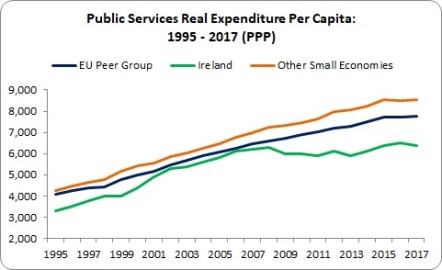
Irish spending on public services never reached the average of our peer group, never mind the average of other small open economies – even during the go-go boom days. In 2017 public spending on public services would have to
· Increase by 21 percent, or €7.6 billion to reach the average of our EU peer-group
· Increase by 34 percent or a staggering €11.9 billion
If anything, the next few years will be worse. Between 2017 and 2019, Irish public services spending will fall from 17.6 percent of GNI* to 16.8 percent; in our EU-peer group spending will remain constant at just above 22 percent. And out to 2021, the Government is projecting a further fall – to 16 percent of GNI*.
What does this mean in actual Euros and cents? The headline figures show an actual increase in public services spending: €3.6 billion or 10 percent between 2017 and 2021. However, factor in the projected 5.5 percent inflation rate (GDP deflator) and, according to the IMF, a 4 percent population increase (nearly 200,000) – and the real increase becomes almost non-existent.
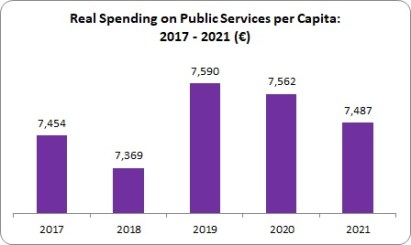
These are just projections and the Government has considerable resources (see here) to increase public service spending over the next three years; therefore, annual expenditure might be smoothed out on the upside. So this could be treated as a base-line. If so, then it is a desultory base-line.
Between 2017 and 2021, real (after inflation) spending will rise by €34 per person. In effect, spending will stagnate.
And it will stagnate at a time of increasing demographic pressure. The number of pensioners is rising fast – in fact, Ireland has the fastest growing over- 65 years demographic in our peer group, though starting from a low base.
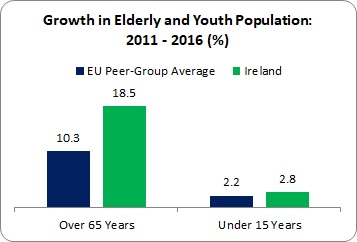
As well, we have the fastest rising youth demographic.
Combined, we will need additional age-related expenditure (health for elderly people, education for children) just to stand still. As it stands now, we are falling backwards. And going further, establishing public services on a par with other European countries is not even on the agenda.
There is a consensus that we need to boost public investment. And, yes, economics is about the art (not science, never science) of allocating scarce resources efficiently. So we might get the argument that the priority is investment and, unfortunately, public services will have to wait.
However, this misunderstands the relationship between public services and the productive economy. We need to boost spending on education and R&D – human capital. We need affordable, quality and professional childcare – drive labour force participation. We need fair public transport fares as part of an ambition to move away from private transport – mobility, climate change. And we need an efficient and effective healthcare system – illness and injury play hell with productivity (never mind life quality).
So it is not so easy to distinguish between capital investment and current expenditure in terms of its impact on the productive economy. But it is very easy to understand the impact of stagnating and sub-optimal public services on living standards.
The Government is attempting to pay for public investment, in order to boost living standards and the productive economy, by squeezing public services and, so, living standards and the productive economy.
It’s a bad trade-off.
 Notes on the Front
Leave a comment