
Just a few quick thoughts on the Summer Economic Statement released Tuesday.
1. €900 million won’t be Spent
In the name of preventing ‘over-heating’ the Government is not going to spend €900 million that it would be entitled to under the fiscal rules. The Minister for Finance stated that to spend this money:
‘ . . . would represent the wrong choice for the economy at this stage of the cycle.’
No, the wrong choice would be to allow homelessness and housing need to rise, to further degrade our childcare system with high fees and poor working conditions, to starve education and R&D of badly needed resources. All three of these – housing, childcare, education – are vital to long-term economic growth. The wrong choice would be to short-change the future.
But it’s not just €900 million next year that the Government intends to forego. According to the Statement, the Government intends to forego spending €2.4 billion in 2020 and €700 million in 2021 (and these are probably under-estimates). That’s €4.2 billion over the next three years that should be invested but won't be, even though it is allowable.
2. Heads You Lose, Tails You Lose
When people were arguing for increased economic and social investment, the Government said they couldn’t because the fiscal rules prevented them. Now that the fiscal rules allow for it, the Government says the fiscal rules are flawed. Regardless of the fiscal rules, the Government intends to pursue a small state strategy.
During the Fiscal Treaty debate we were told (lectured) that only the fiscal rules could save ourselves from our fiscally-reckless selves; that if we followed these rules, we would enjoy fiscal responsibility and stability. Now the Government is saying:
‘The fiscal rules are currently unhelpful . . . A full and literal application of the fiscal rules would involve the adoption of pro-cyclical policies not remotely appropriate to our position in the economic cycle. That is why fiscal space is increasingly an inappropriate concept.’
‘A literal application of the fiscal rules would damage our economy; that is why policy will no longer be formulated on the basis of ‘fiscal space’.
Hmmm. The fiscal rules were to be our financial salvation. Now they would damage the economy. Can we please re-run the Fiscal Treaty referendum? The Minister for Finance could chair the repeal campaign.
3. Over-Heating
The Government fears the economy is ‘over-heating’ – that is, it is reaching full capacity so that additional expenditure could result in inflation, current account deficits and economic imbalance. But is it over-heating? The Government says:
‘Capacity constraints are increasingly becoming a feature of some sectors and this, in turn, could lead to overheating of the economy. Government policy should never add fuel to the fire.’
So the answer would be tentatively, yes. However, the Statement admits to:
‘. . . difficulty in measuring the cycle and the general pro-cyclicality of potential GDP estimates.’
That would suggest the answer is we don’t know because we can’t measure it.
This is the problem: we don’t have the tools to measure over-heating or over-capacity. The usual measurements – output gap and the current account balance – are so tainted by the impact of multi-national accounting practices they are not fit for purpose (for more on this see my post ‘Sweating the Economy’).
The Government assessed the risk of over-heating only a few weeks ago in their Macro-economic Risk Assessment Matrix published in the Stability Programme Update. They rated the risk of the economy over-heating as ‘medium’. Yet, they assessed the risk of housing supply pressures as ‘high’. So we have this curious situation that in addressing the medium risk of over-heating (by not spending €900 million) we could be fuelling the high risk of low housing supply (by not spending the €900 million).
The Statement does not put forward any evidence for over-heating apart from the projected unemployment rate of 5 percent. There are a couple of points here.
First, the employment rate (the percentage of people employed among all adults below 65 years) is still below pre-crash levels. In 2017, the rate was 67.7 percent. 10 years previously, it was 71.8 – a difference of over 130,000. So there is still some room for improvement.
Second, we lag most of our EU peer-group in employment rate.
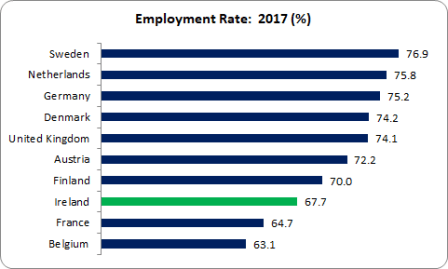
There is evidence that we have not reached employment capacity.
4. We’re Still Borrowing
Yes, we are (fractionally) but let’s get a handle on this. We are running a considerable and growing surplus on our day-to-day spending.
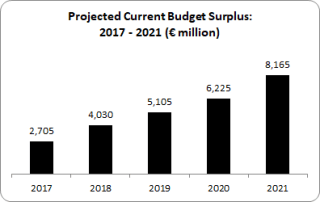
The current budget surplus will rise above €8 billion, or 2.3 percent of GDP by 2021. This is not a bad situation. So why are we still borrowing? Because we’re investing for productive purposes. This, too, is not a bad thing, especially as interest costs will continue to fall up to 2021.
Ultimately, you want to balance your day-to-day spending and borrow for investment purposes only over the life-time of a cycle. This is called the golden rule. We are pursuing a platinum rule – and this is resulting in quickly falling debt levels.
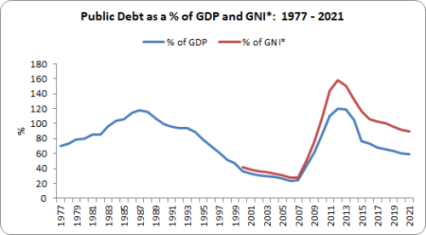
The last 40 years it has been quite a rollercoaster ride. Peaking in the late 1980s debt fell consistently up to the crash, aided by the property boom in the latter years. Then it skyrocketed (thank you private finance capital). Debt is now falling again. In terms of GDP (which is the benchmark used by the fiscal rules) we will become compliant by 2021 – that is, debt will fall below 60 percent of GDP. This means the Government will be provided even more fiscal space.
However, when using GNI* we find the debt higher in percentage terms. However, this is falling just as fast – from nearly 160 percent in 2012 to a projected 89 percent by 2021.
Some commentators want to balance the budget immediately – in other words, the 0.1 percent deficit next year is still a fraction too much. The Minister says he won’t spend the €900 million because this could, apart from over-heating, drive up debt. But we are talking about fractions here. If we spent the €900 million, the debt would rise by less than 0.3 percent of GDP (on a static basis – it would be less when additional growth and tax revenue is factored in). Does anyone really believe these fractions are going to protect us in a downturn? This is angels dancing on the head of a fiscal pin.
The key point here is that debt is falling. If we keep it falling in line with the fiscal rules, not only are we rule-compliant, we are prudent-compliant.
5. The Real Source of Fiscal Instability
The Government published a table, comparing fiscal situation with other ‘small open states’. It showed the countries having a better deficit position than Ireland in 2017. However, it didn’t mention is that the EU Commission projects that all these other countries, with the exception of Slovenia and Ireland, the fiscal position will deteriorate by next year. Leave that aside. There is a larger point here.
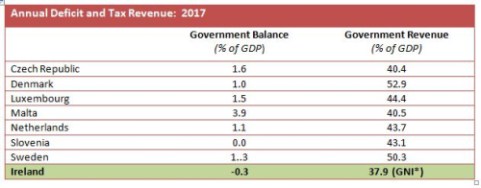
The Government balance (the annual deficit or surplus) was supplied by the Government’s Statement. The Government revenue column is my own addition. Yes, Ireland has a deficit – all the other countries have surpluses. But all those other countries have much higher levels of taxation. The mean average for the other countries is 45 percent of GDP. Ireland lags considerably, being under 38 percent of GNI*. To reach the average of the other countries would require additional taxation of over €13 billion (though this gap might close somewhat once demographics are factored in).
High levels of taxation do not automatically insulate a country. However, a broad robust base of taxation – income, property, environment, profits, capital income, etc. – can cushion a downturn as some tax streams will remain more resilient than others. Ireland, however, does not have such a tax base.
If you want to stabilise public finances and smooth out the cycles – broaden and strengthen your tax base.
* * *
There are calls for a ‘fiscal buffer’ to protect us from a future downturn. This is the cold and misplaced comfort of numbers on a balance sheet. Further, it assumes that improving deficit and debt figures by fractions through suppressing social and economic investment will somehow provide a protective wall. This is mistaken. If we go into the next downturn with high housing needs, a broken childcare system, and low investment in education and R&D, it can only get worse. And on the other side of the downturn, we’ll be in a deeper hole with even higher expenditure needed for social repair.
This is not to ignore the concerns of over-heating and high debt levels. Indeed, it is about integrating investment into sound management policies in order to create a strong ‘economic buffer’. A progressive response would be to take the €4.2 billion the Government intends to forego and create a strategy over five to seven years to addresses our main deficits. This could include:
- Structural reform of the childcare system to attain both affordability and professionalisation of quality
- New programmes to invest in indigenous enterprise innovation, including public enterprise (at national and local level)
- A special agency to roll our cost-rental housing along the lines of the Nevin Economic Research Institute’s proposal capable of leveraging an initial investment. This would allow greater resources to be devoted to social housing.
There are no doubt other and better proposals.
There is no option without a downside. Yes, the economy may start over-heating in the medium-term. The issue is how to manage and stabilise it. The Government’s strategy is to separate out investment from fiscal policies, to the detriment of the former. Progressives must argue for an integrated approach, showing that investment – overcoming our social and economic deficits –is part of the solution, not the problem.
It’s bad enough we are in danger of repeating old mistakes.
What’s worse is that we are in danger of creating new ones.
 Notes on the Front
Leave a comment