
There’s been a lot of commentary so far on the 10th anniversary of the Great Recession: jobs, income, consumer spending, growth. One aspect that has been over-looked, however, is public expenditure. Following the crash public spending – investment, public services, social protection – were all cut with bank-bailouts being the very big exception. Starting in 2014, public spending started to rise but it has not returned to pre-crash levels. We are still in a public spending recession.
The following measures primary public spending per capita (i.e. excluding interest payments) factoring in inflation. Of course, nothing is simple with Ireland’s national accounts. While public spending – excluding the once-off bank bailouts – and population data are relatively straight-forward, inflation is not. 2015 was the year of the Leprechaun, so named by Paul Krugman when Ireland logged a massive 26 percent increase in GDP due to methodological changes. In 2015, economy-wide inflation was recorded as increasing by 7 percent which is not a reflection of the true situation. So, I have done a ‘Leprechaun-adjustment’, inserting consumer inflation in 2015 which was less than 1 percent.
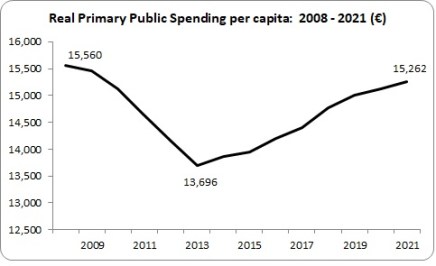
In 2008, public spending per capita slightly exceeded €15,500. Within five years, this was cut to €13,700, or 12 percent. Since the trough in 2013, public spending has been on the rise. However, in 2018 it will only reach €14,000. And according to the Government’s own projections, it will still be below pre-crash levels by 2021.
On current trends, we won’t exceed pre-crash levels until 2023 – 15 years after the start of the Great Recession.
Some will argue that 2008 levels of spending were unsustainable and there is some truth in this. Back then we had gone through a decade of cutting taxes and increasing public spending, relying on revenue from a credit-fuelled property-speculation bubble. It was always going to end in tears.
However, we are still living with austerity’s hangover – repairing the social damage caused by irrational austerity measures while privileging financial creditors over the productive economy: think housing crisis, hospital waiting lists, high levels of deprivation. Austerity dug us into a deep hole which the recovery has yet to lift us out of. And on the Government’s own projections the pace of public spending could start to ease.
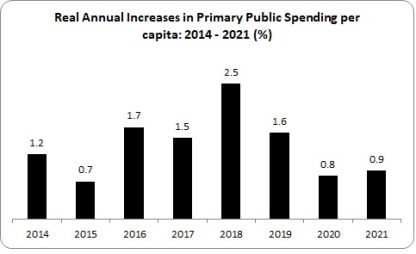
Under current projections 2018 will see the biggest increase since public spending started rising, tailing off by 2021. However, these are just projections contained in Budget 2018. The Taoiseach hints that tax cuts may not proceed to the same extent as they previously hoped (in the three years 2019 to 2021 the government intends to cut taxes by €1.8 billion). This could be a recognition that under current projections, public spending may not be able to keep up with the combination of rising inflation, the elderly cohort and expectations. If more of the fiscal space is assigned to public spending, then we could exit the public spending recession earlier.
But as of now, our public spending is below the level when we entered into the recession. And there are a number of road hazards ahead.
- We may be basing even our current depressed levels of spending on a corporate tax-revenue bubble. What happens to future budgets when that balloon is untied?
- Then there’s Brexit and the danger of decreased revenue and increased unemployment payments if the economy is hit.
- And don’t forget the prospect of future interest rate increases (at the end of this year? in the middle of next?) and the depressing effect this will have on consumer spending as people pay more for property and less on goods and services in the productive economy.
A slow-down will no doubt elicit calls to ‘control’ spending as part of that ol’ fiscal consolidation dance that exhausted us only a few years ago.
Let’s admit it – Ireland doesn’t do macro-economic stability very well. After years of pro-cyclical fiscal policy prior to the crash (fuelling a property-bubble), followed by more pro-cyclical years following the crash (fuelling the recession), we may be looking into another roller-coaster ride – though probably, hopefully, not to the same extremes.
What party or alliance of parties will rid of us this turbulent binge-and-purge cycle while promoting economic efficiency and social prosperity?
 Notes on the Front
Leave a comment