
Is the Government going to introduce an affordable housing scheme? There are reports they will do so. One of the problems is how do we define affordability? Deputy Eoin O’Broin’s criticism of the Taoiseach’s reference to €310,000 as being affordable was correct. But with new accommodation units in Dublin exceeding €400,000, how can we afford ‘affordable’ homes without massive producer or consumer subsidies which rarely have the desired effect and can lead to ever spiralling prices?. There’s a legitimate desire to own a home (the security, the autonomy), even as the prospect is further away for a growing segments of the population. Is there a progressive way to promote home ownership alongside affordable rental and social models? Yes, if we do it in a non-speculative way.
Limited equity housing allows more people to ‘own’ their home without turning the house into a speculative asset. It is similar to the Nevin Economic Research Institute’s cost-rental model, except that equity is purchased. Here’s how it works:
Sarah buys a limited equity house. She pays 50 percent of the price of the house through a mortgage (or cash). She also makes a second payment – which covers the capital costs of the other 50 percent which is held by a public housing association or other public body.
In all respects, Sarah is the owner. She is responsible for the payments, property tax, repairs, maintenance, etc. She can undertake any improvements she wants (within planning rules), just like a home-owner.
The first difference is this: she cannot rent it out it out to a third party. She cannot use the house as a revenue-generating asset.
The second difference: if she wants to sell it she can only sell it back to the housing association. She will get her equity back plus any costs that improve the value of the house (an attic conversion, etc.). In other words, she cannot ‘play the market’ when selling her house. However, there are provisions, as Michelle Norris (Head of the school of Social Policy, Social Work and Social Justice at UCD) points out, where Sarah could sell on to a third party – but under the same restrictions.
In effect, a house becomes an item of consumption (that is, it is used as a home); it is not allowed to be an asset to be speculated on.
Another important point is that the house be procured by the public housing association or other public body. This keeps prices low as the Minister recently told the Dail.
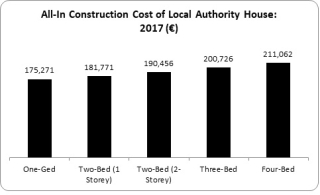
The all-in costs include normal site works and site development, land cost, professional fees, utility connections, site investigations/surveys, archaeology where appropriate, VAT and contribution to public art. It is probably the case – though it’s not stated in the Parliamentary reply – that Dublin prices will be higher, with the rest of the country lower.
Therefore, if the state makes a capital grant of 25 percent towards the building cost, Sarah may find that her mortgage (after a 10 percent deposit) is less than €65,000.
Once Sarah pays off her mortgage, she continues with her second payment. If she sells, she gets back her equity payments (inflation-indexed) and the cost of any improvements.
This is a simplistic summary and, no doubt, there are other considerations (e.g. a small insurance payment for payment defaults). But this makes home-ownership feasible, reducing the amount of savings needed to take out a mortgage, and the monthly payments.
In effect, this complements NERI’s cost-rental model with a cost-purchase home ownership model.
This is not intended to replace traditional home-purchases. However, it is intended to provide another model for housing, another choice – as part of a drive to create a systemic pluralist housing system. It is also intended to provide more social or non-profit, non-speculative models.

This plurality can help make the entire system more efficient and affordable. For instance, under NERI’s cost-rental model, it would not be necessary to replace private rental. However, a few thousand units in Dublin would help drive up the vacancy rate. When this happens, the upward pressures in the private rental sector would ease, rents would stabilise and hopefully fall in real terms in the years ahead. This same process would happen with more social housing– transferring tenants from the private sector to the social sector, thus driving up the vacancy rate. A similar process could develop with the home purchase market if a limited equity was rolled out.
If one insists on seeing this in market terms, then what we need is greater competition with the state stepping in to provide that competition. If cost-rental and cost-purchase took off, private providers would have to up their game – in terms of quality, tenant security and affordability.
All it takes is for policy-makers to break from their ‘residual sector’ mind-set – whereby social housing is for the poor while it is the private sector (with a little/lot of help from state subsidies), and only the private sector, that must cater for everyone else. Once we do that, we can have a plurality of innovative housing models to cater for people’s needs in their different life-cycles.
But until that break is made, we will be swimming in targets and reports and self-congratulating Ministerial statements; but not affordable housing.

 Notes on the Front
Leave a comment