
The following is based on a talk I gave to the housing conference held on Saturday: ‘Towards a Real Housing Strategy’. There were excellent contributions from academics, activists and victims of the housing crisis. The contributions from Dr. Lorcan Sirs (DIT), Dr. Sinead Kelly and Dr. Mick Byrne (both from Maynooth) were particularly provocative, as were many others;including Fr. Peter McVerry and Dr. Rory Hearn.
The current model of 100 percent local authority provision of social housing is no longer capable of meeting the new challenges – not only because of future fiscal restraints and competing demands from other sectors – health, education, social protection, economic infrastructure, etc. Future social housing provision will need to accommodate low and average income households – something which the private rental sector will struggle with, especially as transnational landlords, inward foreign investment and up-market accommodation are squeezing so many out.
This requires a new public sector-led model to adequately house a larger section of society and ensure that rents do not become a burden on the productive economy.
There are three principles that can inform this new model:
- It is not-for-profit (cost rental)
- It blurs the distinction between the ‘social’ and the ‘private’ so that the not-for-profit housing leads and eventually dominates the entire rental sector (unitary market)
- It reduces the impact on public finances (off-the-books)
This will, in the first instance, require new housing providers.
Public Housing Associations
While the voluntary sector will play an important role, new providers will be needed to generate housing at scale. This calls for the creation of public housing associations, similar to municipal housing associations in European continental countries.
These new associations would be part of the public sector but commercially independent – they would be very similar to public enterprise. Therefore, they would not be part of the General Government sector; their activities would not impact on public finances or contribute to the deficit or debt.
They would house people on the waiting list but would be commercially free to develop accommodation for people who now rent in the private sector.
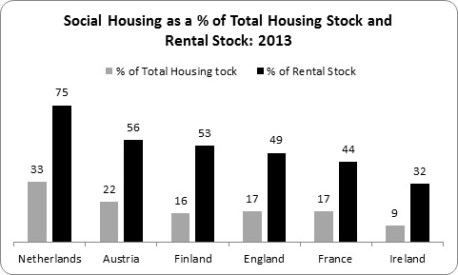
In the Netherlands, social housing makes up 75 percent of all rental housing while in the other countries, social housing makes up approximately half. In Ireland it made up less than a third (data from the National Economic and Social Council, NESC). Social housing needs to play a more important role across the rental sector.
Cost Rental and Financing
These new housing providers would be based on a cost-rental basis. Public housing associations would only charges rents sufficient to cover:
- Borrowing costs for land acquisition & construction
- Management, maintenance and refurbishment
- Taxes
- A sinking fund to cover future capital costs, long-term debt repayments and contingencies.
This removes the profit/speculative element out of this form of rental housing provision.

As seen, the rent charged is based on the costs only (in this example from NESC, there is no provision for a sinking fund – which could amount to 5 percent of other costs – or another €45 per month).
The state will still be a major funder under this model – between 20 and 30 percent of total investment (construction costs). However, to move social housing investment off-balance sheet, the remainder will come from non-state sources. To maximise investment at the lowest cost a Financial Aggregator (e.g. Housing Finance Agency) could be established or expanded.
This agency would ‘aggregate’ finance from different sources and lend on to the housing associations. It would also be a public sector agency but commercially independent. The Aggregator would accumulate funding from a number of sources:
- European Investment Bank and other EU funding institutions
- A new Irish Housing Bond (e.g. for long-term pension investment)
- Domestic and international financial agencies / Credit Unions
- Strategic Investment Fund (and an Infrastructural Bank as proposed by the Nevin Economic and Research Institute)
Unitary ‘Market’
We have public housing associations, charging rents on a cost basis only, and funded primarily by non-Exchequer resources: these need to be organised in a unitary market. This is the long-term goal: the provision of rental accommodation – whether non-profit or for-profit – in one market. In this single market, public and private providers compete with one another.
This transforms social housing from a residual sector – whereby social housing is seen as ‘housing for the poor’ – into one where the distinction between ‘public’ and ‘private’ is blurred. In this market, social housing provides for those unable to afford market rents, but also for those on low to low/middle income households.
This would require three important and inter-related policy initiatives:
- First, regularising tenant subsidies or allowances across sectors. The Housing Assistance Payment is a start whereby differential rent schemes operates in the social and private housing sectors. Such subsidies would not be based on employment status but linked to income. Therefore, it is capable of being accessed by a wider section of the population. The key point is that the same subsidy would be available to all tenants regardless of the sector they rent in.
- Second, the establishment of a rent regulation regime: in the first instance, this might take the form of tight rent control, to halt spiralling rents. Once public housing associations expand throughout the sector, a new, looser, regime could be established: a sophisticated system of setting rents to local markets, quality and size, with a reliable formula for rent increases.
- Third, the provision for private, for-profit providers to be integrated into the cost-rental sector – with a guarantee of an x percentage return (profit). This occurs in other countries where commercial developers can avail of public loans and subsidies; in exchange, they are subject to cost-rental control.
Here is an example of how this might work:
Dublin City Council establishes a Public Housing Association
- The city council transfers land and stock (or leases at long-term discounted rates) to the Association.
- A variety of stock transferred: vacant land, derelict buildings, tenanted buildings. This would ensure a rent stream and an asset base from the outset while starting the process of creating new accommodation. Over time, more and more of the stock would be transferred while the public housing association builds new housing.
- The Aggregator would ‘lend-on’ to the Association for new construction and refurbishment.
- The Public Housing Association charges rent at cost
- A new Housing Benefit could be drawn down by tenants unable to afford the rent
This is a simple scheme. There may be a need for Exchequer to provide initial capital/equity to the Association. And more research and trial-and-error would need to take place to ensure that the activities of the new public housing association (in particular, the transfer of land and stock from the city council) are ‘off-the-books’.
The above only addresses one part of the complex issues involved in providing non-profit housing for people.
- We will need a new institutional landscape capable of planning, driving, delivering, allocating, protecting and maintaining affordable rental housing. Fortunately, those skills are present in the Housing Agency, Housing Finance Agency, NTMA, the local authorities and other bodies.
- We will need a new planning framework that emphasises higher density and integration with infrastructure provision (transport, education and health services, amenities, etc.)
- We will need a new form of Housing Benefit to facilitate this unitary model that puts all tenants on an equal footing – in both the public and private sector.
- We will need to discuss the role of tenant-purchases.
- We will need to find a mechanism to control the price of land with possible provision for compulsory purchase orders for, or high taxation on, idle development land and derelict buildings.
Addressing the Short-Term Housing Crisis
The rolling out of public housing associations is a long-term process. We still require substantial state investment and direct provision of social housing by local authorities given the 100,000 on the waiting list and the growing homelessness crisis.
The Government proposes to spend €4.2 billion over the next six years to provide 35,000 social housing units with 75,000 to be taken up by the voluntary and private rental sector. This seems excessively optimist, especially given the current shortage of private rental accommodation.
There are two sources that can help provide the financing needed to drive a programme of state investment.
First, the Government will be receiving at least €2 billion in repaid bank bail-out money from AIB and PTSB. Currently, it intends to use this money to pay down debt. This is unnecessary and wasteful. Debt is already falling faster than required under EU fiscal rules.
This money should be used for a special once-off social housing programme. While this would have to be negotiated with the EU Commission there are strong arguments the Government could present: it doesn’t impact on the structural deficit (just like the special payments made to banks); and it would constitute addressing an ‘emergency’ which is exempted from the rules. In this respect, it would be helpful for the Oireachtas and Local Authorities to formally declare a ‘housing emergency’.
This could kick-start a substantial housing drive.
Second, if we are serious about treating housing as an emergency (along with other demands on public expenditure) the tax-cuts agenda is more than just a dangerous diversion. We have had proposals to abolish the USC and property tax, cuts to inheritance tax, capital gains tax, employers’ PRSI and the corporate tax rate (for companies using the proposed ‘knowledge box relief’). We cannot address the housing crisis while at the same time hollowing out our revenue base. The math doesn’t work, the politics doesn’t work.
The Government intends to cut taxes by €750 million in Budget 2016. If this were reduced to €250 million (a minimalist demand), this could free up over €3 billion over the next six years.
This could boost house building, acquisition and leasing by an additional 20,000.
Conclusion
Whenever we hear that the ‘property’ market is ‘strengthening’ (house prices, rents, land prices) we should shudder. High rents and house prices are a drain on the productive economy.
A new model can open up public housing to a large swathe of the population now renting – estimated at 500,000. This housing can be provided at cost – not for profit. To give this process a kick-start we can increase spending on housing but only if we get our priorities right.
The future of housing is rental. The future is non-profit. The future is affordability. This is one of the best policies we can pursue to support a productive economy and a prosperous society.
NOTE: Dr. Tom Healy has also written on this topic which you can read here.
 Notes on the Front
Leave a comment